

Botanu Emerges from Stealth, Reveals Enterprises Spend $186M Annually on AI With Little Proof of ROI
Botanu, founded by a former McKinsey AI strategist and a longtime enterprise AI engineer, says the fix for "AI sticker shock" isn't spending less. It's seeing where AI actually creates value. The founders call it "outcome-maxxing."
San Francisco, CA, June 11, 2026 (GLOBE NEWSWIRE) -- Botanu, the COO for AI agents, today emerged from stealth with a platform designed to help enterprises measure and optimize the return on their AI investments. The launch comes as enterprise AI spending reaches an average of $186 million annually, while most organizations still struggle to determine whether their AI agents are delivering meaningful business outcomes.

Botanu co-founders Deborah Jacob, CTO, and Alina Vrsaljko, CEO
For two years, the enterprise AI story was about adoption: how many tools a company could pilot and how fast it could roll them out. In 2026, the boardroom question has flipped. It is no longer how much a company spends on AI, but what it got back. Most can't say.
The numbers are sobering. A recent KPMG report found that only 8% of Enterprises have achieved meaningful business returns with AI. Deloitte reported that 74% of organizations want AI to grow revenue, but only 20% have seen it happen. As the bills arrive, "AI sticker shock" has moved from headlines into budget meetings.
Botanu, a New York- and San Francisco-based startup that bills itself as "the COO for your AI agents," says the panic is misplaced.
"This isn't a bubble. It's a measurement problem," said Alina Vrsaljko, Botanu's co-founder and CEO. "Companies aren't failing because AI doesn't work. They're failing because they can't locate where their agents are working. And this isn't a tech problem anymore - 72% of CEOs now own the AI decision, and they have no way to prove it's paying off.The bill arriving isn't the problem. Not knowing whether you got $3 of value for every $1 you spent is the problem."
Independent analysts land in a similar place. "Enterprises are running out of budget before they run out of enthusiasm. Token spend is up 13x since January 2025, yet only 27% of executives say AI has met their ROI expectations," said Ray Rike, CEO and co-founder of Benchmarkit and host of the "AI to ROI" podcast and newsletter. "The problem is that adoption is not the same as value creation. Companies are celebrating adoption metrics, tokens consumed and agents deployed, while the value created stays invisible. The discipline that's missing is simple to say and hard to do: measure outcomes, not activity, and connect costs to returns. Until then, AI is a compensation-scale expense that demands CFO-level governance most companies don't yet have."
That reframing is deliberate. Botanu's founders argue that an AI agent should be treated less like a software license and more like a hire.
"An AI agent is a new kind of workforce, and it works at 100 times the frequency of a person," Vrsaljko said. "You should performance-manage it, not just cost-manage it. The question isn't 'Why is this so expensive?' It's 'Is this agent doing the job, and is the job worth the salary?'"
Why the old playbook breaks
In the cloud era, cost increased with usage and every bill could be mapped back to the workload, team, or product that drove it. AI breaks that model. The same task can produce very different costs from one run to the next, with little predictability upfront. At the same time, pricing is shifting from flat per-seat subscriptions to usage-based models. That pushes volatility onto the buyer's invoice. By the time the bill comes in, no one can tell which agents were actually worth it.
The hard part: following one agent across everything
For a business leader, the question is simple: is this agent worth what it costs? Actually answering it is the hard part.
“A single agent's cost is scattered across systems, each metered differently, each owned by a different team. No one can see what one agent actually costs. But cost is only half the problem. The value an agent creates is just as scattered as its spend. For a CFO, the question is whether the outcome justified the cost: did the sales agent lift revenue, solve customer service tickets successfully, or protect EBITDA? That cannot be answered from one side alone. That is why Botanu is built to answer what each agent costs, and what it delivered,” said Jacobs.
To do that, Botanu reads telemetry, a systems-level record of activity across a company, to reconstruct an agent's full digital footprint across every model vendor, tool and infrastructure layer, not just tokens. Unlike competitors, it plugs into the systems a company already runs. It then ties that footprint to where outcomes actually land, such as the CRM, and compares it to the company's own labor data, what the same job would cost a person to do. The outcome comes from the business system that owns it, not from what the agent reports about itself.
"Activity is not outcome. A thousand tokens and ten tool calls tell you an agent was busy - not whether it closed the deal," said Deborah Jacob, Botanu's co-founder and chief technology officer. "We measure the result the business actually recorded, and weigh it against what it cost to get there - the one number a CFO can act on."
"We showed enterprises the granular data we're able to capture over the past few weeks, and they asked us how we got it," Vrsaljko said. "These were sophisticated technologists, and even they had never seen their agents mapped end to end."
For the executives deploying agents, the blind spot is becoming urgent. "As we start running AI agents in production, proving the ROI of each one becomes immensely challenging," said Gurpreet Bal, chief information officer at BHI.
"Token-maxxing" vs. "outcome-maxxing"
The gap is felt most acutely in finance. "We're spending confidently on AI. What we're missing is a way to measure it that every CFO would recognize; a real KPI, not usage stats. That's the open space right now," said M.G. Thibault, who leads the Coterie CFO community and is CFO-in-residence at Scale Venture Partners.
For Jacob, that missing KPI comes down to measuring the wrong thing. "Most tools measure activity - tokens consumed, calls made - and they're built for engineers. That's token-maxxing, and it's easy to game," said Jacob, the CTO. "We measure outcomes, for the business leaders who now own AI. We call it outcome-maxxing. The goal is to produce more results, not more activity. A sales agent's job isn't to make calls. It's to create qualified leads."
What's genuinely new, Jacob says, is the refusal to choose between the two halves of the equation. "Most tools look only at cost and call it ROI, or look only at value and ignore what it cost to get there. Connecting both, so a CFO can see that something is expensive but worth it, or cheap and useless, is what's novel. That's how leaders decide where to invest, where to cut and where to scale."
Vrsaljko says that combination of skills is rare. "Deborah has an incredible background building and scaling distributed systems, and she sits right at the frontier - she knows how the newest models actually behave, and how enterprise systems actually run. Things that baffle seasoned engineers are second nature to her."
Who comes out ahead
Botanu's founders are betting the divide won't be between companies that spend on AI and those that don't. It will be between those that can measure it and those that can't. It will be between those that get the most value from their spend, doubling down on the business use cases where AI is delivering 3x.
"The average enterprise now spends about $186 million a year on AI, and that's climbing roughly a third year over year. For some companies it's already more than 1% of revenue," Vrsaljko said. "This fall, when budget planning hits, a lot of leaders will be asked what they got for it. The ones doing AI well, who start with the business outcome, what is this agent's job and how will I know it did it, get about $3 back for every $1 they invest. Right now only about 6% of companies lead with that discipline. They'll pull away from everyone else."
What comes next
"A year from now, proxy metrics like logins, usage and tokens consumed won't be enough," said Jacob, the CTO. "Outcomes become the standard enterprises measure agents against, and we intend to define how that standard gets measured."
"Measuring is just the start," Vrsaljko said. "The questions a business leader actually has aren't technical: which agents are working, which to scale, and where an agent can take over a task so people move to higher-value work. Long term, Botanu runs those operations for your agent workforce, scaling agents up and down, moving spend to what's working, deciding what to keep and what to cut. That's what a COO for your agents really is."
About Botanu
Botanu is the business performance layer for the AI agent workforce, the COO for your AI agents. It connects what a company spends across every model vendor, tool and platform to the outcomes that spending produced: deals closed, tickets resolved, revenue lifted. The result is a single, board-ready view of which agents are worth it, running inside the customer's own security boundary.
Alina Vrsaljko, co-founder and CEO, is a former McKinsey manager with a decade in technology and AI strategy. She holds a Tech MBA from NYU Stern. Deborah Jacob, co-founder and Chief Technology Officer, is an enterprise AI engineer who built large-scale AI and data systems at Verizon and at startups. She holds a Master's in Computer Science from NYU Courant. The founders have been friends since their days at NYU.
Learn more at botanu.ai.
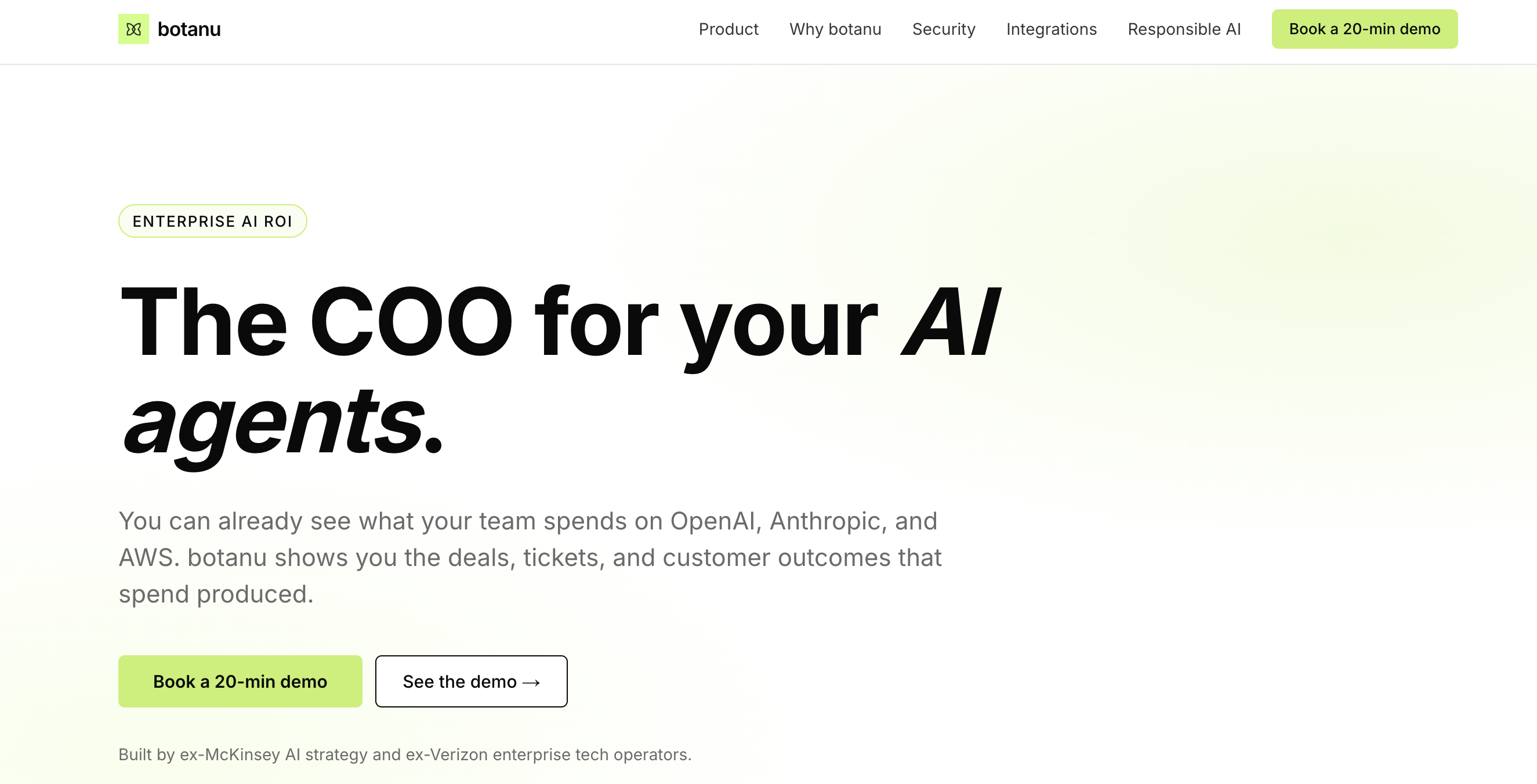
Botanu, "the COO for your AI agents," ties what enterprises spend on AI to the outcomes that spending produces.
Press Inquiries
Alina Vrsaljko
alina [at] botanu.ai
https://botanu.ai/


Legal Disclaimer:
EIN Presswire provides this news content "as is" without warranty of any kind. We do not accept any responsibility or liability for the accuracy, content, images, videos, licenses, completeness, legality, or reliability of the information contained in this article. If you have any complaints or copyright issues related to this article, kindly contact the author above.
