

Your top news on business and economy
Provided by AGP
How Dr. Nina Kottler Told Sanjay Puri on the CAIO Connect Podcast That AI Will Redefine Radiology

CAIO Connect Podcast
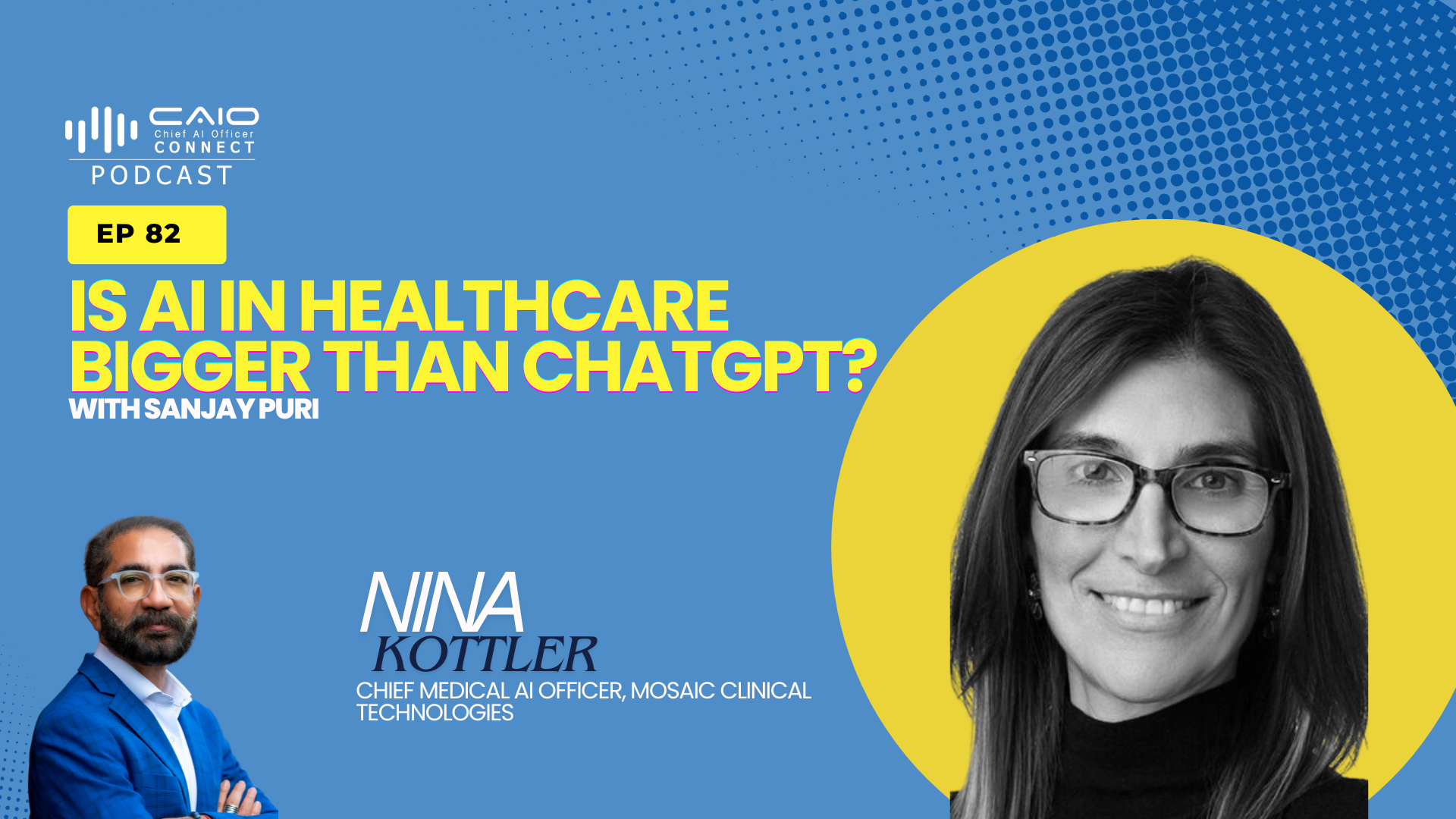
Dr. Nina Kottler, MD, MS, FSIIM, FAIM, Chief Medical AI Officer at Mosaic Clinical Technologies, with Sanjay Puri, President of CAIO Connect
On the CAIO Connect Podcast, Dr. Nina Cotler told Sanjay Puri how AI will transform radiology by boosting accuracy, efficiency, and patient care.
WASHINGTON, DC, UNITED STATES, May 19, 2026 /EINPresswire.com/ -- On the CAIO Connect Podcast, host Sanjay Puri spoke with Dr. Nina Kottler, MD, MS, FSIIM, FAIM, Chief Medical AI Officer at Mosaic Clinical Technologies, about the future of artificial intelligence in healthcare and radiology. Their discussion focused on how AI is changing medical imaging, clinical workflows, and the role of doctors. Kottler explained that AI should not replace physicians. Instead, it should help them make better decisions, improve patient outcomes, and reduce burnout. She also shared how Mosaic Clinical Technologies uses AI at scale within one of the world’s largest radiology networks.Kottler described how her background in applied mathematics shaped her approach to medicine and AI. She explained that optimization theory taught her how to make the best decisions under real-world constraints. She later realized that medicine works the same way because doctors constantly balance accuracy, time, cost, and patient outcomes. That connection pushed her from mathematics into healthcare. At Mosaic, she now oversees AI systems that support radiologists across massive clinical operations. She said healthcare organizations face pressure to improve quality and patient experience while lowering costs, and she believes technology is the only way to achieve all three goals at the same time.
A major theme in the conversation was the challenge of deploying AI at scale. Kottler argued that infrastructure, not AI models, creates the biggest obstacle. Many hospitals still rely on systems built in the 1990s, and those systems struggle to move data efficiently. She explained that many companies claim to be cloud-based, but very few are truly cloud-native. According to Kottler, healthcare needs modern systems where updates and AI tools can spread instantly across thousands of workstations, much like software updates in a Tesla vehicle. She also introduced the idea of “AI-native infrastructure,” where AI acts as the brain that controls older systems instead of the other way around. She stressed that healthcare organizations must monitor AI continuously because AI changes over time as new data enters the system.
Kottler also addressed the risks of AI in medicine. She argued that the biggest danger does not come from flaws in the AI model itself but from the relationship between humans and AI systems. She discussed automation bias, where doctors may trust AI too much, and distrust bias, where one obvious AI mistake causes doctors to reject future suggestions. She emphasized the need for transparency so physicians can understand how AI reaches its conclusions and how confident it feels about a prediction. Kottler shared a study from her own organization that tested AI-generated radiology summaries. The AI alone produced significant clinical errors about 4.8% of the time. However, when radiologists reviewed the AI output, the error rate dropped to about 1%, which was even lower than the normal human-only error rate. She believes these results show that AI can reduce medical mistakes and even lower legal risk when doctors use it correctly.
The interview ended with Kottler’s vision for the future of radiology. She said radiologists will evolve from image interpreters into information experts and AI governors. AI will eventually help doctors detect diseases earlier, predict cancer risks, and even replace some invasive biopsies with advanced imaging analysis. Kottler believes the future lies in “human plus AI,” not humans versus AI. She also discussed agentic AI systems that can adjust workflows automatically based on changing conditions, though she noted that healthcare still lacks the infrastructure to support truly autonomous AI. Throughout the CAIO Connect Podcast conversation, Sanjay Puri highlighted Kottler’s belief that AI should expand human expertise rather than replace it. Her message was clear: healthcare leaders who embrace AI thoughtfully can create faster, smarter, and more personalized care for patients around the world.
Upasana Das
Knowledge Networks
email us here
Visit us on social media:
LinkedIn
Instagram
Facebook
YouTube
X
Legal Disclaimer:
EIN Presswire provides this news content "as is" without warranty of any kind. We do not accept any responsibility or liability for the accuracy, content, images, videos, licenses, completeness, legality, or reliability of the information contained in this article. If you have any complaints or copyright issues related to this article, kindly contact the author above.
