

$690 Billion Crisis: New Study Ranks Philadelphia, NYC, and Houston as Most Vulnerable Sewer Systems in U.S

Nationwide Waste Service - Logo
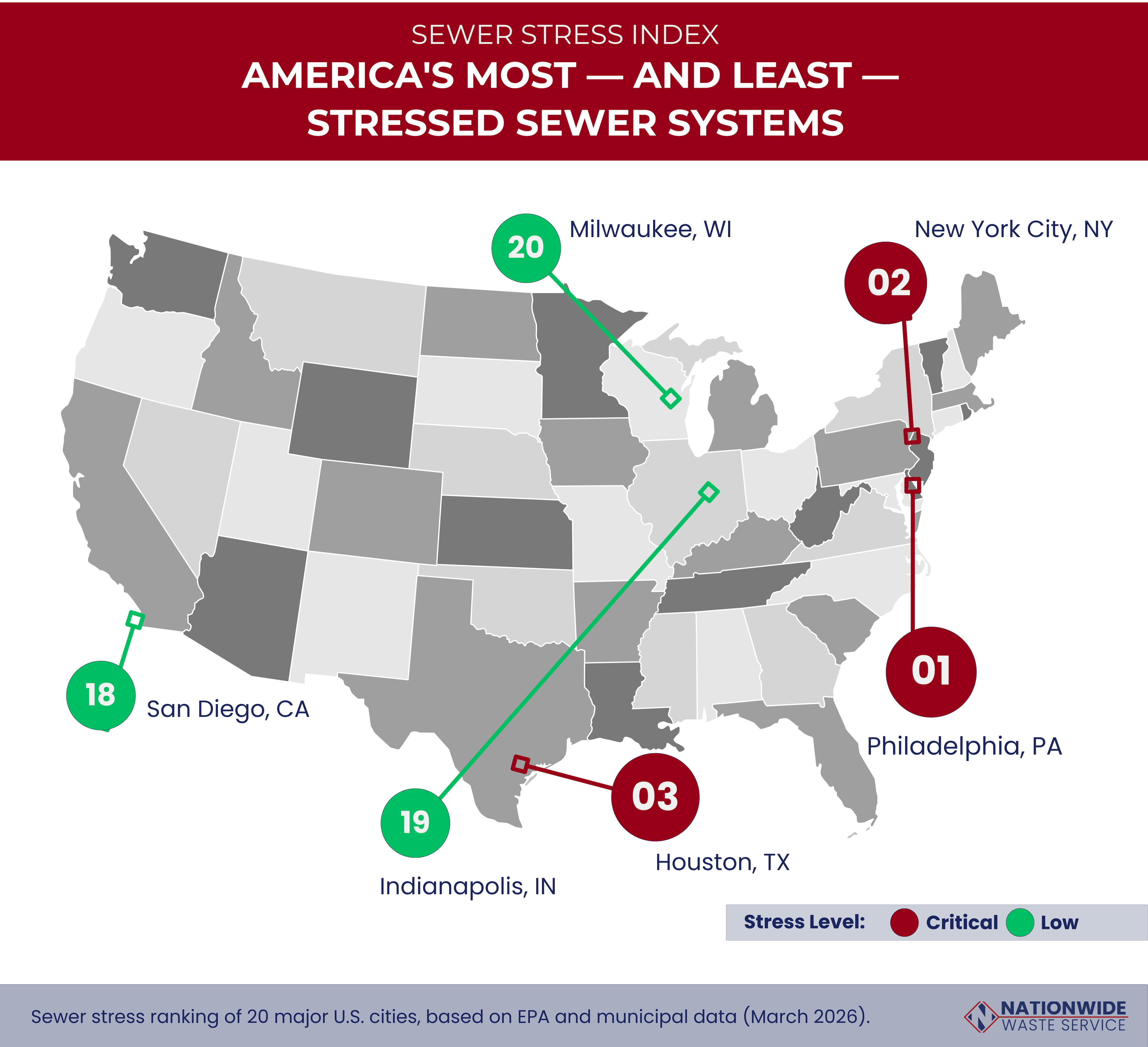
America's Most and Least Stressed Sewer Systems
A new analysis by Nationwide Waste Service ranks the sewer systems of 20 major U.S. cities — revealing which metropolitan hubs are closest to a breaking point.
GILBERT, AZ, UNITED STATES, April 16, 2026 /EINPresswire.com/ -- Nationwide Waste Service, a leading provider of portable sanitation solutions, has released the 2026 Sewer Stress Index: a city-by-city analysis ranking the wastewater infrastructure of 20 major U.S. cities by their vulnerability to failure. The index evaluates each city across four pillars: capacity and utilization, overflow frequency and volume, infrastructure age and condition, and investment gap. Together, these factors produce an overall stress score for each city.Decades of deferred maintenance, rapid urbanization, and increasingly intense rainfall are pushing urban sewer systems across the U.S. toward their limits. The American Society of Civil Engineers gave it a D+ in 2025, as system failures increased from 2 to 3.3 per 100 miles of pipe over the past decade. The U.S. Environmental Protection Agency (EPA) estimates up to $690 billion in infrastructure needs over the next 20 years. The bill is already reaching residents, with water and sewer costs rising at roughly twice the rate of overall inflation since 1998.
Philadelphia is Home to America's Most Stressed Sewer System
Philadelphia ranks as the most stressed sewer system in the country. Its aging infrastructure is operating at near-maximum capacity, discharging an average of 12.7 billion gallons of untreated sewage and polluted stormwater into local rivers and streams each year. A modernization program launched in 2011 was designed to address the problem, but projected costs have ballooned from an original estimate of $1.5–2 billion to $4.5 billion, with no end to the backlog in sight.
Only Three Cities Categorized As Critical
Apart from Philadelphia, two other cities received the critical rating. New York City ranks second, where a combined sewer network spanning over 7,400 miles regularly discharges billions of gallons of raw sewage into surrounding waterways, and a key remediation project at the Gowanus Canal is now more than six years behind schedule. Houston ranks third, reporting over 6,000 sanitary sewer overflows between 2021 and 2025 — a figure on par with much older systems in the Northeast.
Rust Belt and Coastal Cities Face Distinct but Serious Challenges
Beyond the critical tier, the index reveals two further clusters of concern. Detroit, Baltimore, and Cincinnati — all legacy industrial cities — score high on sewer stress due to aging pipe networks, frequent overflow events during wet weather, and constrained municipal budgets that limit capital investment. A separate but growing threat affects coastal cities: sunny-day flooding. In Miami, St. Petersburg, and similar coastal metros, rising sea levels are pushing saltwater into aging sewer pipes on calm, clear days. The resulting corrosion is eating away at century-old infrastructure in ways that conventional maintenance schedules are not designed to catch. This phenomenon is expected to worsen significantly through 2030 and beyond.
Where the System Is Working: The Low-Stress Cities
Only three cities ranked as low stress, offering a benchmark for proactive infrastructure management:
- Milwaukee's (#20, Score 0) deep tunnel system, operating since 1994, has captured or treated more than 138 billion gallons of wastewater that would otherwise have entered Lake Michigan.
- Indianapolis (#19, Score 0) recently completed the DigIndy deep tunnel network, designed to capture and treat overflow before it reaches the environment.
- San Diego (#18, Score: 12) benefits from a dry climate and a largely separated pipe network, keeping overflow risk low.
Sewer failures have consequences far beyond infrastructure. When combined sewer systems overflow, they release untreated wastewater containing pathogens, bacteria, and toxic pollutants into rivers, streets, and in some cases residential areas. For the cities ranked Critical or High in the index, the central question is no longer whether to invest — it is how long they can afford to wait.
For more information about this study, including a detailed overview of the methodology and sources used, please refer to the link here.
-End-
About Nationwide Waste Service: Nationwide Waste Service is a leading provider of portable sanitation solutions in the United States, offering a comprehensive range of products, including porta-potties, luxury restroom trailers, dumpsters, and essential waste management equipment. With an extensive network that covers both rural areas and major metropolitan cities, we ensure timely, reliable delivery nationwide. Whether for construction sites, events, or emergency response scenarios, our dedication to quality, affordability, and exceptional customer service makes us the trusted partner for all portable sanitation needs. To learn more about our services, visit www.nationwidewasteservice.com.
Nadine Bloecher
12100 Collective
email us here
Legal Disclaimer:
EIN Presswire provides this news content "as is" without warranty of any kind. We do not accept any responsibility or liability for the accuracy, content, images, videos, licenses, completeness, legality, or reliability of the information contained in this article. If you have any complaints or copyright issues related to this article, kindly contact the author above.
