

Wireless Charging Market to Reach US$ 94.2 Bn by 2033 as Qi2 and High-Power Applications Accelerate Global Adoption
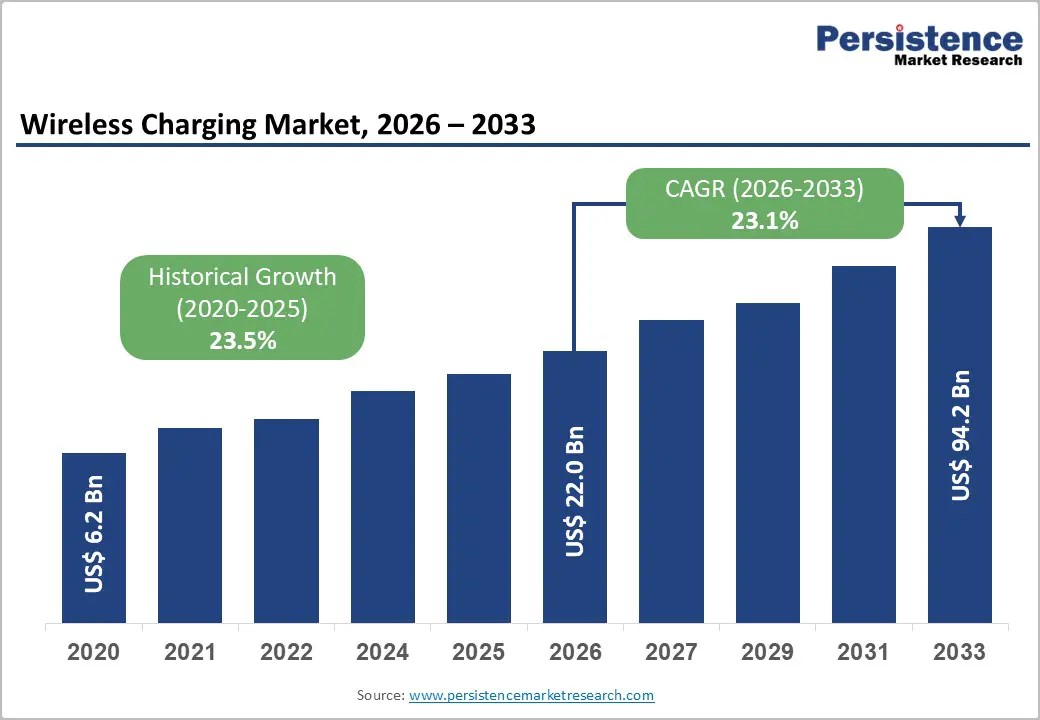
The global wireless charging is valued at US$22 Bn in 2026 and forecast to hit US$94.2 Bn by 2033, reflecting a strong 23.1% CAGR over 2026–2033 period
BRENTFORD, ENGLAND, UNITED KINGDOM, February 19, 2026 /EINPresswire.com/ -- The global Wireless Charging Market is projected to be valued at US$ 22.0 billion in 2026 and is forecast to reach US$ 94.2 billion by 2033, expanding at an impressive CAGR of 23.1% between 2026 and 2033. This remarkable growth reflects the rapid evolution of wireless power transfer technologies across consumer electronics, automotive, healthcare, and industrial applications. The transition from a convenience-driven feature to essential infrastructure marks a structural shift in how devices are powered globally.
The adoption of Qi2 technology has significantly accelerated market transformation, with more than 1,200 new certified products launched in 2025 alone—six times faster than earlier standards. North America leads the market with a 31.4% share in 2025, driven by strong smartphone penetration and premium device ecosystems. Inductive charging dominates the technology landscape with 60% market share, while Asia Pacific is the fastest-growing region due to EV infrastructure expansion and electronics manufacturing leadership.
𝐆𝐞𝐭 𝐚 𝐒𝐚𝐦𝐩𝐥𝐞 𝐏𝐃𝐅 𝐁𝐫𝐨𝐜𝐡𝐮𝐫𝐞 𝐨𝐟 𝐭𝐡𝐞 𝐑𝐞𝐩𝐨𝐫𝐭: https://www.persistencemarketresearch.com/samples/21916
Key Highlights from the Report
• North America holds 31.4% of the wireless charging market share in 2025.
• Asia Pacific is the fastest-growing region with a projected CAGR of 24.36% through 2034.
• Inductive charging technology accounts for 60% of global market revenue.
• High-power wireless charging (above 50W) is the fastest-expanding segment.
• The market is projected to grow at a CAGR of 23.1% from 2026 to 2033.
• Wireless charging-enabled device shipments are expected to reach 4,750 million units by 2030.
Market Segmentation Analysis
The wireless charging market is segmented by technology into inductive, resonant, and radio frequency (RF)-based charging systems. Inductive charging dominates due to established standards, compatibility with major smartphone brands, and high energy efficiency. Its widespread integration in smartphones, wearables, earbuds, and consumer gadgets has solidified its market leadership position.
Resonant wireless charging is gaining traction for mid-range and multi-device charging applications, particularly in automotive consoles and smart furniture. Meanwhile, high-power charging systems above 50W are emerging as transformative solutions for laptops, industrial devices, and electric vehicles (EVs). These advancements are expanding wireless charging beyond handheld electronics into broader mobility and infrastructure ecosystems.
By end-use industry, consumer electronics represent the largest revenue share, followed by automotive, healthcare, industrial equipment, and public infrastructure installations. Increasing integration into dashboards, office desks, airports, and hospitality spaces further strengthens the commercial deployment of embedded wireless charging systems.
Regional Insights and Trends
North America leads the global wireless charging market due to strong consumer demand for premium smartphones and rapid adoption of Qi2-enabled products. The region’s advanced retail ecosystem and EV infrastructure expansion further contribute to sustained growth in wireless power transfer solutions.
Asia Pacific is emerging as the fastest-growing region, supported by China’s electronics manufacturing dominance and expanding EV adoption. Government-backed initiatives promoting electric mobility and smart city infrastructure are accelerating the deployment of wireless charging stations across urban centers.
Europe is also witnessing steady growth, driven by sustainability initiatives and increasing adoption of electric vehicles. Automotive manufacturers in the region are integrating wireless charging solutions directly into vehicle platforms to enhance user convenience and promote cable-free mobility.
𝐃𝐨 𝐘𝐨𝐮 𝐇𝐚𝐯𝐞 𝐀𝐧𝐲 𝐐𝐮𝐞𝐫𝐲 𝐎𝐫 𝐒𝐩𝐞𝐜𝐢𝐟𝐢𝐜 𝐑𝐞𝐪𝐮𝐢𝐫𝐞𝐦𝐞𝐧𝐭? 𝐑𝐞𝐪𝐮𝐞𝐬𝐭 𝐂𝐮𝐬𝐭𝐨𝐦𝐢𝐳𝐚𝐭𝐢𝐨𝐧 𝐨𝐟 𝐑𝐞𝐩𝐨𝐫𝐭: https://www.persistencemarketresearch.com/request-customization/21916
Market Dynamics
Market Drivers
The rapid rise in smartphone penetration and wearable device adoption remains the primary growth driver of the wireless charging market. As consumers demand seamless charging experiences, manufacturers are embedding wireless receivers directly into devices. Additionally, global EV sales exceeding 17 million units in 2024 are creating new demand for high-power wireless charging systems in automotive applications.
Market Restraints
Despite strong growth prospects, challenges related to energy efficiency losses and higher system costs compared to wired charging remain concerns. Thermal management issues in high-power wireless charging systems can also impact performance and user experience. Compatibility limitations across different device ecosystems may slow standardization efforts in certain regions.
Market Opportunities
The integration of wireless charging into public infrastructure, furniture, and commercial environments presents substantial opportunities. Embedded charging solutions in office desks, airport lounges, cafes, and automotive interiors eliminate cable dependency and support smart ecosystem development. Furthermore, advancements in high-power and long-distance charging technologies are opening new industrial and electric vehicle applications.
Competitive Landscape and Company Insights
The wireless charging market is highly competitive, with technology providers, semiconductor manufacturers, and consumer electronics brands investing heavily in R&D and ecosystem expansion.
Company Insights
Apple Inc.
Samsung Electronics Co., Ltd.
Qualcomm Incorporated
Texas Instruments Incorporated
Broadcom Inc.
Energizer Holdings, Inc.
Belkin International, Inc.
Powermat Technologies Ltd.
WiTricity Corporation
Murata Manufacturing Co., Ltd.
Integrated Device Technology (Renesas Electronics)
Sony Corporation
Anker Innovations
Xiaomi Corporation
Huawei Technologies Co., Ltd.
Recent Developments
In 2025, multiple global device manufacturers accelerated adoption of Qi2-certified wireless charging products, surpassing 1,200 newly certified devices within a single year.
Belkin introduced high-power 200W GaN charging solutions, expanding wireless charging capabilities into professional and industrial segments.
𝐁𝐮𝐲 𝐍𝐨𝐰 𝐭𝐡𝐞 𝐃𝐞𝐭𝐚𝐢𝐥𝐞𝐝 𝐑𝐞𝐩𝐨𝐫𝐭: https://www.persistencemarketresearch.com/checkout/21916
Conclusion
The wireless charging market is undergoing a rapid transformation fueled by technological innovation, EV expansion, and increasing device connectivity. With a projected value of US$ 94.2 billion by 2033, the industry is evolving from a niche consumer electronics feature into a foundational component of smart infrastructure.
As high-power wireless charging, embedded device integration, and mobility solutions gain traction, the market is poised to redefine how energy is delivered across consumer and industrial ecosystems. The next decade will likely witness wireless charging becoming a standard expectation rather than an optional convenience, reshaping global power delivery systems.
Related Reports:
Micro Investing Platform Market
Consumer Mobile Payments Market
Pooja Gawai
Persistence Market Research
+1 646-878-6329
email us here
Visit us on social media:
LinkedIn
Instagram
Facebook
YouTube
Legal Disclaimer:
EIN Presswire provides this news content "as is" without warranty of any kind. We do not accept any responsibility or liability for the accuracy, content, images, videos, licenses, completeness, legality, or reliability of the information contained in this article. If you have any complaints or copyright issues related to this article, kindly contact the author above.
