

Global Non-Specific Endonuclease Market Set to Nearly Double by 2036, Reaching USD 726.6 Million | TMR
Non-specific Endonuclease Market
The market expansion results from new bio manufacturing facilities emerging in Asia, along with the ongoing trend of outsourcing biologics production.
Non-Specific Endonuclease Industry Growth Forecast at 6.5% CAGR Through 2036”
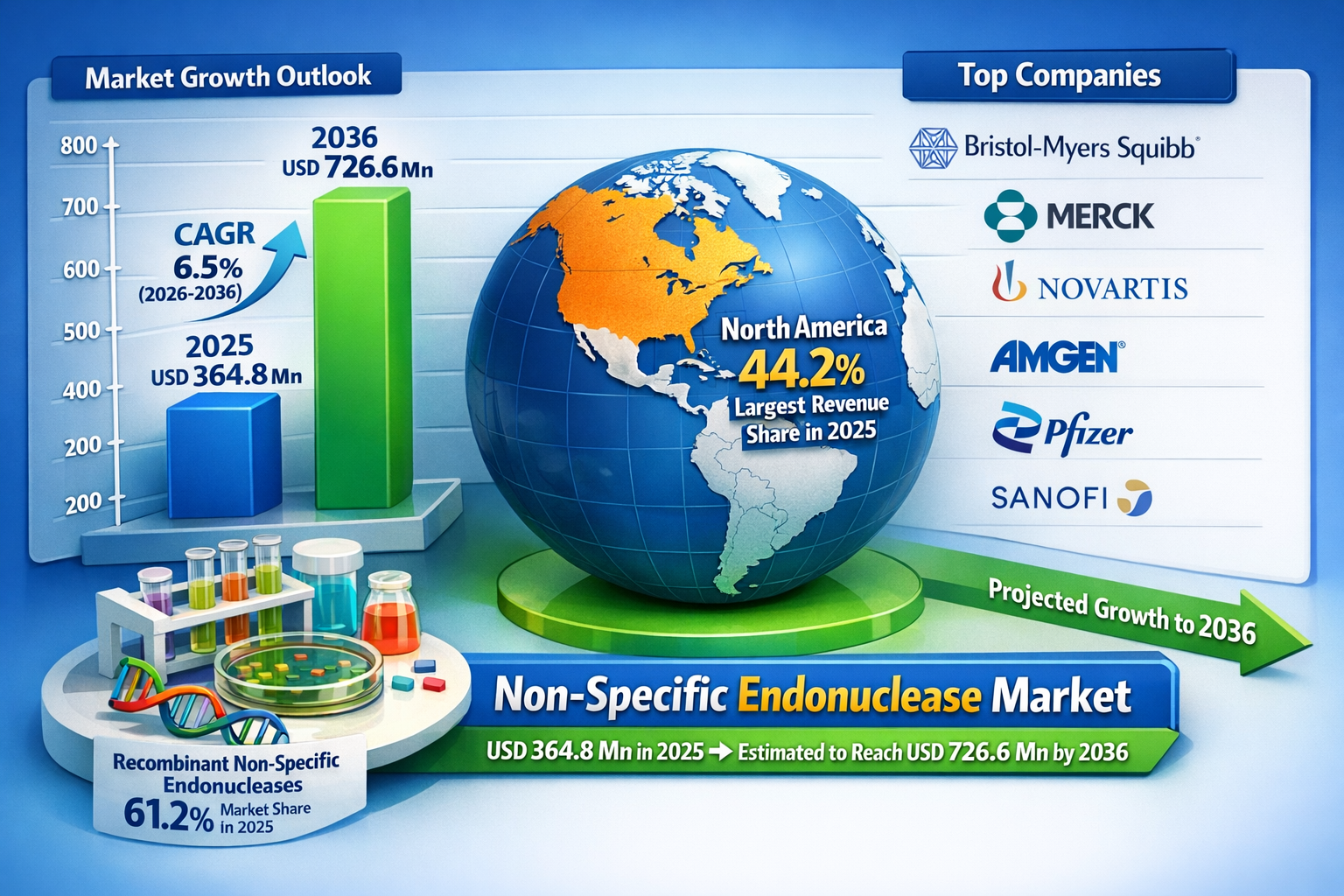
WILMINGTON, DE, UNITED STATES, February 18, 2026 /EINPresswire.com/ -- The global non-specific endonuclease market size was valued at USD 364.8 Mn in 2025 and is projected to reach USD 726.6 Mn by 2036, expanding at a CAGR of 6.5% from 2026 to 2036. The non-specific endonuclease industry keeps expanding as biopharmaceutical manufacturing needs effective nucleic acid removal systems, research laboratories require gene-editing and molecular biology tools, and regulatory bodies demand biologics with superior purity standards.— Transparency Market Research Inc.
👉 Get sample market research report copy today@ https://www.transparencymarketresearch.com/sample/sample.php?flag=S&rep_id=86944
Market Overview
Non-specific endonucleases, such as the widely utilized Serratia marcescens nuclease, are essential tools in biotechnology for the degradation of all forms of DNA and RNA (single-stranded, double-stranded, linear, and circular). Unlike restriction enzymes, these "sequence-agnostic" enzymes are critical for nucleic acid removal during the purification of proteins, vaccines, and viral vectors.
In 2026, the market is characterized by a transition toward animal-free, recombinant formulations produced under strict Good Manufacturing Practice (GMP) conditions. These enzymes are indispensable for reducing the viscosity of cell lysates, which prevents the fouling of downstream filters and chromatography columns—a key bottleneck in large-scale biomanufacturing.
The shift toward Software-Defined Biomanufacturing, where AI optimizes the enzymatic digestion phase in bioreactors, is further strengthening the deployment of advanced endonuclease variants across pharmaceutical platforms.
Analysts' Viewpoint on the Global Non-specific Endonuclease Market
Analysts observe steady growth driven by the "Biologics Revolution." As regulatory agencies (FDA/EMA) tighten purity standards for injectable drugs, the requirement to eliminate residual host-cell DNA has made non-specific endonucleases a non-negotiable component of the downstream process.
The increasing implementation of Cell and Gene Therapy (CGT), particularly AAV (Adeno-associated virus) and Lentivirus production, is significantly contributing to market expansion. These therapies require massive quantities of "clean" viral particles, where endonucleases are used to remove plasmid DNA used during the transfection stage.
Furthermore, the expansion of mRNA vaccine platforms beyond COVID-19 into oncology and personalized medicine is reinforcing long-term growth prospects for RNase-specific and broad-spectrum variants.
Analysis of Key Players in the Non-specific Endonuclease Market
The competitive landscape is defined by "Enzyme Engineering," where companies modify natural nucleases to remain active under extreme conditions, such as high salt concentrations or varying pH levels common in industrial bioprocessing.
Leading companies operating in the global non-specific endonuclease market include:
• F. Hoffmann-La Roche AG
• NuCLEANASE by c-LEcta
• GenScript
• Beyotime Biotechnology
• Vazyme International LLC
• Takara Bio Inc.
• Promega Corporation
• Bio-Techne
• ACROBiosystems Group
• MinneBio
• New England Biolabs
• KACTUS
• ArcticZymes Technologies
• Worthington Biochemical Corporation
• Thermo Fisher Scientific Inc.
• Other Prominent Players
These players are investing in lyophilized (freeze-dried) formulations for easier global shipping and salt-active nuclease variants that allow for digestion directly in high-salt elution buffers, saving time and reducing process steps.
Recent Developments in Non-specific Endonuclease Market
• In June 2025, ArcticZymes Technologies expanded its GMP product range with the launch of M-SAN HQ GMP, a new GMP-grade nuclease specifically designed for viral vector manufacturing.
• In June 2025, New England Biolabs (NEB) introduced its GMP-grade Salt Active Nuclease to the European market for use in biopharmaceutical and viral vector manufacturing workflows, particularly for the removal of nucleic acid impurities under high-salt conditions
• In April 2025, Worthington Biochemical introduced two new enzyme products for nucleic acid research and bioprocessing: NUCxyme DNA/RNA Nuclease, Recombinant, Animal-Free - a broad-spectrum, sequence-independent endonuclease derived from Serratia marcescens and produced recombinantly in yeast. Ribonuclease U2, Recombinant - an RNA-targeting endonuclease with defined specificity, also produced in yeast, designed for applications requiring non-animal-derived enzymes.
• In June 2025, the Ferruz Laboratory, at the Institute of Molecular Biology of Barcelona and Basecamp Research, a global leader in artificial intelligence (AI)-based protein and biological system design, announced the release of ZymCTRL ("enzyme control"). This tool works similarly to ChatGPT and creates new sequences from scratch when a user enters an enzyme identification code that denotes the desired activity.
👉 Discuss Implications for Your Industry Request Sample Research Report PDF@ https://www.transparencymarketresearch.com/sample/sample.php?flag=S&rep_id=86944
Key Developments in the Non-specific Endonuclease Market
• Transition to Recombinant Sources: Over 60% of the market has shifted to recombinant enzymes to ensure batch-to-batch consistency and viral safety.
• Salt-Tolerant Variants: Development of enzymes like ArcticZymes' "SAN" (Salt Active Nuclease) that function in high-molarity environments.
• NGS Library Prep Integration: Use of endonucleases for random fragmentation to ensure unbiased sequencing data.
• Expansion in CDMOs: Contract Development and Manufacturing Organizations are emerging as the fastest-growing end-user segment.
• Diagnostics Innovation: Integration into CRISPR-based diagnostic kits (e.g., DETECTR) for signal amplification.
Key Player Strategies
• 🧬 Enzyme Customization Developing "Engineered Variants" with improved thermal stability and faster reaction kinetics for high-throughput labs.
• 🏭 GMP-Grade Scaling Expanding manufacturing facilities to provide "Bulk" quantities of endonucleases for the burgeoning Biosimilars market.
• 🤝 Bio-Process Integration Partnering with filtration and chromatography companies to provide "Pre-mixed" solutions for cell lysis.
• 🌍 Regional Expansion in APAC: Establishing local distribution and tech-support hubs in China and India to capture the rapidly growing biomanufacturing sector.
• 🛡️ Regulatory Compliance Leadership Providing comprehensive "Drug Master Files" (DMF) to help pharmaceutical clients speed up their FDA approval processes.
Challenges & Opportunities
Challenges:
• High Production Costs: Complex purification of recombinant enzymes can lead to high unit prices.
• Stability Issues: Many liquid-form endonucleases require -20°C storage, complicating global logistics.
• Regulatory Hurdles: Stringent testing required to prove zero residual nuclease remains in the final drug.
Opportunities:
• mRNA Therapeutics: Significant potential in the degradation of DNA templates following in-vitro transcription.
• Salt-Active Innovation: Developing enzymes that function in high-salt buffers to simplify downstream processing.
• Agricultural Biotech: Using nucleases for DNA clean-up in CRISPR-modified crop research.
Market Segmentation
➤ By Product
• Recombinant Non-specific Endonucleases (61.2% Market Share)
• Natural Source Enzymes
• Engineered/Modified Variants (Fastest growing segment)
➤ By Application
• Biopharmaceutical Production (mAbs, Recombinant Proteins)
• Cell & Gene Therapy (AAV, Lentivirus, CAR-T)
• Vaccine Manufacturing (mRNA, Viral Vector)
• Diagnostics & Research (NGS, RNA Sequencing)
➤ By End User
• Biopharmaceutical & Biotechnology Companies
• CDMOs/CMOs (Expanding at 6.8% CAGR)
• Academic & Research Institutions
• Diagnostic Laboratories
➤ By Region
• North America: Leading market (44.2% share) driven by CGT innovation.
• Europe: Significant share due to strong biosimilars and vaccine manufacturing base.
• Asia Pacific: Fastest-growing region with rising investments in bioprocessing in India and China.
Conclusion
The non-specific endonuclease market is poised for robust expansion through 2036, serving as the "silent enabler" of the biologics industry. As the world moves toward more complex cell therapies and personalized mRNA vaccines, the demand for highly efficient, salt-tolerant, and GMP-certified nucleases will remain a cornerstone of modern biotechnology.
👉 To buy this comprehensive market research report, click here to inquire@ https://www.transparencymarketresearch.com/checkout.php?rep_id=86944<ype=S
Frequently Asked Questions
• How big was the global non-specific endonuclease market in 2025?
The global non-specific endonuclease market was valued at US$ 364.8 Mn in 2025
• How big will the global non-specific endonuclease industry be in 2036?
The global non-specific endonuclease industry is projected to reach more than US$ 726.6 Mn by the end of 2036
• What are the factors driving the non-specific endonuclease market?
Rising demand for efficient nucleic acid and rising genetic disorders for advanced diagnostic research are some of the factors driving the expansion of the non-specific endonuclease market.
• What will be the CAGR of the global non-specific endonuclease industry during the forecast period?
The CAGR is anticipated to be 6.5% from 2026 to 2036
• Which region will account for a major share of the non-specific endonuclease sector during the forecast period?
North America is expected to account for the largest share from 2026 to 2036
• Who are the prominent players in the global non-specific endonuclease market?
F. Hoffmann-La Roche AG, NuCLEANASE by c-LEcta, GenScript, Beyotime Biotechnology, Vazyme International LLC, Takara Bio Inc., Promega Corporation, Bio-Techne, ACROBiosystems Group, MinneBio, New England Biolabs, KACTUS, ArcticZymes Technologies, Worthington Biochemical Corporation, Thermo Fisher Scientific Inc., and other prominent players.
About Transparency Market Research
Transparency Market Research, a global market research company registered at Wilmington, Delaware, United States, provides custom research and consulting services. Our exclusive blend of quantitative forecasting and trends analysis provides forward-looking insights for thousands of decision makers. Our experienced team of Analysts, Researchers, and Consultants use proprietary data sources and various tools & techniques to gather and analyses information.
Our data repository is continuously updated and revised by a team of research experts, so that it always reflects the latest trends and information. With a broad research and analysis capability, Transparency Market Research employs rigorous primary and secondary research techniques in developing distinctive data sets and research material for business reports.
Abhishek Budholiya - Marketing Team
Transparency Market Research Inc.
+1 518-618-1030
email us here
Legal Disclaimer:
EIN Presswire provides this news content "as is" without warranty of any kind. We do not accept any responsibility or liability for the accuracy, content, images, videos, licenses, completeness, legality, or reliability of the information contained in this article. If you have any complaints or copyright issues related to this article, kindly contact the author above.
