

Hydrogen Buses Market to Grow from US$ 1.8 Bn in 2026 to US$ 11.1 Bn by 2033 at 29.3% CAGR | Persistence Market Research
Hydrogen Buses Market 2026 - 2033
Hydrogen buses market expands driven by zero-emission transit demand, fuel cell advancements, government support, and growing hydrogen infrastructure worldwide
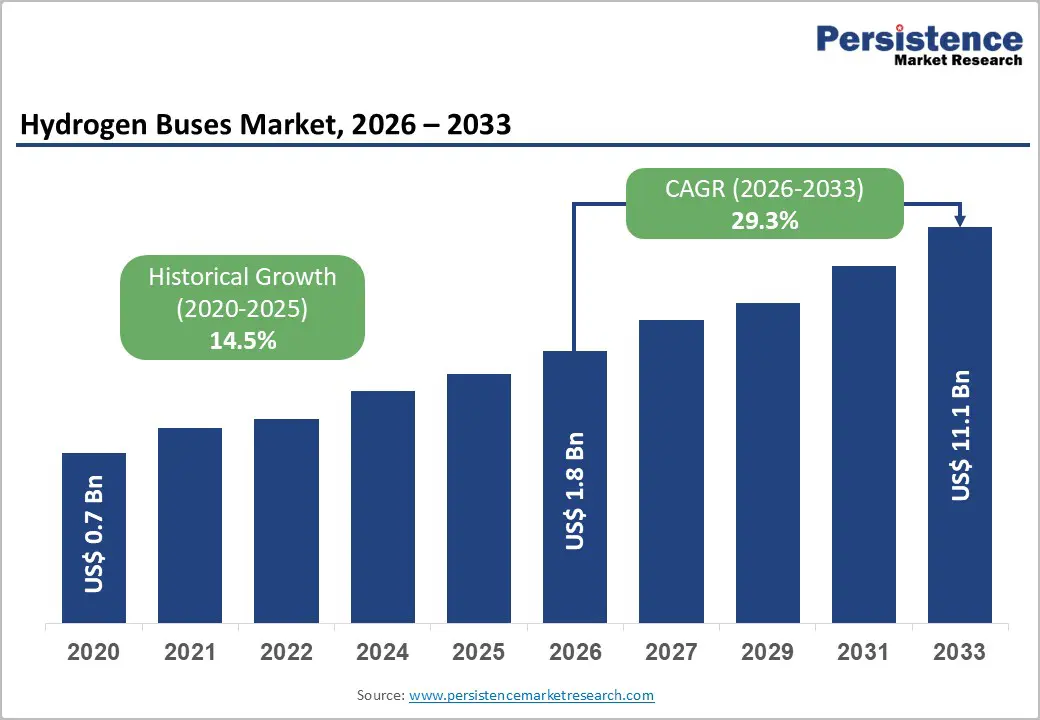
BRENTFORD, LONDON, UNITED KINGDOM, February 18, 2026 /EINPresswire.com/ -- The global Hydrogen Buses Market is gaining remarkable traction as governments and transit authorities accelerate the shift toward zero-emission heavy-duty vehicles. According to Persistence Market Research, the market is likely to be valued at US$ 1.8 billion in 2026 and is projected to reach US$ 11.1 billion by 2033, expanding at a CAGR of 29.3% between 2026 and 2033. The market builds on a historical CAGR of 15.5% from 2020, reflecting strong early-stage adoption momentum. Growing environmental concerns and urban air quality regulations are driving deployment of hydrogen fuel cell buses in public transportation fleets. Policy-backed pilot projects and funding incentives are encouraging municipalities to invest in hydrogen mobility solutions. Large OEM product pipelines are ensuring availability of technologically advanced fuel cell buses.
Market statistics highlight the rapid scale-up potential of hydrogen-powered bus fleets worldwide. The surge from US$ 1.8 billion in 2026 to US$ 11.1 billion by 2033 underscores strong institutional commitment and technological maturity. The leading segment within the Hydrogen Buses Market is fuel cell electric buses (FCEBs), driven by their long driving range and fast refueling capabilities compared to battery electric alternatives. These buses are particularly suitable for long urban routes and intercity operations. Geographically, Europe stands out as a leading region due to proactive decarbonization targets, hydrogen infrastructure development, and supportive policy frameworks. Strong public-private collaborations are accelerating commercial deployment. Together, rapid zero-emission heavy-duty vehicle adoption and policy-driven initiatives reinforce the projected 29.3% CAGR through 2033.
Get Your FREE Sample Report Instantly Click Now: https://www.persistencemarketresearch.com/samples/35127
The key players studied in the report include:
• Wrightbus
• Solaris
• Tata Motors Ltd.
• Hyundai Motor Company
• Beiqi Foton Motor Co. Ltd.
• NFI Group Inc.
• Zhengzhou Yutong Bus Co., Ltd.
• Daimler Buses
• Salvador Caetano Group
• Zhongtong Bus Holding
• IVECO Bus
• Zhejiang Geely New Energy Commercial Vehicle Group Co. Ltd.
• King Long
• Anhui Ankai Automobile Co.,Ltd
• CHERY & WANDA GUIZHOU BUS CO.,LTD
Key Highlights from the Report
➤ The Hydrogen Buses Market is projected to grow from US$ 1.8 billion in 2026 to US$ 11.1 billion by 2033, registering a CAGR of 29.3%
➤ The market builds on a strong historical CAGR of 15.5% from 2020, reflecting accelerating early adoption
➤ Fuel cell electric buses dominate the segment due to extended range and rapid refueling advantages
➤ Policy-backed pilot programs are significantly boosting zero-emission heavy-duty vehicle deployment
➤ Large OEM product pipelines are strengthening commercialization and production capacity
➤ Public transportation electrification initiatives are creating long-term structural demand
Market Segmentation
By Technology
• Proton Exchange Membrane Fuel Cell
• Solid Oxide Fuel Cell
• Phosphoric Acid Fuel Cell
• Others (Alkaline Fuel Cell, etc.)
By Power Output
• Less than 150 k
• 150 to 250 kW
• More than 250 kW
By Bus Type
• Single Deck
• Double Deck
• Articulated Deck
By Region
• North America
• Europe
• East Asia
• South Asia Oceania
• Latin America
• Middle East & Africa
Customize This Report for Your Exact Requirements: https://www.persistencemarketresearch.com/request-customization/35127
Regional Insights
Europe remains a prominent region in the Hydrogen Buses Market, driven by strong policy support and environmental regulations. Decarbonization roadmaps encourage adoption of zero-emission heavy-duty vehicles across major cities. Governments are investing in hydrogen production and refueling infrastructure. Pilot programs are transitioning into full-scale commercial deployments. Collaboration between transit agencies and OEMs accelerates fleet integration. Public funding mechanisms reduce upfront capital costs. Sustainability mandates are strengthening long-term procurement strategies.
Asia Pacific is emerging as a high-growth region due to expanding urban populations and air pollution mitigation strategies. Governments are integrating hydrogen mobility into national energy transition plans. Domestic manufacturers are expanding product pipelines to support fleet demand. Public transportation electrification initiatives are gaining momentum. Infrastructure development remains a priority for long-term scalability. Urban transit authorities are exploring hydrogen buses for high-capacity corridors.
Market Drivers
A primary driver of the Hydrogen Buses Market is the global push for zero-emission heavy-duty vehicles. Urban air pollution concerns are prompting governments to adopt cleaner public transportation solutions. Hydrogen buses offer longer range and faster refueling compared to battery electric buses. Policy incentives and subsidies are reducing capital barriers for transit agencies. The projected increase from US$ 1.8 billion in 2026 to US$ 11.1 billion by 2033 reflects strong institutional demand. Public pressure for sustainable mobility strengthens political commitment.
Another major growth driver is the historical adoption trend, evidenced by a 15.5% CAGR since 2020. Early pilot projects have demonstrated operational reliability and efficiency. Governments are scaling successful trials into larger procurement programs. Investments in hydrogen infrastructure improve refueling accessibility. Fleet operators value the operational flexibility of fuel cell buses. Decarbonization targets across transport sectors reinforce long-term demand
Market Opportunities
The Hydrogen Buses Market presents significant opportunities in large-scale public transportation electrification. Municipalities are prioritizing sustainable urban mobility strategies. Expansion of hydrogen production facilities supports long-term supply security. Strategic partnerships between OEMs and energy companies accelerate ecosystem development. The forecasted rise to US$ 11.1 billion by 2033 highlights substantial investment potential. Integration of renewable energy sources into hydrogen production enhances environmental performance.
Growing focus on green hydrogen initiatives offers additional growth avenues. Public-private collaborations are expanding refueling infrastructure networks. Technological improvements are enhancing fuel cell durability and cost efficiency. Emerging markets are incorporating hydrogen buses into new transit systems. Fleet modernization programs create recurring procurement cycles. The sustained 29.3% CAGR reflects strong expansion capacity.
Buy Full Report Today: https://www.persistencemarketresearch.com/checkout/35127
Recent Developments
• In March 2024, major OEMs expanded hydrogen bus production capacity to meet growing municipal demand.
• In October 2024, leading market participants strengthened partnerships to accelerate hydrogen refueling infrastructure deployment.
Future Opportunities and Growth Prospects
The Hydrogen Buses Market is positioned for exponential expansion as cities intensify decarbonization efforts. With projected growth from US$ 1.8 billion in 2026 to US$ 11.1 billion by 2033 at a CAGR of 29.3%, the sector demonstrates transformative potential. Continued policy backing, infrastructure investment, and technological innovation will shape the next phase of sustainable public transportation development.
Persistence Market Research
Persistence Market Research Pvt Ltd
+1 646-878-6329
email us here
Visit us on social media:
LinkedIn
Instagram
Facebook
YouTube
X
Legal Disclaimer:
EIN Presswire provides this news content "as is" without warranty of any kind. We do not accept any responsibility or liability for the accuracy, content, images, videos, licenses, completeness, legality, or reliability of the information contained in this article. If you have any complaints or copyright issues related to this article, kindly contact the author above.
