

EV Driveline NVH Couplings Market Forecast 2026-2036: Market Size, Share, Competitive Landscape & Future Growth Outlook
EV Driveline NVH Couplings Market
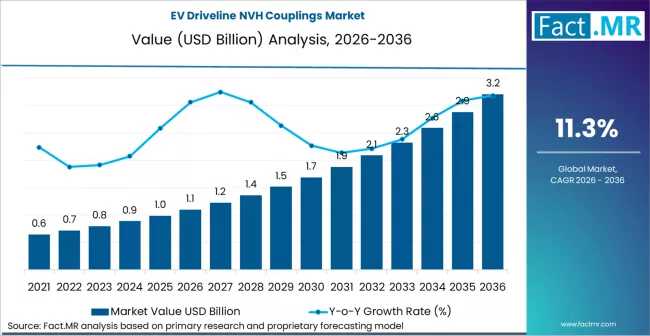
EV Driveline NVH Couplings Market to Reach USD 3.2 Billion by 2036 at 11.3% CAGR
ROCKVILLE, MD, UNITED STATES, February 17, 2026 /EINPresswire.com/ -- The global EV driveline NVH couplings market is valued at USD 1.1 billion in 2026 and is projected to surge to USD 3.2 billion by 2036. Growing at a compound annual growth rate (CAGR) of 11.3%, the market is undergoing a transformational shift as cabin quietness becomes a primary competitive metric for electric vehicle manufacturers. This expansion is driven by the critical need for specialized mechanical components to manage unique vibration patterns and high-frequency electromagnetic whines inherent in electric powertrains.Request for Sample Report | Customize Report |purchase Full Report - https://www.factmr.com/connectus/sample?flag=S&rep_id=14243
global EV driveline NVH couplings market Snapshot
Market size 2026? The market is estimated to be valued at USD 1.1 billion.
Market size 2036? The market is projected to reach USD 3.2 billion.
CAGR? The market will grow at a compound annual growth rate of 11.3%.
Leading product segment(s) and shares? The Single-Motor eDrive powertrain layout leads with a 41% market share by 2026.
Leading sales channel and share? OEM Line-Fit is the dominant sales channel, capturing 81% of the market share by 2026.
Leading end use and share? Not applicable; the market is segmented by Sales Channel, where OEM Line-Fit (81%) is the primary driver for mass-market EV production.
Key growth regions? China (13.3% CAGR), Brazil (13.0% CAGR), and France (11.6% CAGR) are the fastest-growing regions.
Top companies? Schaeffler AG, ZF Friedrichshafen AG, BorgWarner Inc., Dana Incorporated, Magna International Inc., Vibracoustic SE, KTR Systems GmbH, Flender GmbH, Rexnord Corporation, and Nidec Corporation.
Market Momentum (YoY Path)
The EV driveline NVH couplings market is set for consistent value appreciation over the next decade. From its 2026 valuation of USD 1.1 billion, the market will climb to USD 1.36 billion in 2028 and reach USD 1.69 billion by 2030. Growth continues to USD 1.88 billion in 2031 and USD 2.33 billion in 2033, eventually culminating in the 2036 forecast of USD 3.2 billion. This represents an absolute dollar growth of USD 2.1 billion from the 2026 baseline.
Why the Market is Growing
The primary catalyst is the global transition to electric drivetrains, which introduces new vibration patterns from motors and gear sets that traditional couplings cannot manage. Additionally, the enhanced driving experience has become a differentiator; as EVs lack engine noise to mask mechanical whines, quietness is now a key competitive metric. Finally, regulatory requirements and stricter noise standards in major global markets are compelling manufacturers to adopt high-precision NVH components.
Segment Spotlight
1) Powertrain Layout (Single-Motor eDrive 41%)
The Single-Motor eDrive layout is expected to account for 41% of the market share by 2026. This configuration is the most common in mass-market EVs due to its cost-effectiveness and simplicity. These systems rely heavily on NVH couplings to minimize vibrations and ensure the smooth operation expected by modern consumers.
2) Sales Channel (OEM Line-Fit 81%)
OEM Line-Fit is the dominant force in the market, capturing 81% of the share by 2026. This segment thrives because original equipment manufacturers prioritize the direct and efficient integration of NVH solutions during the initial assembly process to optimize both cost and vehicle performance.
3) Coupling Function (Torsional Damping & Flexible Couplings)
The market is shifting from passive damping to advanced acoustic engineering. Specialized components like Torsional Damping Couplings and Flexible Disc Couplings are being increasingly utilized to neutralize high-frequency electromagnetic whines and torque ripples, which are critical for maintaining drivetrain integrity in high-performance EVs.
Drivers, Opportunities, Trends, Challenges
Drivers: The rapid shift from internal combustion engines to electric drivetrains is the fundamental driver. Because EVs operate at higher rotational speeds without engine noise to mask mechanical sounds, there is an urgent demand for vibration isolators that can ensure cabin comfort and protect high-torque drivelines from premature wear.
Opportunities: Emerging markets like China and Brazil offer significant expansion opportunities due to national green mobility programs and new quality standards. In these regions, the implementation of rigorous safety and performance certifications is forcing a shift toward higher-grade elastomeric and specialized damping solutions.
Trends: The industry is moving toward high-precision, lightweight rubber and composite materials. There is a clear trend of premiumization where advanced elastomeric and tuned mass solutions are replacing simpler, rigid couplings. Manufacturers are now focusing on neutralizing specific high-frequency vibrations rather than just providing general damping.
Challenges: The market faces substitution pressure from software-based noise cancellation technologies. Furthermore, volatility in the feedstock for specialized elastomers and tightening environmental regulations regarding the chemical compounds used in advanced dampeners act as structural constraints, particularly in mature markets like Germany and the UK.
Country Growth Outlook (CAGR)
Country CAGR (2026–2036)
China 13.3%
Brazil 13.0%
France 11.6%
United States 10.9%
Germany 10.6%
South Korea 10.6%
United Kingdom 10.5%
Japan 10.0%
Competitive Landscape
Competition in the EV driveline NVH couplings market is defined by technical innovation in acoustic isolation. Schaeffler AG and ZF Friedrichshafen AG lead by integrating thermal management and modular e-drive kits. BorgWarner Inc. specializes in custom solutions for high-performance AWD systems, while Dana Incorporated and Magna International Inc. focus on optimizing efficiency for electric drivetrains. Specialized firms like Vibracoustic SE, KTR Systems GmbH, Flender GmbH, and Rexnord Corporation provide critical vibration isolation systems, supported by Nidec Corporation’s high-precision components.
Related Reports
EV Portable Power Banks and Boosters Market https://www.factmr.com/report/ev-portable-power-banks-and-boosters-market
EV Charging Cable Locks and Security Devices Market https://www.factmr.com/report/ev-charging-cable-locks-and-security-devices-market
EV Charging Cable Management Accessories Market https://www.factmr.com/report/ev-charging-cable-management-accessories-market
EV Charge Port Covers Market https://www.factmr.com/report/ev-charge-port-covers-market
About Fact.MR
Fact.MR is a global market research and consulting firm, trusted by Fortune 500 companies and emerging businesses for reliable insights and strategic intelligence. With a presence across the U.S., UK, India, and Dubai, we deliver data-driven research and tailored consulting solutions across 30+ industries and 1,000+ markets. Backed by deep expertise and advanced analytics, Fact.MR helps organizations uncover opportunities, reduce risks, and make informed decisions for sustainable growth.
S. N. Jha
Fact.MR
+1 628-251-1583
email us here
Legal Disclaimer:
EIN Presswire provides this news content "as is" without warranty of any kind. We do not accept any responsibility or liability for the accuracy, content, images, videos, licenses, completeness, legality, or reliability of the information contained in this article. If you have any complaints or copyright issues related to this article, kindly contact the author above.
