

Antibody Optimization Service Market is Estimated to Reach US$ 6.5 Bn by 2036, Driven by Biologics and R&D Outsourcing
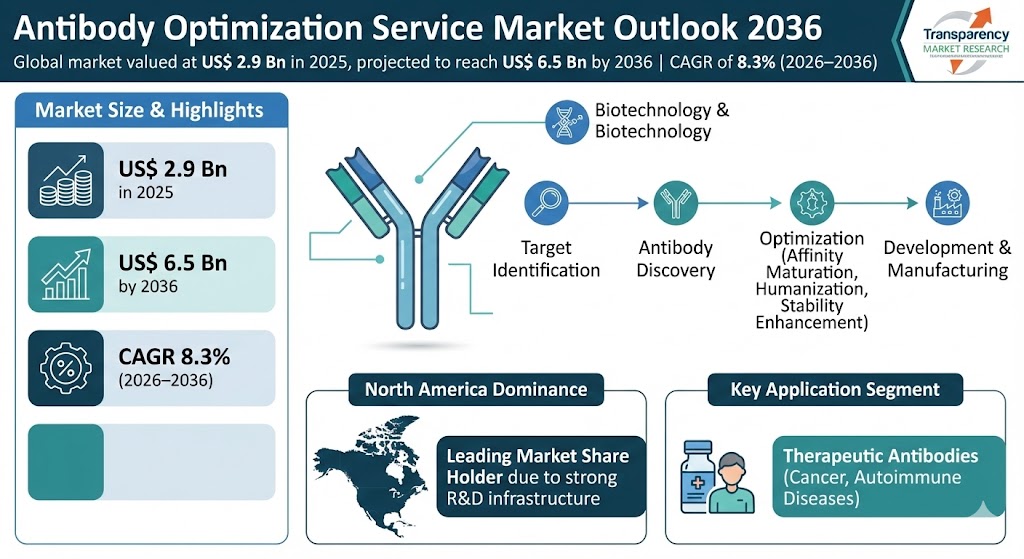
Antibody Optimization Service Market
The global antibody optimization service market size was valued at US$ 2.9 Bn in 2025 and is projected to reach US$ 6.5 Bn by 2036
The antibody optimization service industry is anticipated to expand at a CAGR of 8.3% from 2026 to 2036.
”
WILMINGTON, DE, UNITED STATES, February 17, 2026 /EINPresswire.com/ -- The global antibody optimization service market was valued at US$ 2.9 Bn in 2025 and is projected to reach US$ 6.5 Bn by 2036, expanding at a CAGR of 8.3% from 2026 to 2036. The market is witnessing strong and sustained growth due to the rapid expansion of monoclonal antibody therapeutics, increasing investment in biologics research, growing outsourcing of drug development activities, and continuous technological advancements in protein engineering and computational biology.— Transparency Market Research
Antibody optimization services play a critical role in the drug discovery and development process. As antibodies move from early discovery to preclinical and clinical development, they often require structural and functional refinement to improve their safety, efficacy, stability, and manufacturability. Optimization ensures that antibody candidates meet regulatory standards while delivering high therapeutic performance.
👉 Get your sample market research report copy today@ https://www.transparencymarketresearch.com/sample/sample.php?flag=S&rep_id=86937
Market Overview
Antibody optimization refers to a range of scientific techniques used to enhance the characteristics of antibodies, including binding affinity, specificity, half-life, solubility, and reduced immunogenicity. These services are typically provided by specialized biotechnology firms and contract research organizations (CROs) equipped with advanced molecular engineering platforms.
In modern biopharmaceutical development, antibodies have become one of the most successful therapeutic modalities. Monoclonal antibodies (mAbs), bispecific antibodies, antibody-drug conjugates (ADCs), and fragment-based antibodies are widely used in oncology, autoimmune disorders, infectious diseases, and rare genetic conditions. However, naturally discovered antibodies often require refinement before they can be used clinically. This necessity has created a robust demand for professional optimization services.
The growing complexity of biologics development and the need to accelerate time-to-market are further driving pharmaceutical companies to outsource antibody engineering to specialized service providers.
Key Growth Drivers
Rising Demand for Monoclonal Antibodies
Monoclonal antibodies continue to dominate the biologics market due to their high target specificity and clinical effectiveness. The increasing number of antibody-based drug approvals across therapeutic areas is creating a consistent pipeline of candidates requiring optimization. As competition intensifies, pharmaceutical companies aim to improve binding affinity, reduce side effects, and enhance therapeutic outcomes, further boosting service demand.
Expansion of Biologics and Advanced Therapies
The rapid growth of biologics, including cell and gene therapies, is fueling the need for advanced antibody engineering solutions. Complex biologic formats such as bispecific antibodies and antibody-drug conjugates require sophisticated optimization processes to ensure stability and functionality. The increasing focus on precision medicine is also supporting tailored antibody development.
Increasing Outsourcing Trends
Pharmaceutical and biotechnology companies are increasingly outsourcing research and development tasks to reduce operational costs and access specialized expertise. Establishing in-house antibody optimization capabilities can be capital-intensive and time-consuming. Outsourcing allows companies to leverage advanced technologies such as high-throughput screening, computational modeling, and AI-based antibody design without significant infrastructure investment.
Technological Advancements
Recent technological innovations are transforming the antibody optimization landscape. Artificial intelligence and machine learning are being used to predict antigen-binding interactions and improve molecular design. High-throughput screening platforms enable rapid identification of high-affinity variants. Additionally, improvements in recombinant DNA technology and protein expression systems are enhancing optimization efficiency and scalability.
Key Developments in Antibody Optimization Service Market
In May 2025, GenScript announced the launch of a GMP-like mRNA Solution that can potentially address phase-appropriate drug development needs through the expansion of its mRNA synthesis and formulation capabilities.
In April 2025, Charles River Laboratories announced the expansion of its portfolio of products and services that utilize advanced technology and support oncology drug discovery and development.
Market Segmentation
The antibody optimization service market can be segmented based on service type, application, and end user.
By Service Type, the market includes antibody humanization, affinity maturation, stability enhancement, immunogenicity reduction, and structural engineering. Humanization services are essential for converting non-human antibodies into forms suitable for clinical use, while affinity maturation enhances antigen-binding strength. Stability enhancement and immunogenicity reduction services are critical for improving product shelf life and minimizing immune responses.
By Application, the market is categorized into oncology, autoimmune diseases, infectious diseases, neurology, and others. Oncology accounts for the largest share due to the extensive use of antibody-based therapies in cancer treatment. Autoimmune and inflammatory diseases also represent significant segments, driven by the need for targeted biological therapies.
By End User, pharmaceutical companies and biotechnology firms represent the dominant segment, as they maintain extensive biologics pipelines. Academic and research institutions also contribute to market growth, particularly in early-stage discovery programs.
👉 To buy this comprehensive market research report, click here to inquire@ https://www.transparencymarketresearch.com/checkout.php?rep_id=86937<ype=S
Regional Analysis
North America leads the global antibody optimization service market due to strong biopharmaceutical research infrastructure, high R&D expenditure, and the presence of major pharmaceutical companies. The United States remains a central hub for antibody-based drug development and innovation.
Europe represents a substantial share of the market, supported by robust biotechnology clusters in countries such as Germany, the United Kingdom, and Switzerland. Favorable regulatory frameworks and collaborative research initiatives further strengthen regional growth.
The Asia-Pacific region is anticipated to witness the fastest growth over the forecast period. Rapid expansion of biotechnology industries in China, India, South Korea, and Japan, along with increasing government funding for life sciences research, is driving demand for antibody engineering services. The region is also becoming a key destination for contract research and manufacturing activities.
Latin America and the Middle East & Africa are gradually emerging markets, benefiting from increasing healthcare investments and growing awareness of advanced biologic therapies.
Competitive Landscape
The antibody optimization service market is highly competitive, with numerous specialized biotechnology firms and CROs offering advanced engineering solutions. Market participants focus on expanding service portfolios, enhancing technological capabilities, and forming strategic partnerships with pharmaceutical companies.
Abzena
GenScript
Creative Biolabs
FairJourney Biologics
Absolute Antibody
Lonza
Merck KGaA/MilliporeSigma
Thermo Fisher Scientific
Charles River Laboratories
WuXi AppTec
Adimab
Abcam
Bio-Rad Laboratories
Sino Biological
ProteoGenix
Evotec
Bio-Techne
ProMab Biotechnologies
AbCellera
Sartorius
Other Prominent Players
Investments in artificial intelligence platforms and automated screening systems are becoming key differentiators in the competitive landscape. Companies are also emphasizing regulatory compliance, quality assurance, and end-to-end development support to strengthen client relationships.
Collaborations between academic institutions and industry players are further accelerating innovation and expanding service offerings.
Market Challenges
Despite strong growth prospects, the market faces several challenges. High costs associated with advanced technologies and skilled personnel may limit access for smaller biotech firms. Regulatory complexity and intellectual property concerns can also delay development timelines. Additionally, intense competition among service providers may result in pricing pressures.
However, continuous technological improvements and rising global biologics demand are expected to offset these challenges over the long term.
Future Outlook
The antibody optimization service market is poised for sustained expansion through 2036. As biologics continue to reshape modern medicine and personalized therapies gain prominence, demand for high-quality antibody engineering services will remain strong. Technological advancements in computational biology, AI-driven design, and high-throughput screening will further enhance efficiency and success rates.
With increasing R&D investments, expanding outsourcing trends, and growing therapeutic applications of antibodies, the market is expected to surpass US$ 6.5 Bn by 2036. The projected CAGR of 8.3% underscores the strategic importance of antibody optimization in the evolving biopharmaceutical ecosystem.
Flooring Market : https://www.transparencymarketresearch.com/flooring-market.html
Produced Water Treatment Market: https://www.transparencymarketresearch.com/produced-water-treatment-market.html
Abhishek Budholiya - Marketing Team
Transparency Market Research Inc.
+ +1 518-618-1030
email us here
Legal Disclaimer:
EIN Presswire provides this news content "as is" without warranty of any kind. We do not accept any responsibility or liability for the accuracy, content, images, videos, licenses, completeness, legality, or reliability of the information contained in this article. If you have any complaints or copyright issues related to this article, kindly contact the author above.
