

Returnable Circular Packaging Market Set to Reach US$174.8 Billion by 2033 Driven by Reuse and Refill Shift
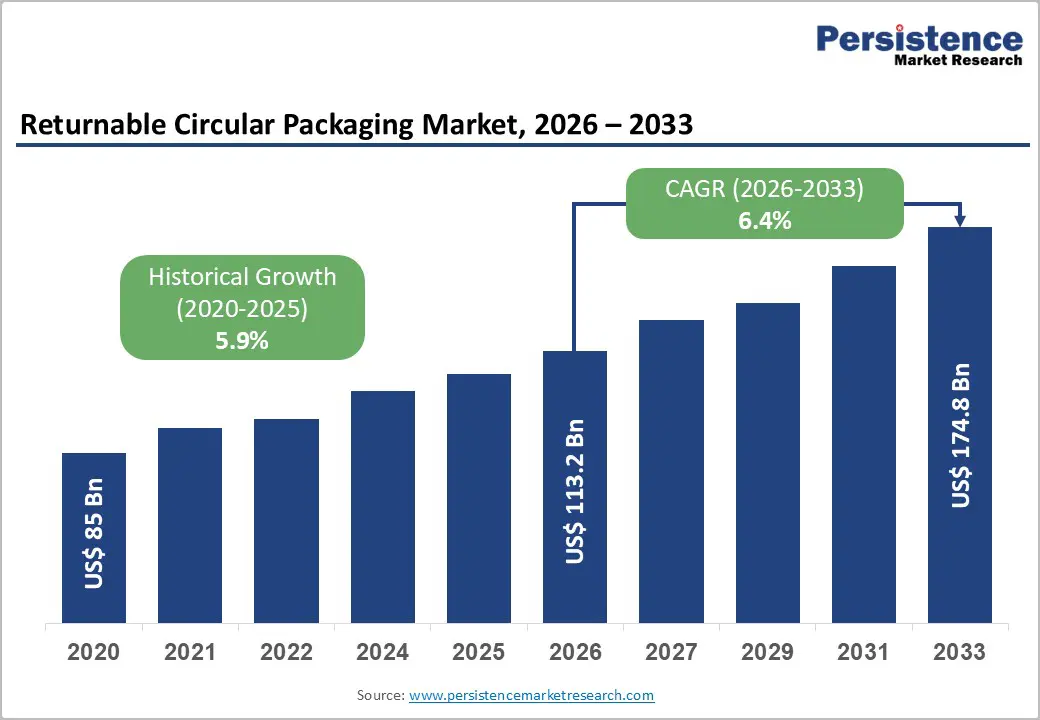
Returnable Circular Packaging Market
Europe to Capture Around 34.5% Market Share Backed by Strong Regulatory Mandates, Deposit Return Systems, and Established Pooling Infrastructure
LONDON, LONDON, UNITED KINGDOM, February 17, 2026 /EINPresswire.com/ --
The returnable circular packaging market is emerging as one of the most transformative segments within the global packaging industry. As sustainability becomes a core strategic priority for governments, corporations, and consumers alike, reusable and returnable packaging systems are gaining strong traction. These systems are designed to circulate within supply chains multiple times, reducing waste generation and lowering dependence on single use packaging materials.
According to the latest study by Persistence Market Research, the global returnable circular packaging market size is likely to be valued at US$113.2 billion in 2026 and is expected to reach US$174.8 billion by 2033, growing at a CAGR of 6.4% between 2026 and 2033, driven by regulatory pressure to reduce single use packaging, manufacturer commitments to reuse and refill systems, and measurable cost efficiency gains from pooled logistics models. This steady expansion highlights the increasing acceptance of circular economy principles across industries.
One Click to Access Your Free Sample Report : https://www.persistencemarketresearch.com/samples/36013
Key Drivers Accelerating Market Adoption
One of the primary growth drivers for the returnable circular packaging market is the rising regulatory pressure to reduce packaging waste. Governments across North America and Europe are introducing extended producer responsibility regulations, plastic reduction targets, and waste management reforms that encourage reuse over disposal. These regulatory measures are compelling manufacturers to rethink packaging strategies and adopt returnable models. Another major driver is corporate sustainability commitments. Large multinational brands are setting measurable targets for reducing carbon footprints and packaging waste. Returnable circular packaging systems enable companies to meet environmental goals while also generating cost savings over the long term. Pooled logistics models, in particular, help reduce per use packaging costs and improve supply chain efficiency.
Want Specific Data? Request Report Customization : https://www.persistencemarketresearch.com/request-customization/36013
Market Segmentation
The returnable circular packaging market is segmented by materials, packaging formats, end use industry, and region.
By Materials
•Rigid Plastics
•Metals
•Glass
•Others
By Packaging Formats
•Crates and Pallets
•Drums and Barrels
•Intermediate Bulk Containers IBCs
•Bottles and Jars
By End Use Industry
•Food and Beverages
•Chemicals and Industrial
•Healthcare and Pharmaceuticals
•Retail and E Commerce
By Region
•North America
•Europe
•East Asia
•South Asia and Oceania
•Latin America
•Middle East and Africa
Rigid plastics dominate the material segment due to their durability, lightweight properties, and ability to withstand repeated handling. In packaging formats, crates and pallets account for a significant share as they are widely used in pooled logistics and retail supply chains. The food and beverages sector represents the leading end use industry, driven by high turnover rates and structured distribution networks that support reuse systems.
Role of Food and Beverage Industry
The food and beverage sector plays a central role in the adoption of returnable circular packaging. Beverage crates, glass bottles, and reusable pallets have long been part of established return systems in many developed economies. The shift toward refillable packaging in supermarkets and quick service restaurants is further boosting demand. Additionally, the growth of organized retail and cold chain logistics has strengthened the use of reusable crates and containers. These packaging solutions reduce product damage, maintain hygiene standards, and improve inventory management efficiency.
Technological Innovations and Logistics Integration
Digital technologies are enhancing the effectiveness of circular packaging systems. Tracking technologies such as RFID and barcode scanning enable companies to monitor packaging assets throughout the supply chain. This visibility improves asset utilization rates and reduces loss or theft. Advanced cleaning and refurbishment technologies also support extended packaging lifecycles. Automated washing systems and quality inspection tools ensure that returnable packaging meets hygiene and safety standards, particularly in food and healthcare applications.
Regional Market Insights
Europe leads the returnable circular packaging market due to strong regulatory frameworks and early adoption of circular economy initiatives. Countries across the region have well established deposit return systems and producer responsibility regulations that promote reuse.
North America represents another significant market, driven by corporate sustainability strategies and organized retail networks. East Asia is witnessing rapid growth as manufacturing industries expand and governments introduce environmental reforms. South Asia and Oceania, Latin America, and the Middle East and Africa are gradually adopting returnable packaging models as supply chain infrastructure improves.
Competitive Landscape and Strategic Positioning
The returnable circular packaging market is characterized by a mix of global pooling service providers, packaging manufacturers, and logistics specialists. Companies are focusing on expanding pooling networks, enhancing product durability, and integrating digital tracking solutions to strengthen their market positions. Strategic collaborations between manufacturers and retailers are becoming more common, enabling efficient reverse logistics and higher asset circulation rates. Innovation in material science and modular packaging design is also shaping competitive differentiation.
Exclusive Data Awaits – Continue to Checkout : https://www.persistencemarketresearch.com/checkout/36013
Company Insights
Key players operating in the returnable circular packaging market include
✦ Brambles CHEP
✦ IFCO Systems
✦ Schoeller Allibert
✦ ORBIS Corporation
✦ Schütz GmbH
✦ Greif
✦ Loscam
✦ Mauser Packaging Solutions
✦ Rehrig Pacific
✦ Owens Illinois O I Glass
✦ Paccor Group
✦ Plastic Logic
✦ ALPLA Group
✦ K Hartwall
✦ RPC Group
✦ Cabka Group
✦ SSI Schaefer
✦ IPL Group
Future Outlook and Strategic Opportunities
The future of the returnable circular packaging market looks promising as sustainability moves from voluntary initiative to mandatory requirement. Businesses are increasingly recognizing the financial benefits of reusable systems, particularly in high volume distribution networks. Cost savings from reduced material consumption, lower waste disposal fees, and optimized logistics are making returnable packaging economically attractive. Furthermore, consumer awareness about environmental impact is encouraging brands to adopt visible and transparent circular packaging strategies. As technology integration improves and reverse logistics networks expand, the market is expected to witness consistent and resilient growth through 2033. In conclusion, the returnable circular packaging market is transitioning from niche sustainability solution to mainstream supply chain strategy. With strong regulatory support, corporate commitments, and measurable cost advantages, the industry is poised for sustained expansion in the coming years.
Explore More Related Reports :
CBD pouches market
Polyether Modified Polysiloxane Market
Persistence Market Research
Persistence Market Research Pvt Ltd
+1 646-878-6329
email us here
Visit us on social media:
LinkedIn
Instagram
YouTube
X
Legal Disclaimer:
EIN Presswire provides this news content "as is" without warranty of any kind. We do not accept any responsibility or liability for the accuracy, content, images, videos, licenses, completeness, legality, or reliability of the information contained in this article. If you have any complaints or copyright issues related to this article, kindly contact the author above.
