

Global Frozen Food Market to Reach USD 4.6 Billion by 2032 at 3.9% CAGR | Maximize Market Research
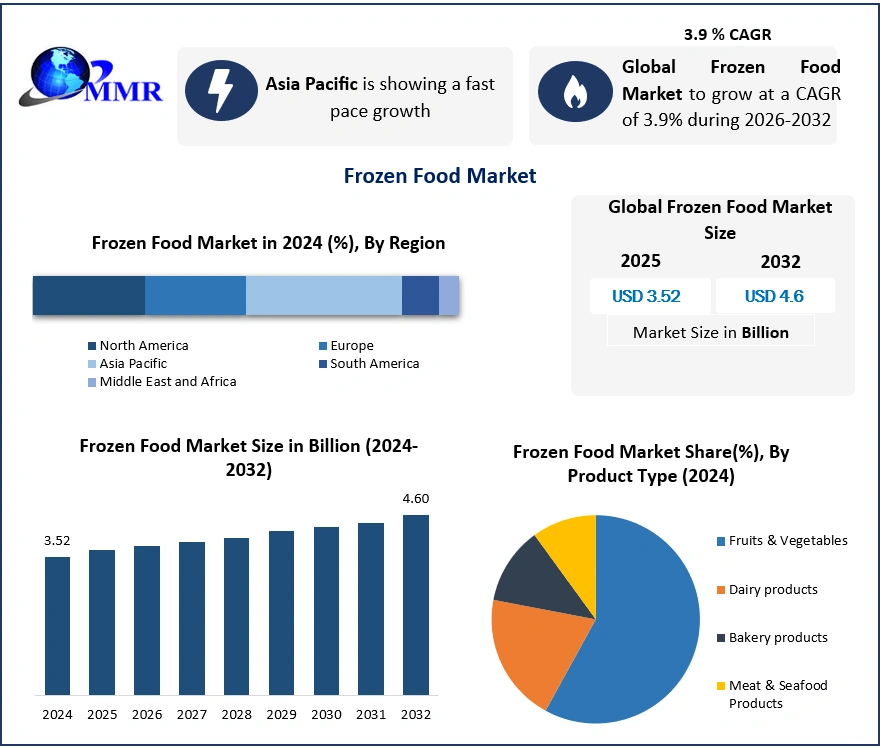
Frozen Food Market graph
Global Frozen Food Market was USD 3.52 Billion in 2025 and is projected to grow at 3.9% CAGR, reaching nearly USD 4.6 Billion by 2032.
“Consumers are not replacing fresh food with frozen; they are replacing unplanned meals with predictable nutrition solutions,” states Maximize Market Research analysts.”
NEW YORK, NY, UNITED STATES, February 16, 2026 /EINPresswire.com/ -- Global Frozen Food Market size was valued at USD 3.52 Billion in 2025 and is expected to grow at a CAGR of 3.9 % from 2025 to 2032, reaching nearly USD 4.6 Billion for the forecasted period.— Maximize Market Research
The industry demonstrates steady expansion supported by premiumization, protein-rich formulations, and expanding cold-chain infrastructure. Frozen Food Market growth is shifting toward value-led consumption driven by RTE adoption and retail digitization, while private-label competition reshapes pricing dynamics. The long-term Frozen Food Market forecast depends on processing innovation, supply reliability, and nutrition-focused product differentiation.
Get Full PDF Sample Copy of Report: (Including Full TOC, List of Tables & Figures, Chart) @ https://www.maximizemarketresearch.com/request-sample/11588/
What Is Really Driving Frozen Food Market Growth? Premiumization, Protein Density, and Digital Cold Chains
The category is experiencing margin-led premiumization driven by clean-label reformulation and ingredient transparency. Manufacturers are eliminating artificial preservatives and leveraging advanced flash-freezing to enhance nutrient retention and texture quality. This transition is expanding category demand particularly in North America and Western Europe, where premium SKUs deliver stronger value realization.
Protein-dense, keto-aligned, and plant-based innovations are accelerating category demand growth across urban retail and e-commerce channels. Fortified frozen vegetables, seafood, and meat alternatives are aligning with performance nutrition demand, increasing per-SKU velocity. This functional positioning is contributing to Frozen Food Market size expansion through higher replenishment frequency and premium pricing resilience.
AI-driven forecasting, IoT temperature monitoring, and automated cold storage systems are strengthening industry fundamentals. Companies are reducing spoilage volatility and optimizing logistics efficiency through predictive distribution platforms. Cold-chain modernization in Asia-Pacific and Latin America is improving penetration and reinforcing the long-term Frozen Food Market forecast.
Private-label expansion is reshaping the competitive landscape, particularly across Europe and North America. Retailers are launching premium private-label frozen portfolios, narrowing price differentials versus branded products. This dynamic is intensifying pricing pressure on mid-tier brands while influencing Frozen Food Market industry outlook through SKU rationalization and innovation-led differentiation.
Regionally, North America leads the regional consumption through premium SKU concentration and advanced cold-chain density, while Western Europe sustains value growth via private-label penetration and clean-label reformulation. Asia-Pacific drives volume-led Frozen Food Market growth, supported by urbanization and modern retail expansion, strengthening the long-term Frozen Food Market forecast.
Frozen Food Market Segmentation Analysis by Product, Type, Technology, and Distribution Channel
The market is structured across product, type, freezing technology, and distribution channel, establishing a logical hierarchy of demand and value concentration. Product categories — fruits & vegetables, frozen potatoes and French fries, dairy, bakery, meat & seafood, plant-based protein, RTE meals and pet food — define consumption behavior, while raw, half-cooked and RTE formats determine pricing tiers and margin spread. Individual Quick Freezing commands premium positioning versus blast and belt freezing due to superior texture retention, creating competitive differentiation. Retail channels, especially modern trade and online platforms, generate higher value realization, whereas food service drives volume stability. Future market growth is expected to concentrate in protein-rich and RTE segments supported by expanding cold-chain infrastructure.
By Product
Fruits & Vegetables
Frozen Fruits
Berries
Mango Chunks
Others
Vegetables
Cauliflower
Broccoli
Bell paper
Carrot
Beans
Mushroom
Avocado
Corn
Others
Frozen Potatoes
French Fries
Others
Dairy Products
Bakery Products
Proofed
Fully Baked
Meat & Seafood Products
Poultry
Red Meat
Fish & Seafood
Plant Based Protein
RTE Meals
Pet Food
Others
By Type
Raw Material
Half Cooked
RTE
By Freezing Technique
Individual Quick Freezing
Blast Freezing
Belt Freezing
By Distribution Channel
Food Service
Retail
Hypermarkets & Supermarkets
Convenience Stores
Online
Offline
Get Full PDF Sample Copy of Report: (Including Full TOC, List of Tables & Figures, Chart) @ https://www.maximizemarketresearch.com/request-sample/11588/
Frozen Food Market Demand Drivers: Convenience Shift, Cold-Chain Expansion, and Dietary Transformation
Busy Urban Lifestyles and Time-Saving Consumption
• Dual-income households growth
• Longer commuting hours
• Work-from-home meal reliance
• Demand for quick meal preparation
Food Waste Reduction and Shelf-Life Advantage
• Extended storage stability
• Portion control convenience
• Bulk purchase behavior
• Household inventory planning
Health-Oriented Dietary Preferences
• Balanced meal portioning demand
• Calorie-controlled meal options
• Vegetable intake convenience
• Nutrition-labeled product preference
Product Variety and Culinary Globalization
• International cuisine accessibility
• Ready-to-eat meal diversification
• Seasonal food year-round availability
• Premium ingredient inclusion
Cold-Chain and Retail Infrastructure Expansion
• Expansion of refrigerated logistics
• Modern retail freezer penetration
• Tier-II and Tier-III city availability
• Improved storage reliability
Digital Grocery and Rapid Delivery Adoption
• Online grocery ordering growth
• Scheduled meal purchasing
• Subscription meal planning
• Quick-commerce frozen delivery
Price Stability and Value Economics
• Protection from fresh food price volatility
• Bulk buying cost efficiency
• Consistent year-round pricing
• Reduced preparation labor cost
Foodservice and Institutional Consumption
• Restaurant kitchen efficiency
• Catering portion consistency
• Airline and hotel procurement
• Corporate cafeteria usage
Frozen Food Market Latest Industry Developments and Corporate Expansion Activities
On 14 February 2025, Nestlé S.A commissioned a new frozen ready-meal production line in Germany, increasing European capacity for portion-controlled meals and strengthening growth visibility across premium nutrition segments. On 10 June 2024, Conagra Brands launched a 20-gram protein Healthy Choice frozen bowl range in the United States, supporting market size expansion through higher-margin functional meal adoption. On 5 September 2024, McCain Foods partnered with a European logistics operator to deploy energy-efficient cold-storage warehouses, improving distribution efficiency and stabilizing market forecast reliability. On 21 November 2024, Ajinomoto Co., Inc. introduced plant-based gyoza across Japan and Southeast Asia, reinforcing market trends toward protein diversification and long-term market outlook strengthening.
Global Frozen Food Market Geographic Breakdown and Regional Industry Outlook
North America
North America leads the Frozen Food Market size supported by high freezer penetration, single-serve meal adoption, and mature foodservice procurement. Dense cold-chain networks and premium clean-label launches sustain stable market growth across retail channels.
Europe
Europe maintains significant market size driven by private-label dominance, structured procurement systems, and strict food safety standards. Mature retail infrastructure and portion-controlled ready-meal consumption reinforce steady Frozen Food Market industry outlook.
Asia-Pacific
Asia-Pacific records the fastest Frozen Food Market growth due to urbanization and expanding modern retail presence. Rising middle-income consumption, protein-rich diets, and improving cold-chain infrastructure strengthen the long-term Frozen Food Market forecast across regional economies.
Competitive Landscape
The competitive landscape remains moderately consolidated, led by multinational players such as Nestlé, Conagra Brands, General Mills, Tyson Foods, Kraft Heinz, McCain Foods, and Ajinomoto. These companies strengthen Frozen Food Market growth through diversified portfolios, private-label collaboration, and global cold-chain distribution, while regional manufacturers intensify pricing competition and niche category positioning.
Frozen Food Market, Major Key Players
Conagra Brands
General Mills
Tyson Foods
The Kraft Heinz Company
Bellisio Foods
J&J Snack Foods
Schwan’s Company
Rich Products Corporation
Maple Leaf Foods
McCain Foods
Nomad Foods
Nestlé S.A
Iceland Foods
Dr. Oetker
Associated British Foods
Vandemoortele
Ajinomoto Co., Inc.
Nichirei Corporation
Maruha Nichiro
Shishi He Deming Seafood Co. Ltd.
Omar International Pvt. Ltd.
Mother Dairy
Sanquan Food
OOB Organic
ITC Limited
Bon Appetit
BRF S.A
JBS Foods
Grupo Bimbo
Vida Foods
Get access to the full description of the report @ https://www.maximizemarketresearch.com/market-report/frozen-food-market-industry/11588/
FAQ’s
What is the market estimation of Frozen Food Market?
Ans: The Frozen Food Market size is estimated near USD 3.52 billion in 2025 and projected to reach approximately USD 4.6 billion by 2032, reflecting steady market growth driven by retail and foodservice expansion.
What factors are driving Frozen Food Market growth?
Ans: Frozen Food Market growth is driven by rising demand for convenient meals, extended shelf-life advantages, and increasing adoption of ready-to-eat products among urban households and working populations.
How does e-commerce influence the Frozen Food Market size?
Ans: Online grocery platforms improve accessibility and repeat purchasing frequency, expanding Frozen Food Market size through higher basket values, subscription ordering patterns, and rapid delivery infrastructure supporting temperature-sensitive product distribution.
What role does foodservice play in Frozen Food Market industry analysis?
Ans: Foodservice adoption ensures portion consistency and operational efficiency, making institutional procurement a reliable contributor to Frozen Food Market industry analysis and maintaining stable baseline demand across hospitality and catering sectors.
Analyst Perspective
The analyst indicates that Frozen Food Industry is transitioning from volume-led consumption toward value-centric growth anchored in premiumization, protein enrichment, and digitally managed cold-chains. Technology integration is elevating operational efficiency and raising entry barriers, favoring multinational producers with scale distribution and formulation capabilities, while mid-tier brands face margin compression from private-label expansion. Retail digitization is shifting bargaining power toward modern trade platforms and quick-commerce networks. However, energy-intensive cold storage costs, agricultural input volatility, and regulatory labeling standards remain key risks. Long-term industry outlook will depend on processing innovation, supply reliability, and nutrition-focused differentiation rather than pricing competition.
Related reports
Asia Pacific Frozen Food Market: https://www.maximizemarketresearch.com/market-report/asia-pacific-frozen-food-market/208039/
North America Frozen Food Market: https://www.maximizemarketresearch.com/market-report/north-america-frozen-food-market/208032/
South America Frozen Food Market: https://www.maximizemarketresearch.com/market-report/south-america-frozen-food-market/208018/
Europe Frozen Food Market: https://www.maximizemarketresearch.com/market-report/europe-frozen-food-market/199959/
Top Reports:
Needle Coke Market https://www.maximizemarketresearch.com/market-report/needle-coke-market/11668/
Restaurant Management Software Market https://www.maximizemarketresearch.com/market-report/global-restaurant-management-software-market/23421/
Global Duty-Free Liquor Market https://www.maximizemarketresearch.com/market-report/global-duty-free-liquor-market/94512/
Mushroom Packaging Market https://www.maximizemarketresearch.com/market-report/global-mushroom-packaging-market/24731/
Tortilla Market https://www.maximizemarketresearch.com/market-report/tortilla-market/127189/
About Maximize Market Research
Maximize Market Research is a leading global market research and business consulting firm delivering data-driven insights across the Global Frozen Food Market. Our Frozen Food Market industry analysis supports strategic decision-making by evaluating market size structure, Frozen Food Market growth dynamics, processing technologies, pricing architecture, channel expansion, and competitive positioning across the global frozen food value chain.
Domain Focus – Food & Beverages
Within the Food & Beverages domain, Maximize Market Research provides in-depth intelligence across the Global Frozen Food Market, including ready-to-eat formats, protein enrichment innovation, cold-chain infrastructure, packaging evolution, and omnichannel distribution strategies. Our expertise spans consumer demand analytics, regional consumption patterns, retail economics, and long-term Frozen Food Market forecast modeling for stakeholders.
Lumawant Godage
MAXIMIZE MARKET RESEARCH PVT. LTD.
+91 96073 65656
email us here
Visit us on social media:
LinkedIn
Instagram
Facebook
X
Legal Disclaimer:
EIN Presswire provides this news content "as is" without warranty of any kind. We do not accept any responsibility or liability for the accuracy, content, images, videos, licenses, completeness, legality, or reliability of the information contained in this article. If you have any complaints or copyright issues related to this article, kindly contact the author above.
