

Impact-Modified PCR Plastics for Packaging Market to Reach USD 2,880 Million by 2036 at 9.6% CAGR
Impact-Modified PCR Plastics for Packaging
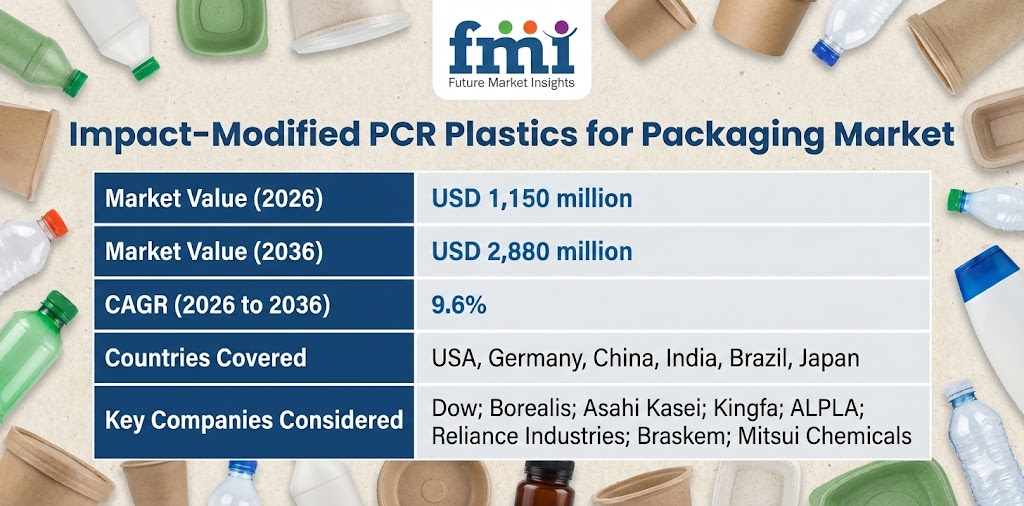
Global impact-modified PCR plastics for packaging market set to grow from USD 1,150 million in 2026 to USD 2,880 million by 2036.
NEWARK, DE, UNITED STATES, February 16, 2026 /EINPresswire.com/ -- The global impact-modified PCR plastics for packaging market is estimated at USD 1,150 million in 2026 and is projected to expand to USD 2,880 million by 2036, registering a CAGR of 9.6% over the forecast period. The market’s momentum reflects a clear shift from recycled-content compliance toward performance-driven material substitution in packaging applications. As converters and brand owners prioritize durability, process stability, and lifecycle performance economics, engineered PCR materials are becoming central to packaging redesign strategies.
Market snapshot:
Market size 2025: Not specified in the source; market enters forecast period at USD 1,150 million in 2026.
Market size 2035: Not explicitly stated; market progresses toward USD 2,880 million by 2036.
CAGR: 9.6% (2026–2036).
Leading product segments: Baking accessories (25.6%) and grilling & frying (45.1%).
Leading material type: Disposable materials account for 58.1% share.
Leading end use: Residential segment leads with 51.9% share.
Key growth regions: USA, Germany, China, India, Brazil, and Japan, with China and India showing the fastest expansion.
Top companies: Dow, Borealis, Asahi Kasei, Kingfa, ALPLA, Reliance Industries, Braskem, Mitsui Chemicals.
Request For Sample Report | Customize Report |purchase Full Report - https://www.futuremarketinsights.com/reports/sample/rep-gb-32005
Market Momentum
The impact-modified PCR plastics for packaging market follows a steady expansion path driven by engineering-led adoption. While detailed annual values are not specified, the trajectory shows a clear progression from early-stage adoption in 2025, acceleration through converter qualification cycles in 2028, wider penetration into rigid and semi-rigid formats by 2030, increasing integration into packaging redesign strategies by 2031, deeper performance-led substitution around 2033, and culmination at USD 2,880 million by 2035–2036 as impact-modified PCR materials become mainstream across packaging value chains. This momentum reflects growing understanding of lifecycle cost savings tied to durability, reduced breakage, and improved processing stability.
Segment Spotlight
Product Type
Grilling & frying accounts for 45.1%, reflecting strong demand for high-performance formats requiring improved impact resistance. In the broader market, rigid and semi-rigid packaging dominates demand with a 40% share due to strict mechanical performance requirements in bottles, containers, trays, caps, and closures. Impact modification enables these formats to withstand drop impacts and transport stresses while maintaining structural reliability.
Material Type
Disposable materials lead with a 58.1% share, reflecting strong industry focus on hygiene, operational efficiency, and reduced cleanup complexity. Within the market, PCR-PP and PCR-PE blends represent a dominant material strategy, allowing compounders to balance stiffness and toughness while compensating for feedstock variability inherent in recycling streams.
End Use
Residential applications account for 51.9%, supported by growing demand for durable home and household packaging solutions. In the packaging landscape, residential and consumer-use applications require materials capable of maintaining integrity across storage, handling, and repeated use scenarios, reinforcing demand for impact-modified PCR solutions.
Drivers, Opportunities, Trends, Challenges
Drivers:
The key driver is the incompatibility of unmodified PCR materials with modern packaging performance requirements. Faster packaging lines and logistics-heavy supply chains demand materials that maintain toughness, crack resistance, and process stability.
Opportunities:
Premium and performance-sensitive packaging segments, including cosmetic and specialty food applications, represent major opportunities. Impact-modified PCR materials enable downgauging and material reduction without compromising durability.
Trends:
Key trends include increased use of compatibilised PCR-PP/PCR-PE blends, rising demand for food- and cosmetic-grade compounds, adoption of high-throughput blending and pelletising systems, and growing emphasis on odour mitigation and aesthetic control.
Challenges:
Feedstock variability, contamination levels, and inconsistent molecular characteristics remain structural barriers. Additional challenges include achieving acceptable appearance and odour profiles, particularly in high-value consumer packaging.
Country Growth Outlook (CAGR)
China is projected to expand at a CAGR of 12.0%, reflecting strong momentum driven by scaling packaging production and increasing recycled feedstock availability. India leads global growth with a 12.8% CAGR, supported by expanding consumer markets and improving recycling systems that favor cost-efficient impact-modified PCR compounds. The United States is expected to grow at 8.8% CAGR, where large-scale automated packaging operations prioritize performance-qualified recycled materials.
Germany follows with a steady 8.2% CAGR, supported by regulatory clarity and a quality-driven approach to engineered PCR adoption. Brazil is forecast to grow at 8.4% CAGR, driven by gradual adoption in consumer packaging and improving access to recycled polyolefins. Japan records a more moderate 5.6% CAGR, reflecting its focus on niche, high-value packaging segments that demand strict aesthetic and performance standards.
Competitive Landscape
Competition in the impact-modified PCR plastics for packaging market is defined by formulation expertise, consistency control, and integration across sourcing, compounding, and modifier chemistry. Suppliers capable of delivering low-variability compounds that run efficiently on high-speed packaging lines hold a structural advantage. Performance qualification support, processing stability, and application-specific technical guidance increasingly differentiate leading participants, reinforcing market consolidation around engineering-driven players.
FAQ
How big is the impact-modified PCR plastics for packaging market in 2026?
The market is estimated at approximately USD 1.2 billion in 2026.
What will be the market size by 2036?
The market is projected to reach around USD 2.9 billion by 2036.
How fast will the market grow between 2026 and 2036?
The market is expected to expand at a CAGR of 9.6% over the forecast period.
What are the key product types?
Major product categories include rigid & semi-rigid packaging, food & beverage containers, flexible & rigid packaging, household & FMCG packaging, and consumer goods packaging.
Which impact-modified PCR type holds significant share?
Impact-modified PCR-PP/PCR-PE is projected to command a 45.0% share in 2026.
Why FMI: https://www.futuremarketinsights.com/why-fmi
Browse Related Insights
PCR Packaging for Pharma and OTC Market : https://www.futuremarketinsights.com/reports/pcr-packaging-for-pharma-and-otc-market
PCR Plastic Packaging Market : https://www.futuremarketinsights.com/reports/pcr-plastic-packaging-market
PCR Cosmetic Packaging Market : https://www.futuremarketinsights.com/reports/pcr-cosmetic-packaging-market
About Future Market Insights (FMI)
Future Market Insights, Inc. (FMI) is an ESOMAR-certified, ISO 9001:2015 market research and consulting organization, trusted by Fortune 500 clients and global enterprises. With operations in the U.S., UK, India, and Dubai, FMI provides data-backed insights and strategic intelligence across 30+ industries and 1200 markets worldwide.
Sudip Saha
Future Market Insights Inc.
+1 347-918-3531
email us here
Legal Disclaimer:
EIN Presswire provides this news content "as is" without warranty of any kind. We do not accept any responsibility or liability for the accuracy, content, images, videos, licenses, completeness, legality, or reliability of the information contained in this article. If you have any complaints or copyright issues related to this article, kindly contact the author above.
