

Dye-Free & Label-Free Packaging for PCR Optimization Market to Reach USD 3,540 Million by 2036 at 12.8% CAGR
Dye-Free & Label-Free Packaging for PCR Optimization
Global market expands as brands adopt dye-free, label-free packaging to improve food-grade PCR quality and recycling efficiency through 2036.
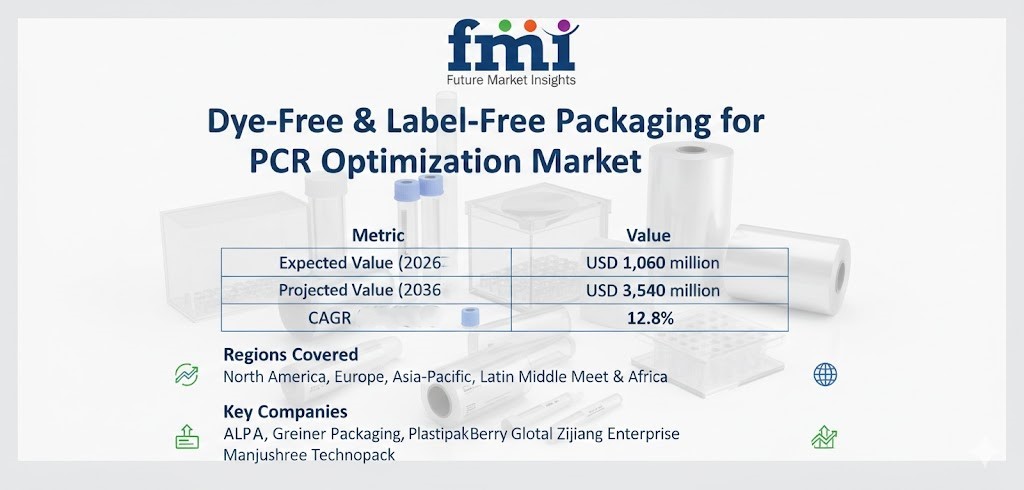
NEWARK, DE, UNITED STATES, February 16, 2026 /EINPresswire.com/ -- The global dye-free & label-free packaging for PCR optimization market is projected to grow from USD 1,060 million in 2026 to USD 3,540 million by 2036, registering a CAGR of 12.8%. The shift reflects how packaging design is increasingly shaped by recycling economics rather than sustainability messaging alone. As food-grade PCR supply becomes more strategic for brands, packaging is being specified from the design stage to eliminate dyes and labels that reduce recyclate value.
Market snapshot:
Market size (2025): Industry positioned ahead of a projected USD 1,060 million valuation in 2026
Market size (2035): Market trajectory supports expansion toward USD 3,540 million by 2036
CAGR (2026–2036): 12.8%
Leading product segments: baking accessories (25.6%) and grilling & frying (45.1%)
Leading material type: disposable packaging, holding 58.1% share
Leading end use: residential segment with 51.9% share
Key growth regions: United States, Germany, China, India, and Japan
Top companies: ALPLA Group, Greiner Packaging International GmbH, Plastipak Holdings, Inc., Berry Global Inc., Zijiang Enterprise Group Co., Ltd., Manjushree Technopack Ltd.
Request For Sample Report | Customize Report |purchase Full Report - https://www.futuremarketinsights.com/reports/sample/rep-gb-32003
Market Momentum
The dye-free & label-free packaging for PCR optimization market shows a steady expansion path supported by structural recycling changes. The market enters 2025 with strong upstream design adoption, advances to a projected USD 1,060 million in 2026, and continues scaling through 2028 as natural-color formats gain acceptance. By 2030, expanding food-grade PCR infrastructure accelerates demand, with 2031 marking greater implementation of mold-in embossing and digital marking systems. Momentum further strengthens in 2033 as brands align packaging design with bale-level pricing dynamics at recovery facilities, culminating in a projected USD 3,540 million valuation by 2035–2036, reflecting sustained long-term confidence in closed-loop recycling economics.
Segment Spotlight
Product Type
The grilling & frying segment leads with a 45.1% share, supported by demand for packaging formats that maintain material purity while enabling efficient high-volume recycling. The broader packaging landscape continues to move toward unpigmented containers and simplified structures, ensuring compatibility with bottle-to-bottle recycling streams and maximizing recyclate value.
Material Type
Disposable packaging accounts for a leading 58.1% share, reflecting strong demand for hygiene-focused and easy-cleanup solutions that also align with recycling efficiency. Natural polymer grades without added colorants are preferred because they deliver predictable processing properties and reduce contamination concerns within recycling facilities.
End Use
Residential applications dominate with a 51.9% share as home-kitchen and household consumption patterns continue to influence packaging design. Products such as milk, bottled water, and household liquids increasingly rely on natural-color containers where embossing or laser marking replaces traditional labels, ensuring functionality while maintaining recyclability.
Drivers, Opportunities, Trends, Challenges
Drivers: Material recovery facilities increasingly pay higher prices for natural-color, label-free bales. This pricing signal moves upstream to brand owners, encouraging packaging designs optimized for higher recycling value and cleaner polymer streams.
Opportunities: Retail private-label programs present a significant scaling opportunity. High-volume categories controlled by supermarket chains allow rapid adoption of dye-free and label-free packaging across multiple products, creating consistent market demand.
Trends: Technology improvements are reshaping decoration methods. Laser marking, surface texturing, and mold-in embossing allow brands to shift toward “brand by shape,” where packaging geometry and tactile design replace labels while preserving mono-material integrity.
Challenges: Transitioning away from established supply chains remains difficult. Existing ecosystems built around colored masterbatch and label manufacturing require converters to invest in new tooling and equipment, which may slow adoption among smaller players.
Country Growth Outlook (CAGR)
India leads the country outlook with a projected CAGR of 0%, supported by strong dairy-sector demand and laser-marked packaging formats.
China follows at 2% CAGR, driven by vertically integrated recycling and packaging systems that favor optimized, label-free designs.
The United States is expected to grow at 0% CAGR, supported by retailer-driven adoption and expanding food-grade PCR recycling capacity.
Germany records an 6% CAGR, shaped by deposit return systems and strong circular economy alignment that prioritizes unpigmented containers.
Brazil is forecast to expand at 4% CAGR, supported by bio-based polymer usage and cleaner recycling feedstock strategies.
Japan shows steady growth at 0% CAGR, driven by precision sorting technologies and demand for high-purity recycled materials.
Competitive Landscape
The competitive landscape of the dye-free & label-free packaging for PCR optimization market centers on integrating advanced decoration technologies with high-speed molding operations. Companies are differentiating themselves through mold-in embossing expertise, laser coding integration, and partnerships with recycling entities to validate real-world recyclability performance. Collaboration between converters and recycling companies ensures that packaging designs support sorting and washing efficiency, providing brand owners with practical assurance that packaging is optimized for closed-loop recycling rather than merely theoretically recyclable.
FAQ
What is the long-term growth outlook for the dye-free & label-free packaging market?
The market is projected to grow from USD 1,060 million in 2026 to USD 3,540 million by 2036, expanding at a CAGR of 12.8%.
How is the market expected to evolve structurally?
Packaging will shift from basic unbranded formats toward advanced designs using texture, shape, mold-in embossing, and laser marking for identity and compliance.
Which geographies hold strategic importance?
The United States and Germany are early adopters due to strong food-grade PCR demand, while China and India show high growth supported by expanding recycling infrastructure. Japan focuses on precision sorting and high-quality material recovery.
What will be the market size by 2036?
The dye-free & label-free packaging for PCR optimization market is expected to reach USD 3,540 million by 2036.
What global trends are shaping the market?
Key trends include the Natural HDPE standard in dairy packaging, digital watermarks as alternatives to labels, and RFID integration in molded packaging.
Why FMI: https://www.futuremarketinsights.com/why-fmi
Browse Related Insights
PCR Compliance Market : https://www.futuremarketinsights.com/reports/pcr-compliance-market
Mycobacterium Tuberculosis PCR Detection Kits Market: https://www.futuremarketinsights.com/reports/mycobacterium-tuberculosis-pcr-detection-kits-market
Industry-Integrated Data Networks for PCR Verification Market: https://www.futuremarketinsights.com/reports/industry-integrated-data-networks-for-pcr-verification-market
About Future Market Insights (FMI)
Future Market Insights, Inc. (FMI) is an ESOMAR-certified, ISO 9001:2015 market research and consulting organization, trusted by Fortune 500 clients and global enterprises. With operations in the U.S., UK, India, and Dubai, FMI provides data-backed insights and strategic intelligence across 30+ industries and 1200 markets worldwide.
Sudip Saha
Future Market Insights Inc.
+1 347-918-3531
email us here
Legal Disclaimer:
EIN Presswire provides this news content "as is" without warranty of any kind. We do not accept any responsibility or liability for the accuracy, content, images, videos, licenses, completeness, legality, or reliability of the information contained in this article. If you have any complaints or copyright issues related to this article, kindly contact the author above.
