

Textile Coating Market to Reach US$ 6.8 Bn by 2033 Driven by Rising Demand for Functional and Protective Textiles
textile coating market
Asia Pacific leads with 47.3% share driven by strong textile manufacturing base and rapid infrastructure expansion in China and India
LONDON, LONDON, UNITED KINGDOM, February 12, 2026 /EINPresswire.com/ -- The textile coating market is witnessing steady expansion as industries increasingly demand high performance fabrics with enhanced durability, resistance, and safety features. Textile coatings are specialized polymer based layers applied to fabrics to improve properties such as water resistance, flame retardancy, chemical protection, and abrasion strength. These coatings play a critical role in transportation, industrial manufacturing, construction, and protective clothing applications where performance and safety standards are paramount.
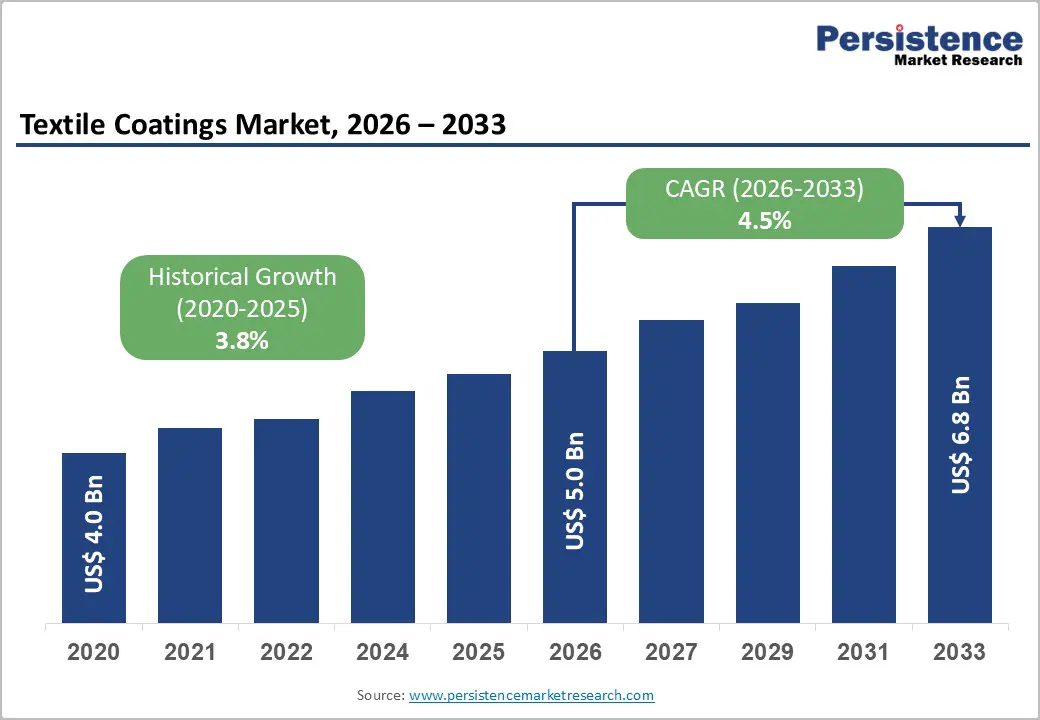
According to the latest study by Persistence Market Research, the global textile coating market size is supposed to be valued at US$ 5.0 Bn in 2026 and is projected to reach US$ 6.8 Bn by 2033, growing at a CAGR of 4.5 percent between 2026 and 2033. This moderate yet stable growth reflects increasing adoption of functional textiles across diverse end use industries and rising investments in advanced coating technologies.
Explore Full Report Quality – Free Sample Inside : https://www.persistencemarketresearch.com/samples/34786
Rising Demand for Functional and Performance Textiles
One of the primary growth drivers of the textile coating market is the increasing demand for functional textiles. Modern industries require fabrics that offer more than aesthetic appeal. Performance attributes such as water repellency, flame resistance, antimicrobial protection, and UV stability are becoming essential. Coated textiles are widely used in automotive interiors, airbags, seat belts, and convertible tops due to their durability and resistance to environmental stress. In industrial settings, coated fabrics provide protection against chemicals, heat, and mechanical wear. As safety regulations become stricter, manufacturers are compelled to use coated textiles that comply with performance and compliance standards.
Growth in Protective Clothing Applications
Protective clothing represents a major application segment driving the textile coating market. Manufacturing facilities, oil and gas operations, chemical plants, and healthcare environments require garments that protect workers from hazardous conditions. Coatings enhance the protective characteristics of textiles, enabling them to resist flames, liquids, and contaminants. The rising focus on worker safety, particularly in emerging economies, is boosting demand for advanced protective fabrics. Governments and regulatory authorities are enforcing stricter workplace safety norms, encouraging industries to adopt high quality coated textiles.
Expansion of Transportation and Automotive Sector
The transportation sector is another key contributor to market expansion. Coated textiles are extensively used in automotive interiors, marine covers, aircraft seating, and rail upholstery. These materials must withstand mechanical stress, exposure to sunlight, and varying climatic conditions. The growth of the global automotive industry, coupled with rising demand for lightweight and durable materials, supports the steady adoption of textile coatings. Manufacturers are focusing on polymer based solutions that enhance flexibility while maintaining structural integrity.
Technological Advancements in Polymer Based Coatings
Innovation in polymer chemistry is significantly influencing the textile coating market. Advanced thermoplastic and thermoset coatings offer improved adhesion, flexibility, and environmental resistance. Manufacturers are developing eco friendly formulations that reduce volatile emissions and align with sustainability goals. Technological advancements have also improved coating application methods, resulting in better uniformity and reduced material waste. These innovations help manufacturers optimize production efficiency while meeting stringent environmental regulations.
Increasing Focus on Sustainability and Eco Friendly Solutions
Sustainability has emerged as a central theme in the textile coating industry. Consumers and businesses alike are seeking environmentally responsible products. This shift is encouraging the development of water based coatings and bio derived polymers that minimize ecological impact. Rising consumer awareness regarding sustainable and eco friendly coating formulations, combined with regulatory pressure in developed markets, is accelerating the transition toward greener alternatives. Companies investing in sustainable product portfolios are likely to gain competitive advantages in the long term.
Get a Customized Market View in One Click : https://www.persistencemarketresearch.com/request-customization/34786
Market Segmentation
By Polymer Type
Thermoplastic
Thermosets
Other
By Industry
Transportation
Construction & Building
Protective Clothing
Industrial
Medical
Other
By Region
North America
Europe
East Asia
South Asia and Oceania
Latin America
Middle East and Africa
Regional Growth Trends
Asia Pacific, particularly East Asia and South Asia and Oceania, is emerging as a prominent region in the textile coating market. Rapid industrialization, growth in automotive production, and rising safety awareness contribute to regional expansion. Investments in textile manufacturing infrastructure further support market growth.
North America and Europe remain mature markets characterized by strong regulatory frameworks and advanced technological capabilities. Companies in these regions focus heavily on research and development to create sustainable and high performance coating solutions.
Latin America and the Middle East and Africa present moderate growth opportunities driven by infrastructure development and increasing industrial activities.
Don’t Miss Out – Buy the Report Now : https://www.persistencemarketresearch.com/checkout/34786
Company Insights
The textile coating market features several global and regional players striving to enhance their market presence through innovation and strategic partnerships. Key companies operating in the market include:
✦ Covestro AG
✦ Solvay SA
✦ BASF SE
✦ Sumitomo Chemical Co., Ltd.
✦ The Lubrizol Corporation
✦ Arkema
✦ Clariant
✦ Huntsman International LLC
✦ OMNOVA North America Inc.
✦ Tanatex Chemicals B.V.
✦ Formulated Polymer Products Ltd.
These companies are focusing on expanding production capacity, launching sustainable product lines, and investing in research initiatives to meet evolving customer demands.
Future Outlook
The textile coating market is poised for stable growth through 2033, supported by increasing demand for high performance fabrics across transportation, industrial, and protective clothing sectors. Technological innovation, sustainability initiatives, and expanding applications in emerging economies will continue to shape the market landscape. As industries prioritize safety, durability, and environmental responsibility, textile coatings will remain a vital component of advanced textile manufacturing. Companies that emphasize innovation and sustainability are expected to maintain a competitive edge in the evolving global market.
Explore the More Related Reports :
Panel Level Packaging Market
Hot Fill Packaging Market
Persistence Market Research
Persistence Market Research Pvt Ltd
+1 646-878-6329
email us here
Visit us on social media:
LinkedIn
Instagram
YouTube
X
Legal Disclaimer:
EIN Presswire provides this news content "as is" without warranty of any kind. We do not accept any responsibility or liability for the accuracy, content, images, videos, licenses, completeness, legality, or reliability of the information contained in this article. If you have any complaints or copyright issues related to this article, kindly contact the author above.
