

Hydro Fiber Pads Market Set for Robust Expansion as Advanced Wound Care Adoption Accelerates
Hydro Fiber Pads Market
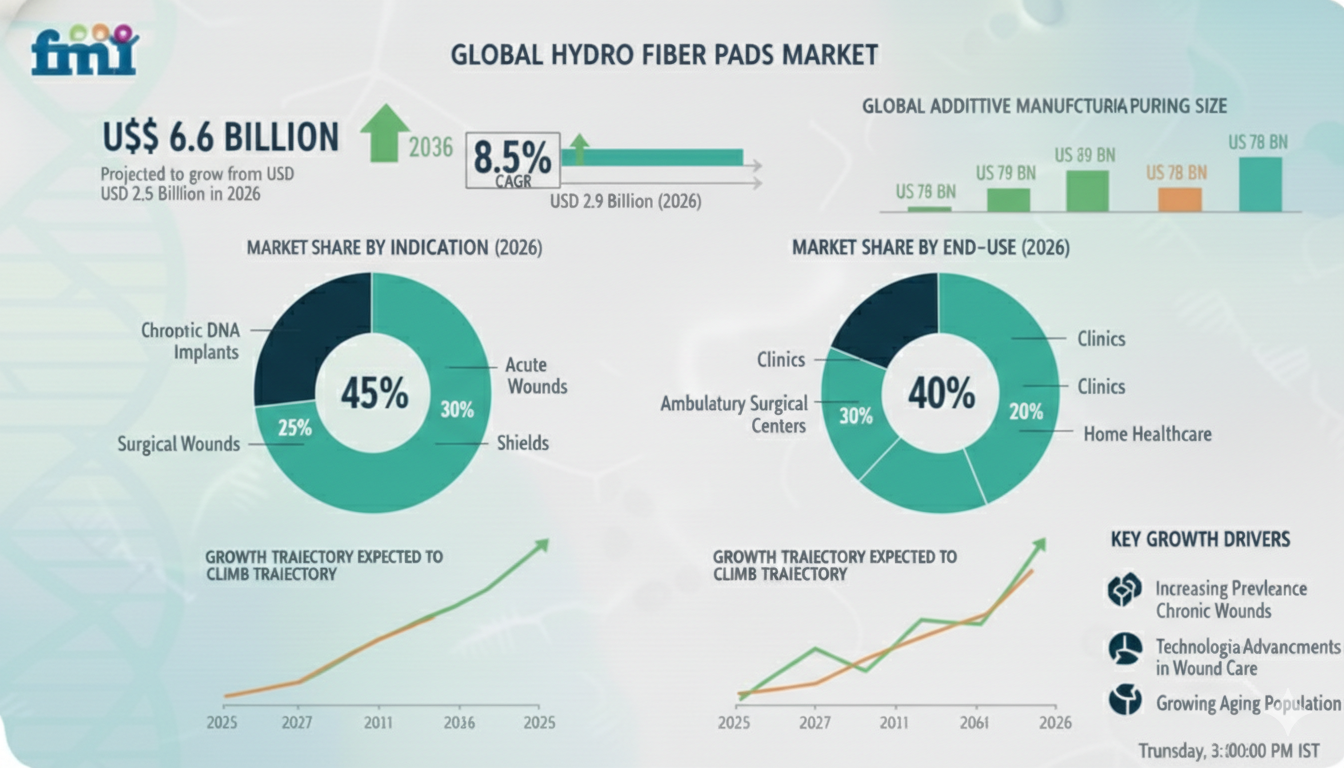
MD, UNITED STATES, February 10, 2026 /EINPresswire.com/ -- The global Hydro Fiber Pads market is poised for sustained expansion over the next decade, with Future Market Insights (FMI) forecasting growth from USD 2.9 billion in 2026 to USD 6.6 billion by 2036, reflecting a robust 8.5% compound annual growth rate (CAGR). This growth trajectory is being driven by structural changes in wound care delivery, including the shift from acute hospital settings to post-acute and home care, as well as the increasing role of procurement-led standardization in clinical decision-making.
According to FMI, advanced wound care is undergoing a fundamental transformation. Integrated care pathways are prioritizing continuity from hospital to clinic to home, placing greater emphasis on dressings that can be standardized across multiple care settings. Mölnlycke’s 2024 integrated annual report highlights that wound care is increasingly migrating from acute environments to post-acute and home care, with procurement playing a more central role in product selection and utilization governance. These trends structurally favor hydro fiber pads, which offer predictable exudate management, protocol compatibility, and ease of standardization across care transitions.
Competitive Investment and Portfolio Realignment Reinforce Market Momentum
Leading wound care companies are aligning their strategies to capitalize on chronic care growth and advanced dressing demand. ConvaTec’s annual results for the year ended December 31, 2024, underscore this pivot, with wound care and chronic care positioned as execution priorities within a broader profitable growth strategy. CEO Karim Bitar noted that ConvaTec’s FY2024 performance reflects a successful transition to broad-based, sustainable, and profitable growth, reinforcing continued investment in advanced dressing platforms such as hydro fiber technologies.
Market Outlook: Protocol-Driven Growth and Standardization
FMI’s forecasting model links hydro fiber pad demand to chronic wound case volumes, hospital procurement conversion rates, and channel-level replenishment patterns across regulated care settings. Analysts anticipate that purchasing behavior will increasingly tighten around protocol-led standardization, where suppliers must demonstrate continuity of care across acute, post-acute, and home environments.
Segment Leadership: Silver Variants and Chronic Wound Applications
By product type, silver impregnated hydro fiber pads are projected to lead the market with a 47.3% share in 2026. This dominance reflects institutional preference for dressings aligned with infection management protocols, particularly in high-exudate wounds. Rather than being driven by marketing claims, this leadership is shaped by procurement logic. Silver variants are easier to justify in formulary committees when infection prevention is framed as a cost-avoidance strategy, especially in settings where antimicrobial stewardship and pathway compliance are tightly monitored.
From an application perspective, chronic wounds are expected to account for the largest share, representing 65.0% of total market demand in 2026. This is driven by the long-duration nature of chronic wound episodes, including diabetic foot ulcers, pressure ulcers, and venous leg ulcers. These conditions require repeat dressing changes over multi-week or multi-month periods, making hydro fiber pads particularly well-suited for protocolized, long-term care pathways.
End Users and Distribution: Hospitals and Hospital Pharmacies Lead
Hospitals are projected to remain the largest end-user segment, accounting for 51.5% of market share in 2026, while hospital pharmacies are expected to dominate distribution with a 43.8% share. This reflects the central role of formulary-controlled initiation of advanced wound dressings and the importance of central inventory governance. As patients transition from inpatient to outpatient and home care, hospitals and their affiliated pharmacies play a critical role in ensuring continuity of dressing protocols and replenishment patterns.
Regional Growth: China and India Lead Expansion
FMI identifies China as the fastest-growing market, with an expected 11.7% CAGR from 2026 to 2036. This growth is driven by Diagnosis-Related Group (DRG) and Diagnosis-Intervention Packet (DIP) payment reforms, which are intensifying hospital cost governance and accelerating protocol-led standardization of wound care purchasing. These reforms strengthen procurement influence and favor hydro fiber systems that can be standardized across departments and extended into discharge plans.
Other key growth markets include Germany (10.0% CAGR), Brazil (9.1%), the United States (8.3%), the United Kingdom (7.4%), and Japan (6.5%). Germany’s aging demographics, Brazil’s ANVISA-led regulatory framework, and the U.S.’s sustained chronic disease burden are all contributing to steady adoption of hydro fiber pads across institutional and post-acute settings.
Competitive Landscape and Recent Developments
The hydro fiber pads market is characterized by competition among global advanced wound care platform companies, including ConvaTec Group, Smith+Nephew, Mölnlycke Health Care, Paul Hartmann AG, Coloplast, B. Braun Melsungen, Medline Industries, Integra LifeSciences, Derma Sciences, and Solventum. These companies leverage broad portfolios, global hospital contracts, and sustained innovation pipelines to secure formulary positions and tender wins.
Request for Sample Report | Customize Report |purchase Full Report -https://www.futuremarketinsights.com/reports/sample/rep-gb-31908
Market Definition and Scope
Hydro fiber pads are gelling fiber wound dressings designed to absorb exudate and maintain a moist wound environment. They are used across chronic wounds, surgical wounds, burns, traumatic wounds, and pressure ulcers in hospitals, clinics, and supervised home care settings. The market tracks hydro fiber-format pads as a distinct advanced dressing category within broader wound care portfolios, where procurement, protocol fit, and continuity of care drive purchasing decisions.
Explore More Related Studies Published by FMI Research:
ePTFE Vascular Prosthesis Market- https://www.futuremarketinsights.com/reports/eptfe-vascular-prosthesis-market
Elderly Safety Monitoring Device Market- https://www.futuremarketinsights.com/reports/elderly-safety-monitoring-device-market
Drug-Gene Interaction Panels Market- https://www.futuremarketinsights.com/reports/drug-gene-interaction-panels-market
Dental Wounds Treatment Market- https://www.futuremarketinsights.com/reports/dental-wounds-treatment-market
CRDMO Market- https://www.futuremarketinsights.com/reports/crdmo-market
About Future Market Insights (FMI)
Future Market Insights, Inc. (FMI) is an ESOMAR-certified, ISO 9001:2015 market research and consulting organization, trusted by Fortune 500 clients and global enterprises. With operations in the U.S., UK, India, and Dubai, FMI provides data-backed insights and strategic intelligence across 30+ industries and 1200 markets worldwide.
Why FMI: Decisions that Change Outcomes- https://www.futuremarketinsights.com/why-fmi
Contact Us:
Future Market Insights Inc.
Christiana Corporate, 200 Continental Drive,
Suite 401, Newark, Delaware – 19713, USA
T: +1-347-918-3531
Website: https://www.futuremarketinsights.com
LinkedIn| Twitter| Blogs | YouTube
Have a specific Requirements and Need Assistant on Report Pricing or Limited Budget please contact us - sales@futuremarketinsights.com
Sudip Saha
Future Market Insights Inc.
+1 347-918-3531
email us here
Legal Disclaimer:
EIN Presswire provides this news content "as is" without warranty of any kind. We do not accept any responsibility or liability for the accuracy, content, images, videos, licenses, completeness, legality, or reliability of the information contained in this article. If you have any complaints or copyright issues related to this article, kindly contact the author above.
