

Microscopy Devices Market Size will Estimated to Reach to US$ 18.7 Bn by 2036 at a CAGR of 5.5% - TMR Report
Microscopy Devices Market
Microscopy Devices Market Outlook 2036: Advancing Scientific Discovery, Clinical Diagnostics, and Industrial Quality Control
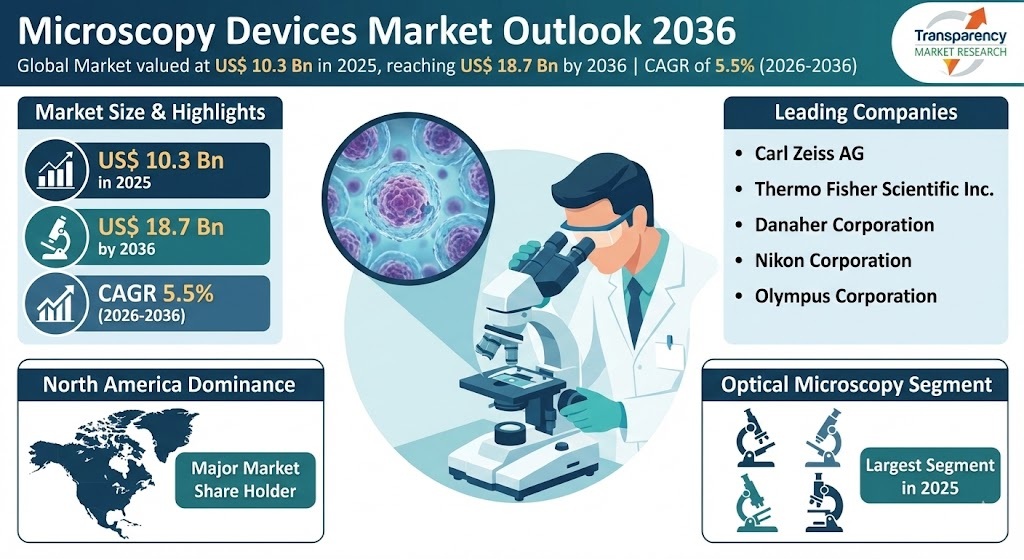
The global microscopy devices market size was valued at US$ 10.3 Bn in 2025 and is projected to reach US$ 18.7 Bn by 2036, expanding at a CAGR of 5.5% from 2026 to 2036. ”
WILMINGTON, DE, UNITED STATES, February 10, 2026 /EINPresswire.com/ -- The global microscopy devices market was valued at US$ 10.3 billion in 2025 and is projected to reach US$ 18.7 billion by 2036, expanding at a compound annual growth rate (CAGR) of 5.5% from 2026 to 2036. This steady growth is driven by rapid advancements in imaging technologies, rising investments in life sciences research, increasing demand for early disease diagnosis, and expanding applications across healthcare, biotechnology, materials science, and industrial inspection.— Transparency Market Research
Microscopy devices are fundamental tools in modern science and medicine, enabling visualization of structures at cellular, subcellular, and nanoscale levels. Continuous innovation in optical, electron, and scanning probe microscopy is transforming how researchers, clinicians, and manufacturers analyze biological samples, materials, and complex surfaces.
👉 Get your sample market research report copy today@ https://www.transparencymarketresearch.com/sample/sample.php?flag=S&rep_id=226
Market Overview
Microscopy devices encompass a wide range of instruments, including optical microscopes, electron microscopes, scanning probe microscopes, fluorescence microscopes, and digital microscopy systems. These devices are used extensively in academic research, clinical diagnostics, pharmaceutical development, semiconductor manufacturing, and quality assurance processes.
The market has evolved significantly over the past decade, moving beyond traditional optical microscopes toward high-resolution, automated, and digitally integrated systems. Modern microscopy devices now combine advanced optics, high-speed imaging, artificial intelligence (AI), and data analytics, enabling faster, more accurate, and reproducible results.
Growing emphasis on precision medicine, nanotechnology, and advanced materials research continues to expand the scope and importance of microscopy solutions worldwide.
Key Growth Drivers
One of the primary drivers of the microscopy devices market is the rapid expansion of life sciences and biomedical research. Increased funding for genomics, proteomics, cell biology, and neuroscience research is fueling demand for high-performance microscopy systems capable of delivering detailed structural and functional insights.
The rising burden of chronic and infectious diseases is also contributing significantly to market growth. Microscopy plays a crucial role in pathology, microbiology, and clinical diagnostics, supporting disease detection, tissue analysis, and drug response evaluation. Hospitals and diagnostic laboratories are increasingly adopting advanced microscopy devices to improve diagnostic accuracy and workflow efficiency.
Another major growth driver is the growing semiconductor and electronics industry. Microscopy devices are essential for inspecting microchips, circuit boards, and nanostructures during manufacturing and failure analysis. As electronic components continue to shrink in size, the need for high-resolution imaging tools is becoming more critical.
Technological Advancements
Technological innovation remains at the core of market expansion. Advances in electron microscopy, such as cryo-electron microscopy (cryo-EM), have revolutionized structural biology by enabling visualization of biomolecules at near-atomic resolution. These breakthroughs have significantly increased adoption in pharmaceutical research and drug discovery.
In optical microscopy, innovations in super-resolution microscopy, confocal microscopy, and fluorescence imaging are allowing researchers to overcome traditional resolution limits. Integration of AI-powered image analysis is further enhancing data interpretation, reducing manual errors, and accelerating research timelines.
Digital microscopy and automated imaging platforms are also gaining popularity. These systems enable remote viewing, data sharing, and seamless integration with laboratory information management systems (LIMS), making them ideal for large research institutions and industrial environments.
Application Analysis
The life sciences and healthcare segment represents the largest share of the microscopy devices market. Applications include cell biology, histopathology, microbiology, oncology research, and clinical diagnostics. Increasing use of microscopy in personalized medicine and translational research is further strengthening this segment.
The materials science and nanotechnology segment is another key contributor. Microscopy devices are widely used to study metals, polymers, ceramics, and nanomaterials, supporting research in aerospace, automotive, energy, and construction industries.
Industrial applications, including quality control, failure analysis, and process optimization, are also expanding rapidly. Manufacturers rely on microscopy systems to detect defects, ensure compliance with standards, and improve product reliability.
Academic and research institutions continue to be major end users, supported by government funding and collaborations with private industry.
Key Developments
In July 2025, Thermo Fisher Scientific announced the launch of two new electron microscopes that will be unveiled at Microscopy & Microanalysis (M&M) in Salt Lake City, Utah, U.S., each contributing to the democratisation of research in the sciences. The Thermo Scientific Scios 3 is a focused ion beam (FIB) scanning electron microscope (SEM) with automation to dramatically improve site-specific quality control.
In July 2025, Leica Microsystems, launched ARveo 8x, a hybrid surgical microscope for neurosurgery, spine, and plastic reconstructive procedures. It blends ‘high-quality Leica optics’ with 3D visualisation technologies and digital data integration capabilities.
👉 To buy this comprehensive market research report, click here to inquire@ https://www.transparencymarketresearch.com/checkout.php?rep_id=226<ype=S
Regional Market Insights
North America holds a dominant position in the global microscopy devices market, supported by strong research infrastructure, high healthcare spending, and the presence of leading market players. The United States remains a major hub for biomedical research, pharmaceutical development, and advanced manufacturing.
Europe follows closely, driven by well-established academic institutions, government-funded research programs, and increasing adoption of advanced diagnostic technologies. Countries such as Germany, the UK, France, and Switzerland play a key role in market growth.
The Asia-Pacific region is expected to witness the fastest growth during the forecast period. Rapid expansion of biotechnology and pharmaceutical industries, increasing healthcare investments, and growing research activities in countries such as China, Japan, South Korea, and India are fueling demand for microscopy devices. Rising focus on domestic manufacturing and technological self-reliance further supports market expansion in this region.
Competitive Landscape
The microscopy devices market is highly competitive and innovation-driven. Leading companies focus on product development, technological differentiation, and strategic partnerships to strengthen their market presence. Investments in research and development are aimed at improving resolution, automation, and user-friendliness.
Olympus Corporation
Leica Microsystems
Carl Zeiss AG
Bruker
Nikon Corporation
Thermo Fisher Scientific Inc.
Hitachi, Ltd
JEOL Ltd
KEYENCE CORPORATION.
Nanosurf
EVIDENT
Oxford Instruments
Agilent Technologies, Inc
Motic Microscopes
Other Prominent Players
Manufacturers are increasingly offering customized and application-specific solutions to meet the diverse needs of researchers and industrial users. After-sales services, training, and software upgrades also play a crucial role in customer retention and brand loyalty.
Collaborations between microscope manufacturers, research institutions, and pharmaceutical companies are accelerating innovation and expanding application areas.
Challenges and Market Restraints
Despite strong growth prospects, the microscopy devices market faces several challenges. High equipment costs and maintenance expenses can limit adoption, particularly among small laboratories and institutions in developing regions.
The complexity of advanced microscopy systems requires skilled professionals for operation and data interpretation. Lack of trained personnel may hinder adoption in certain markets. Additionally, long replacement cycles for microscopy equipment can slow revenue growth for manufacturers.
However, increasing availability of modular systems, financing options, and training programs is gradually addressing these challenges.
Future Market Outlook
The global microscopy devices market is expected to experience sustained growth through 2036, supported by continuous technological advancements and expanding application areas. Integration of AI, machine learning, and automation will further enhance imaging capabilities and workflow efficiency.
Growing demand for high-resolution imaging in drug discovery, precision diagnostics, and nanotechnology research will continue to drive innovation. As scientific research becomes more interdisciplinary and data-intensive, microscopy devices will remain indispensable tools across multiple industries.
FAQs – Microscopy Devices Market
Q1. What is the projected market size by 2036?
The global microscopy devices market is expected to reach US$ 18.7 billion by 2036.
Q2. What is the growth rate of the market?
The market is projected to grow at a CAGR of 5.5% from 2026 to 2036.
Q3. Which segment dominates the market?
The life sciences and healthcare segment holds the largest market share.
Q4. What are the key technologies driving growth?
Electron microscopy, super-resolution microscopy, digital imaging, and AI-based image analysis are key growth drivers.
Q5. Which region is expected to grow the fastest?
The Asia-Pacific region is anticipated to register the fastest growth during the forecast period.
More Trending Research Reports-
Anesthesia Drugs Market: https://www.transparencymarketresearch.com/anesthesia-drugs-market.html
Microgreens Market: https://www.transparencymarketresearch.com/microgreens-market.html
Atil Chaudhari
Transparency Market Research Inc.
+ +1 518-618-1030
email us here
Legal Disclaimer:
EIN Presswire provides this news content "as is" without warranty of any kind. We do not accept any responsibility or liability for the accuracy, content, images, videos, licenses, completeness, legality, or reliability of the information contained in this article. If you have any complaints or copyright issues related to this article, kindly contact the author above.
