

Anabolic Steroids Market to Reach US$ 156.3 Bn by 2033 | Persistence Market Research
Anabolic Steroids Market
The anabolic steroids market is expanding due to growing medical use for hormone therapy and muscle-wasting disorders, alongside rising demand from fitness .
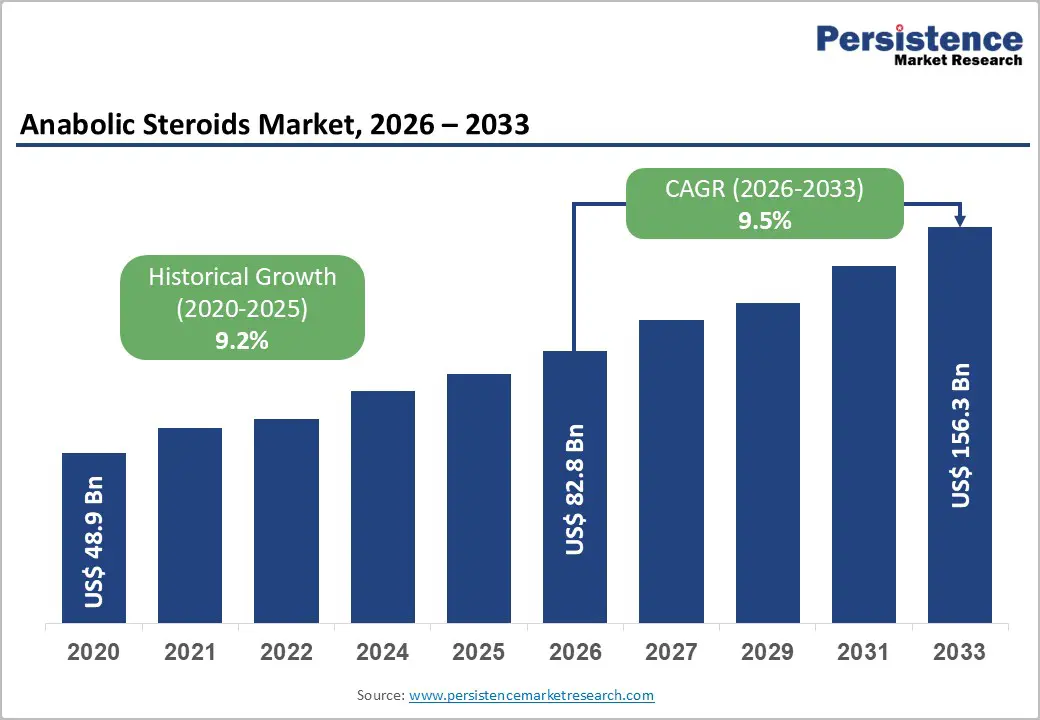
LONDON, UNITED KINGDOM, February 10, 2026 /EINPresswire.com/ -- The global anabolic steroids market is expected to reach a value of US$ 82.8 billion in 2026 and grow to US$ 156.3 billion by 2033, registering a compound annual growth rate (CAGR) of 9.5% from 2026 to 2033. Key factors driving this market expansion include rising clinical diagnoses of testosterone deficiency, growing demand for performance enhancement in fitness, and the increasing adoption of anabolic steroids for treating muscle-wasting disorders.
Download Your Free Sample & Explore Key Insights: https://www.persistencemarketresearch.com/samples/29509
Market Overview
Anabolic steroids are synthetic substances similar to male sex hormones like testosterone. They are commonly used for medical purposes, particularly in hormone replacement therapies for conditions like testosterone deficiency, muscle-wasting disorders, and certain forms of anemia. Over the past decade, the global market for anabolic steroids has witnessed significant growth due to advancements in medical treatments, expanding patient bases, and the increasing use of these compounds in non-medical settings such as bodybuilding and fitness.
Growth Drivers and Opportunities
The rising prevalence of testosterone deficiency among aging populations is a significant market driver. Studies indicate that about 20–25% of men over the age of 60 suffer from clinically significant hypogonadism. Furthermore, muscle-wasting disorders, such as sarcopenia, affect over 10% of adults above the age of 65. These conditions have driven the increased use of anabolic steroids in regulated healthcare systems, with physicians increasingly prescribing these therapies to address both testosterone replacement and muscle support.
Segment Analysis
End-Use Applications
Medical applications are expected to dominate the anabolic steroids market, contributing around 55% of the global market share by 2026. The use of anabolic steroids for hormone replacement therapies (HRT) and for treating muscle-wasting disorders is a major factor in this dominance. Rising awareness among healthcare providers and improved diagnostic protocols are also contributing to the market's growth in the medical sector.
Non-medical use, primarily for performance enhancement in bodybuilding and fitness, also represents a significant portion of the market. Despite facing legal and ethical scrutiny, the demand for anabolic steroids remains strong, particularly in emerging economies where regulatory enforcement is less stringent. This non-medical segment is projected to grow at an 11% CAGR from 2026 to 2033, driven by the expansion of fitness culture and increasing participation in recreational and competitive sports.
Compounds
Testosterone-based anabolic steroids are projected to account for nearly 48% of the market share in 2026, owing to their strong clinical validation and first-line use in the treatment of testosterone deficiency. These compounds, available in injectable, gel, and patch forms, continue to be the preferred treatment option in endocrinology. Innovations in long-acting injectable formulations have improved pharmacokinetic consistency and patient adherence, making testosterone-based compounds the most widely prescribed anabolic steroid.
Oxandrolone, another key anabolic steroid, is expected to grow at a 10.8% CAGR through 2033. Known for its favorable safety profile and lower hepatotoxicity risk, oxandrolone is increasingly used in muscle-wasting treatments and post-surgical recovery.
Route of Administration
Injectable anabolic steroids are projected to hold a significant market share, accounting for 42% of global revenues by 2026. These products offer superior bioavailability, controlled dosing, and longer therapeutic durations, making them a preferred option in chronic testosterone replacement therapy. In North America and Europe, long-acting injectables are commonly prescribed, given their predictable pharmacokinetics.
Transdermal systems, including gels and patches, are expected to be the fastest-growing route of administration. These products provide a non-invasive, convenient method of hormone delivery, which leads to improved patient adherence. The growth of transdermal systems is anticipated to reach a 10.5% CAGR from 2026 to 2033, driven by innovations such as enhanced skin adhesion technology in patches and better formulations in gels.
Get Custom Insights Designed for Your Business: https://www.persistencemarketresearch.com/request-customization/29509
Regional Insights
North America
North America is expected to lead the anabolic steroids market, holding a 38% market share in 2026. The region’s advanced healthcare infrastructure, high clinical awareness, and robust diagnostic capabilities support the growing demand for testosterone replacement therapies. Established healthcare systems in the U.S. and Canada have integrated anabolic steroids into standard care protocols, reinforcing the region’s dominance.
Asia Pacific
The Asia Pacific region is set to experience the fastest growth, with a projected 10.8% CAGR from 2026 to 2033. Rising healthcare access, urbanization, and the increasing prevalence of fitness culture are key drivers in countries such as China, Japan, and India. The region's expanding middle class and increasing insurance penetration are improving access to anabolic steroids for both medical and non-medical purposes.
Regulatory Landscape
Anabolic steroids are controlled substances in many regions, including the U.S., EU, and Canada. Strict regulations, such as prescription-only mandates and import-export controls, limit market scalability. Enforcement agencies like the U.S. Drug Enforcement Administration (DEA) and the European Medicines Agency (EMA) play a significant role in ensuring compliance with safety and quality standards.
Competitive Landscape
The anabolic steroids market is moderately consolidated, with major players like Pfizer Inc., Bayer AG, AbbVie Inc., and Endo International dominating the market. These companies focus on product innovation, geographic expansion, and regulatory-compliant technologies to maintain their market share. Smaller manufacturers, including Hikma Pharmaceuticals and regional players from India and China, target emerging markets with cost-effective solutions. The competition is likely to intensify as leading companies pursue strategic acquisitions and partnerships to expand their market presence.
Checkout Now & Download Complete Market Report: https://www.persistencemarketresearch.com/checkout/29509
Market Segmentation
By Compound Type
Testosterone
Oxandrolone
Methyltestosterone
Stanozolol / Boldenone
Others
By Route of Administration
Injectable
Oral
Transdermal Delivery Systems
Other Delivery Systems
By End-Use
Medical
Non-Medical
Veterinary
Others
Read Related Reports:
CMO/CDMO Biotechnology Market: The global CMO/CDMO biotech market is set to grow rapidly from USD 74.0B in 2025 to USD 168.9B by 2032, expanding at a CAGR of 12.5% during 2025–2032
Herbalist and Herbal Practitioner Market: The global herbalist and herbal practitioner market is valued at US$30.2 Bn in 2025 and projected to reach US$61.2 Bn by 2032, growing at a 10.6% CAGR
Persistence Market Research
Persistence Market Research Pvt Ltd
+1 646-878-6329
email us here
Visit us on social media:
LinkedIn
Instagram
Facebook
YouTube
X
Legal Disclaimer:
EIN Presswire provides this news content "as is" without warranty of any kind. We do not accept any responsibility or liability for the accuracy, content, images, videos, licenses, completeness, legality, or reliability of the information contained in this article. If you have any complaints or copyright issues related to this article, kindly contact the author above.
