

Cancer Biomarkers Market to Reach USD 100.9 Billion by 2036, Driven by Precision Oncology and Liquid Biopsy Adoption
Cancer Biomarkers Market
The global cancer biomarkers market is projected to cross US$ 100.9 Bn by the end of 2035”
WILMINGTON, DE, UNITED STATES, February 10, 2026 /EINPresswire.com/ -- The global Cancer Biomarkers Market is experiencing unprecedented growth as the healthcare industry pivots toward precision medicine, early detection, and targeted cancer therapies. Biomarkers have emerged as essential tools in identifying cancer at earlier stages, monitoring disease progression, and predicting patient response to treatment — enabling clinicians to deliver highly personalized care. With increasing cancer prevalence, technological breakthroughs, and expanding research initiatives, the cancer biomarker market is positioned to revolutionize oncology outcomes globally.— By Transparency Market Research
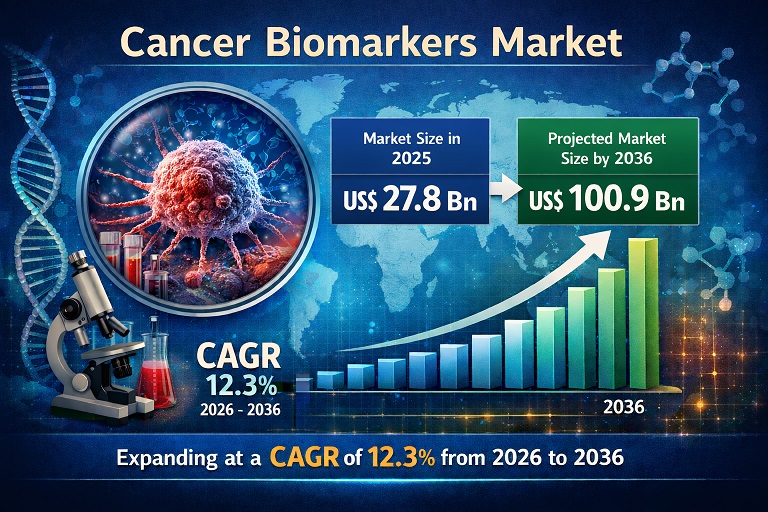
The Cancer Biomarkers Market is witnessing robust expansion, driven by the rising global cancer burden and the rapid shift toward precision oncology. The market was valued at over US$ 27.8 Bn in 2025 and is projected to reach approximately US$ 100.9 Bn by 2036, expanding at a CAGR of around 12.3% during the forecast period. Growth is fueled by increasing adoption of molecular diagnostics, advancements in next-generation sequencing (NGS), and the growing use of liquid biopsy and companion diagnostics in targeted cancer therapies.
Access the Sample Copy – Dive Into Data-Driven Insights: https://www.transparencymarketresearch.com/sample/sample.php?flag=S&rep_id=479
Key Players:
• Illumina
• Abbott
• Roche Diagnostics
• PerkinElmer, Inc.
• Siemens Healthcare Private Limited
• Bio-Rad Laboratories, Inc.
• bioMérieux
• Merck KGaA
• Bio-Techne
• RayBiotech, Inc.
• EagleBio
• Creative Diagnostics
• OncoDNA
• Quanterix
• Biocartis
• Other prominent players
Market Overview
The Cancer Biomarkers Market involves the development, manufacturing, and application of diagnostic biomarkers used to detect cancer-related biological changes. These biomarkers include proteins, genetic mutations, circulating tumor DNA (ctDNA), RNA, and other molecular indicators detectable in blood, tissues, or other body fluids. They help clinicians identify cancer earlier than conventional imaging and monitor treatment efficacy with greater precision.
Several types of biomarkers serve specific clinical purposes:
Diagnostic Biomarkers: Used to detect the presence of cancer at an early or asymptomatic stage.
Prognostic Biomarkers: Provide information about cancer progression and patient survival.
Predictive Biomarkers: Forecast how patients will respond to specific therapies, especially targeted or immunotherapies.
Pharmacodynamic Biomarkers: Indicate how a patient’s body responds to treatment over time.
Key Growth Drivers
The growth of the cancer biomarkers market is underpinned by several significant factors:
Rising Cancer Incidence and Awareness: The global burden of cancer is increasing due to aging populations, lifestyle changes, and environmental risks. This drives demand for better diagnostic tools to improve patient outcomes.
Advancements in Molecular Diagnostics: Innovations in genomics, proteomics, and next-generation sequencing (NGS) have enhanced the sensitivity and specificity of biomarker detection, accelerating broader clinical adoption.
Personalized Medicine Movement: A stronger focus on individualized treatment regimens has propelled the integration of biomarker profiling to match patients with the most effective therapies, particularly in breast, lung, colorectal, and prostate cancers.
Regulatory Support and Reimbursement Policies: Governments and regulatory bodies are promoting early detection programs and providing reimbursement support for biomarker tests, accelerating market growth.
Expansion of Biotech and Pharmaceutical R&D: Ongoing clinical research and collaborations between biotech firms, diagnostic companies, and academic institutions are driving novel biomarker discovery and clinical validation.
Get this premium report for strategic insights: https://www.transparencymarketresearch.com/checkout.php?rep_id=479<ype=S
Market Segmentation
Biomarker Type
• Genetic Biomarker
• BRAF
• ALK
• Others (BRCA1 and BRCA2, etc.)
Protein Biomarker
• CA-125
• HER2
• Prostate-specific antigen (PSA)
• Alfa-fetoprotein
• Human chorionic gonadotropin-β
• Calcitonin
• CA 15-3
• Others (CA 27-29, etc.)
Cells as Cancer Biomarkers
• Circulating Tumor Cells
• Immune Cells
• Others (Cancer Stem Cells, etc.)
Cancer Type
• Breast Cancer
• Prostate Cancer
• Ovarian Cancer
• Colorectal Cancer
• Thyroid Cancer
• Testicular Cancer
• Liver Cancer
• Testicular Cancer
• Colon Cancer
• Others (Kidney Cancer, Bladder Cancer, etc.)
End-user
• Diagnostic Laboratories
• Biopharmaceutical Companies
• Hospitals & Specialty Clinics
• Others (Research Laboratories, Academic Institutes, etc.)
Regional Insights
North America currently dominates the cancer biomarkers market, driven by strong healthcare infrastructure, significant R&D investments, and favorable regulatory frameworks. Europe follows closely with rising awareness and screening programs. Asia Pacific is poised for the fastest growth due to expanding healthcare facilities, increasing cancer incidence, and improving access to diagnostic technologies in nations like China and India.
Trends Shaping the Market
Liquid Biopsy Revolution: Liquid biopsies — minimally invasive tests detecting tumor DNA in blood — offer a promising alternative to traditional tissue biopsies, enabling real-time monitoring and earlier detection.
Integration of Artificial Intelligence (AI): AI and machine learning are being leveraged to analyze complex biomarker datasets, improving diagnostic accuracy and predictive insights.
Companion Diagnostics Expansion: Biomarkers are increasingly paired with targeted therapies as companion diagnostics, ensuring that patients receive treatments most likely to be effective for their tumor profile.
Focus on Multi-Omics Approaches: Combining genomics, proteomics, and metabolomics data provides a more comprehensive understanding of cancer biology and therapeutic response.
Decentralized Testing Models: Point-of-care and decentralized testing solutions are emerging, increasing accessibility in remote and low-resource settings.
Challenges and Restraints
Despite substantial opportunities, the market faces hurdles:
High Development Costs: Biomarker discovery and clinical validation require significant investments and time.
Regulatory Complexity: Navigating regulatory approvals and demonstrating clinical utility poses challenges for developers.
Data Interpretation Complexity: Large volumes of genomic data demand advanced analytics and skilled personnel.
Reimbursement Barriers: Variable reimbursement policies across regions can deter adoption.
Future Outlook
The future of the cancer biomarkers market is promising, with sustained growth expected in the coming decade. Technological breakthroughs and increasing integration of biomarker testing into clinical practice will likely enhance treatment outcomes and reduce healthcare costs through earlier detection and tailored therapies. The emergence of integrated multi-biomarker panels and AI-driven diagnostics will continue to redefine the cancer care paradigm.
Strategic collaborations, mergers and acquisitions, and robust investment in precision oncology will also fuel innovation and market expansion. Industry stakeholders are focusing on holistic solutions that combine diagnostics, therapeutics, and data analytics to create a seamless continuum of care.
Frequently Asked Questions (FAQs)
1. How big was the global cancer biomarkers market in 2025?
The global cancer biomarkers market was valued at US$ 27.8 Bn in 2025
2. What is the projected size of the cancer biomarkers industry by 2035?
The global cancer biomarkers market is projected to cross US$ 100.9 Bn by the end of 2035
3. What is the cancer biomarkers market expected to grow during the forecast period?
The global cancer biomarkers market is anticipated to grow at a CAGR 12.3% from 2026 to 2036
4. Which region is expected to dominate the cancer biomarkers market during the forecast period?
North America is expected to account for the largest share from 2026 to 2036
5. Who are the prominent cancer biomarkers providers?
Illumina, Abbott, Roche Diagnostics, PerkinElmer, Inc., Siemens Healthcare Private Limited, Bio-Rad Laboratories, Inc., bioMérieux, Merck KGaA, Bio-Techne, RayBiotech, Inc., EagleBio, Creative Diagnostics, OncoDNA, Quanterix, Biocartis, and the other prominent players
More Trending Reports by Transparency Market Research –
Sleep Apnea Devices Market - https://www.transparencymarketresearch.com/sleep-apnea-devices-market.html
Skin Antiseptic Market - https://www.transparencymarketresearch.com/skin-antiseptic-market.html
Medical Devices Outsourcing Market - https://www.transparencymarketresearch.com/medical-devices-outsourcing-market.html
Atil Chaudhari
Transparency Market Research Inc.
+ +1 518-618-1030
email us here
Legal Disclaimer:
EIN Presswire provides this news content "as is" without warranty of any kind. We do not accept any responsibility or liability for the accuracy, content, images, videos, licenses, completeness, legality, or reliability of the information contained in this article. If you have any complaints or copyright issues related to this article, kindly contact the author above.
