

Prelithiation Materials and High-Silicon Anode Market is rising USD 3.7 billion by 2036, at a CAGR of 16.5%
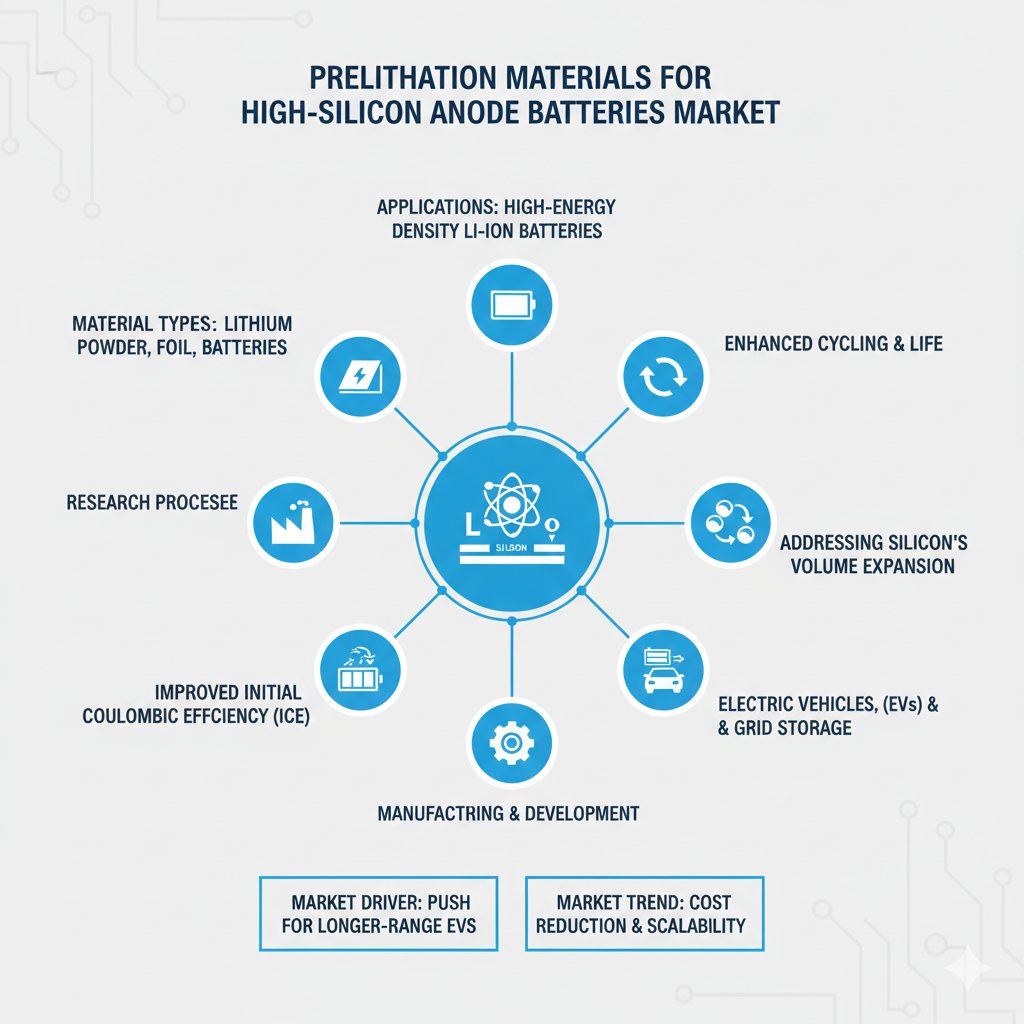
Prelithiation Materials for High-Silicon Anode Batteries Market
The global prelithiation materials and high-silicon anode batteries market is rising at a CAGR of 16.5% to total USD 3.7 billion by 2036
NEWARK, DE, UNITED STATES, February 9, 2026 /EINPresswire.com/ -- The global energy storage landscape has reached a decisive inflection point. As of 2026, the prelithiation materials and high-silicon anode market is valued at USD 0.8 billion, with projections from Future Market Insights (FMI) indicating an acceleration to USD 3.7 billion by 2036. This represents a robust CAGR of 16.5%, driven by the exhaustion of traditional lithium-ion performance limits and a global "arms race" for superior energy density.
The Industrial Threshold: Why Silicon is No Longer Optional
For over a decade, graphite has been the backbone of the lithium-ion battery. However, graphite anodes are nearing their theoretical capacity limits. To meet the demands of long-range electric vehicles (EVs) and high-voltage architectures, battery manufacturers are forced to adopt silicon-dominant chemistries.
Silicon offers a theoretical capacity nearly ten times higher than graphite. However, it comes with a "silicon tax"—a massive volumetric expansion during charging that leads to structural fatigue and irreversible lithium loss. This is where prelithiation becomes critical. It acts as a system-critical enabler, compensating for early-cycle lithium consumption and stabilizing the battery's lifecycle.
Request For Sample Report | Customize Report | Purchase Full Report
https://www.futuremarketinsights.com/reports/sample/rep-gb-31902
Strategic Segmentation: The Materials Landscape
The market is currently being shaped by manufacturing pragmatism. Companies are prioritizing "drop-in" solutions that require minimal changes to existing gigafactory infrastructure.
Stabilized Lithium Metal Powder (SLMP): The 42% Leader
SLMP has become the preferred prelithiation material. Its surface-stabilized particles allow for precise dosing and predictable lithium release during the initial formation cycles. Because SLMP can be dry-blended or slurry-mixed into existing workflows, it offers the most scalable path for manufacturers seeking incremental performance gains without a total process redesign.
Lithium-Rich Alloys: The Safe Alternative
Accounting for 34% of the market, lithium-rich intermetallic alloys (such as Li–Si and Li–Al) are gaining ground. These materials offer improved handling stability and lower reactivity compared to pure lithium metal. They are particularly attractive for the automotive and stationary storage sectors, where safety margins and long-term repeatability are paramount.
Anode-Side Dosing: The Preferred Route
With 58% adoption, anode-side dosing allows lithium compensation to occur exactly where the loss originates. This route avoids complex electrochemical steps or post-assembly treatments, making it the most controllable and high-yield pathway for high-volume cell manufacturing.
Regional Dynamics: Regulation as a Catalyst
The growth of this market is not just a technological race; it is a regulatory one. The way different regions handle manufacturing and compliance is creating distinct market profiles.
Regional Growth Outlook (2026–2036)
• China (17.8% CAGR): Focuses on aggressive industrial scaling and real-world regulatory stress-testing to force technological maturity.
• South Korea (16.6% CAGR): Prioritizes execution discipline and maintaining export-ready stability within established battery platforms.
• United States (15.4% CAGR): Centers on domestic supply-chain traceability and alignment with Inflation Reduction Act (IRA) compliance mandates.
China: Forcing Maturity
China remains the largest market share holder. The implementation of the GB38031-2025 standard has forced silicon anodes to mature quickly by mandating rigorous bottom-impact testing. This ensures that silicon-rich designs are not just energy-dense but mechanically robust enough for real-world deployment.
The United States: The Regulatory Envelope
In the U.S., development is unfolding within the "regulatory envelope" of the Inflation Reduction Act (IRA). Success is defined by ownership structure and material provenance. Companies like Sila Nanotechnologies and Group14 Technologies are leading the charge by establishing domestic, GWh-scale facilities that align with federal incentive eligibility.
South Korea: The Export Experts
South Korea is integrating silicon anodes through "execution discipline." By embedding silicon content into established platforms at LG Energy Solution and SK On, they are advancing the technology without destabilizing global supply chains or manufacturing yields.
The Competitive Landscape: From Lab to Gigafactory
The era of experimental silicon is over. Competition has moved beyond energy density claims and is now focused on system durability and fast-charging resilience.
Key Players Driving Innovation
• Sila Nanotechnologies & Group14 Technologies: Transitioning from demonstration to automotive-grade output at scale.
• Amprius Technologies: Addressing high-performance requirements for defense and aerospace.
• Gotion High-Tech: Leading the integration of silicon with semi-solid and solid-state pilot operations.
• Enovix: Focusing on operational certainty through the acquisition of existing manufacturing assets.
"2026 will see the first large-scale deployment of silicon batteries in EVs... resulting in end users demanding silicon-level performance across all applications." — Rick Luebbe, CEO, Group14 Technologies.
Future Outlook: Beyond 2030
As we look toward the 2030s, the market for prelithiation and high-silicon anodes will move into two key phases:
1. Mass Market Accountability: Cycle reliability benchmarks will rise. The "stretch goal" of 1,500 full charge-discharge cycles is becoming the standard expectation for all silicon-enabled batteries.
2. Solid-State Integration: Prelithiation is emerging as a critical interface solution for all-solid-state battery (ASSB) programs. By stabilizing electrode behavior, prelithiation suppliers are moving closer to the system level, where value is defined by yield improvement and manufacturability rather than raw material supply alone.
Conclusion
The transition to silicon-rich anodes is a structural necessity for the next generation of electrification. With a projected market value of USD 3.7 billion by 2036, the prelithiation and high-silicon anode sector is no longer a niche supporting industry—it is the engine of the battery revolution.
Similar Industry Reports
Thermal Management Materials for EV Batteries Market
https://www.futuremarketinsights.com/reports/thermal-management-materials-for-ev-batteries-market
Anode Foil Coatings Market
https://www.futuremarketinsights.com/reports/anode-foil-coatings-market
Anode Refining Furnace Market
https://www.futuremarketinsights.com/reports/anode-refining-furnace-market
Sudip Saha
Future Market Insights Inc.
+1 347-918-3531
email us here
Legal Disclaimer:
EIN Presswire provides this news content "as is" without warranty of any kind. We do not accept any responsibility or liability for the accuracy, content, images, videos, licenses, completeness, legality, or reliability of the information contained in this article. If you have any complaints or copyright issues related to this article, kindly contact the author above.
