

Automotive IoT Market Size to Reach USD 91.69 Billion by 2034, Driven by Nationwide V2X, 5G Connectivity
Automotive Internet of Things (IoT) Market Trends
Automotive Internet of Things (IoT) Market: Growth Drivers, Segmentation Analysis, and Regional Forecast, 2026–2034
Ecosystem Complexity and Partnership Volatility Disrupt Market Growth”
PUNE, MAHARSHTRA, INDIA, February 9, 2026 /EINPresswire.com/ -- The global Automotive Internet of Things (IoT) Market is accelerating rapidly as vehicles evolve into connected, software-defined platforms integrated with digital infrastructure and cloud ecosystems. The market size was valued at USD 32.42 billion in 2025 and is projected to grow from USD 37.20 billion in 2026 to USD 91.69 billion by 2034, exhibiting a strong compound annual growth rate (CAGR) of 11.9% during the forecast period. This expansion reflects rising adoption of connected vehicle technologies, advanced telematics, and data-driven mobility services across passenger and commercial vehicles.— Fortunebusinessinsights.com
Automotive IoT enables real-time communication between vehicles, infrastructure, cloud platforms, and users through embedded sensors, connectivity modules, and software platforms. These systems support applications such as vehicle-to-everything (V2X) communication, predictive maintenance, fleet management, infotainment, advanced driver assistance systems (ADAS), and over-the-air (OTA) software updates. As automakers prioritize connectivity and intelligence as core vehicle attributes, IoT is becoming foundational to modern automotive architectures.
Get a Free Sample Research Report: https://www.fortunebusinessinsights.com/enquiry/request-sample-pdf/automotive-internet-of-things-iot-market-114638
Market Drivers: Nationwide V2X and 5G Connectivity Accelerates Adoption
A major driver of automotive IoT adoption is the global push toward interoperable V2X frameworks and high-bandwidth 5G connectivity. Governments, automakers, and telecom operators are aligning on deployment roadmaps that scale roadside units, cellular C-V2X pilots, and cloud backends to unlock safety, traffic efficiency, and new mobility services. As coverage deepens, connected features—such as real-time hazard warnings, cooperative perception, traffic signal prioritization, and advanced telematics—are becoming default expectations in new vehicle models.
Policy momentum is reinforcing this trend. In August 2024, the U.S. Department of Transportation (USDOT) released a national plan to accelerate V2X deployment and paired it with approximately USD 60 million in grants, catalyzing infrastructure rollout and ecosystem investment. Similar initiatives across Europe and Asia are driving harmonization, lowering integration risk, and encouraging supplier innovation.
Software-Defined Vehicles and Data Monetization
The transition to software-defined vehicles (SDVs) is reshaping the automotive IoT landscape. Centralized computing, zonal architectures, and cloud-native platforms enable continuous feature upgrades, enhanced cybersecurity, and scalable service delivery. Automakers are increasingly monetizing vehicle data through subscription-based services, usage-based insurance, predictive maintenance, and fleet analytics. Automotive IoT provides the telemetry and analytics backbone required to support these recurring revenue models.
Electrification further amplifies IoT value. Connected EVs leverage IoT for battery health monitoring, smart charging, route optimization, and energy management. Fleet operators rely on IoT-enabled dashboards to reduce downtime, optimize total cost of ownership, and comply with emissions and safety regulations.
Technology Stack Evolution: Edge AI, Semiconductors, and Cloud
Rapid advances in edge AI, automotive-grade semiconductors, and cloud platforms are expanding IoT capabilities. On-vehicle AI accelerators enable low-latency perception and decision-making, while secure connectivity modules support high-throughput data exchange. Cloud services aggregate and analyze data at scale, powering digital twins, OTA updates, and cross-fleet insights. Interoperability between edge and cloud layers is becoming a competitive differentiator as automakers seek resilient, future-proof architectures.
LIST OF KEY AUTOMOTIVE INTERNET OF THINGS (IoT) MARKET COMPANIES PROFILED
The automotive IoT ecosystem spans Tier-1 suppliers, semiconductor leaders, cloud providers, and OEMs. Key companies profiled include:
Robert Bosch GmbH (Germany) – Delivers sensors, ECUs, and connectivity solutions for connected vehicles.
Continental AG (Germany) – Develops V2X, telematics, and software platforms for SDVs.
Harman International Industries Inc. (U.S.) – Provides connected car platforms, infotainment, and cloud services.
Qualcomm Technologies Inc. (U.S.) – Supplies automotive SoCs and C-V2X solutions enabling high-performance connectivity.
NXP Semiconductors N.V. (Netherlands) – Focuses on secure connectivity, processors, and V2X chips.
NVIDIA Corporation (U.S.) – Powers in-vehicle AI, digital twins, and cloud-edge orchestration.
Mobileye N.V. (Israel) – Integrates perception, mapping, and V2X-enabled safety solutions.
Texas Instruments Inc. (U.S.) – Provides automotive-grade processors and connectivity components.
Cisco Systems Inc. (U.S.) – Supports secure vehicle networking and edge-to-cloud connectivity.
Thales SA (France) – Delivers cybersecurity and secure connectivity for connected vehicles.
IBM Corporation (U.S.) – Offers analytics and AI platforms for mobility data.
Microsoft Corporation (U.S.) – Provides cloud and IoT services for connected vehicle ecosystems.
Aptiv PLC (Ireland) – Develops vehicle architectures and connected systems.
Denso Corporation (Japan) – Integrates sensors, ECUs, and connectivity for OEMs.
Valeo SA (France) – Focuses on ADAS, connectivity, and smart mobility solutions.
Ford Motor Company (U.S.), General Motors Company (U.S.), Volkswagen AG (Germany), and Volvo Car Corporation (Sweden) – OEMs advancing connected, software-defined vehicle strategies.
Buy This Report Now: https://www.fortunebusinessinsights.com/select-license/114638
Regional Outlook
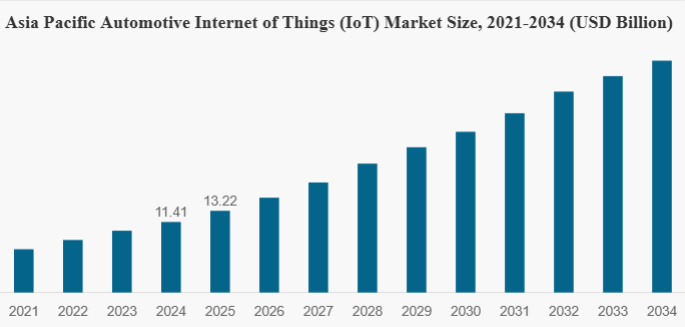
North America leads adoption due to early V2X pilots, strong cloud ecosystems, and policy support. Europe follows with harmonized standards and smart mobility investments. Asia Pacific is expected to post the fastest growth, driven by large-scale 5G rollout, EV penetration, and smart city programs in China, Japan, and South Korea.
Future Outlook
The automotive IoT market is set for sustained expansion through 2034 as connectivity becomes intrinsic to vehicle value. Nationwide V2X, pervasive 5G, and SDV architectures will unlock safer roads, efficient traffic systems, and new digital services. With the market projected to reach USD 91.69 billion by 2034, automotive IoT will remain a cornerstone of the connected mobility ecosystem, attracting continued investment across the value chain.
Ashwin Arora
Fortune Business Insights™ Pvt. Ltd.
+1 833-909-2966
sales@fortunebusinessinsights.com
Legal Disclaimer:
EIN Presswire provides this news content "as is" without warranty of any kind. We do not accept any responsibility or liability for the accuracy, content, images, videos, licenses, completeness, legality, or reliability of the information contained in this article. If you have any complaints or copyright issues related to this article, kindly contact the author above.
