

Molecular Recycling Feedstock and Polyester Renewal Resins Market to Reach USD 6.4 Billion by 2036 at 10.3% CAGR
Molecular Recycling Feedstock and Polyester Renewal Resins Market
Molecular Recycling Feedstock and Polyester Renewal Resins Market advances into industrial execution, driven by regulation, and integrated recycling ecosystems.
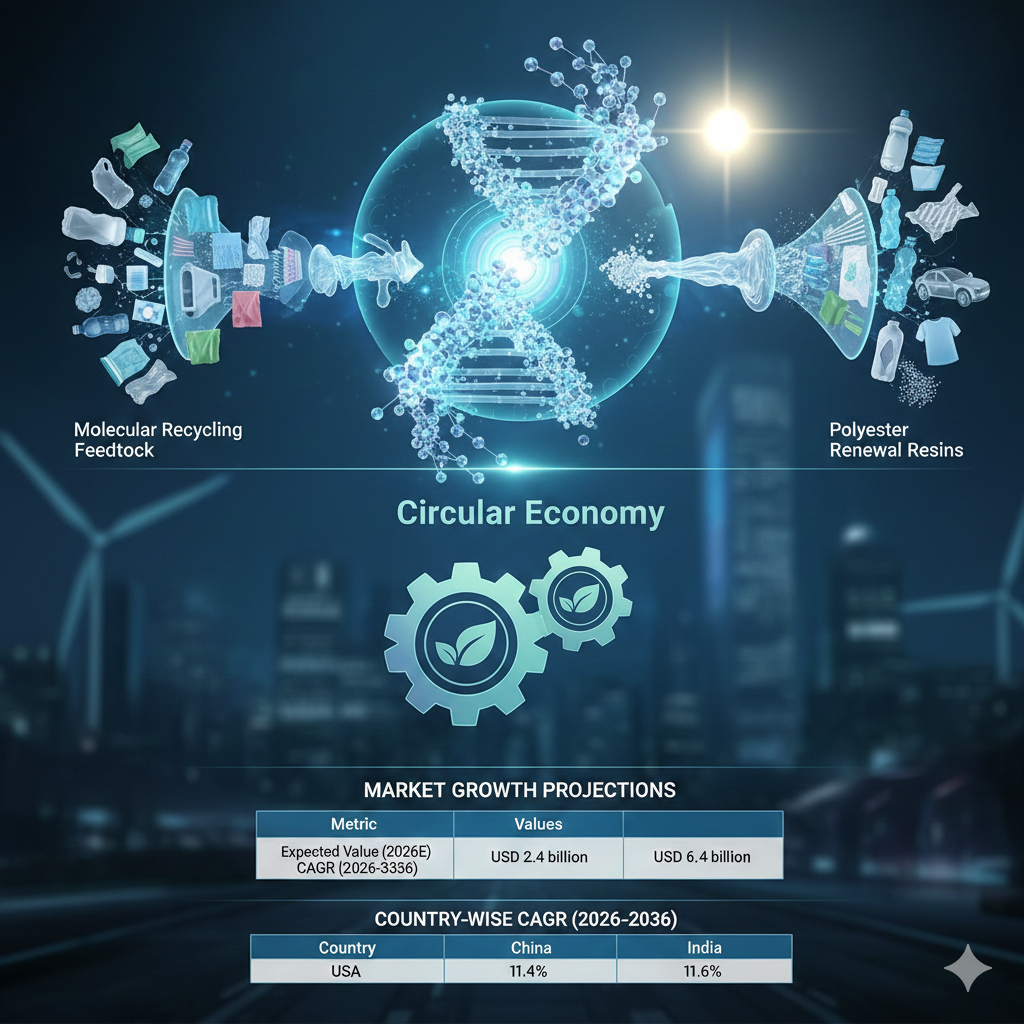
NEWARK, DE, UNITED STATES, February 9, 2026 /EINPresswire.com/ -- The Molecular Recycling Feedstock and Polyester Renewal Resins Market is entering a decisive phase of commercial maturity, marking a structural shift in how the global chemical and plastics industries approach recycling. According to analysis by Future Market Insights (FMI), the market is forecast to reach USD 2.4 billion in 2026 and expand to USD 6.4 billion by 2036, advancing at a 10.3% CAGR. This growth trajectory reflects the sector’s transition away from experimental validation toward scalable, regulation-driven industrial execution.
Momentum is being driven by the growing limitations of mechanical recycling. While mechanical processes remain effective for clean, single-polymer waste streams, they struggle with mixed plastics, contaminated materials, and textile-based polyester waste. Molecular recycling addresses these gaps by depolymerizing plastics back into their chemical building blocks, enabling the production of specification-grade recycled polyester suitable for regulated packaging and high-performance textile applications. For brand owners, this capability is now less about sustainability messaging and more about securing compliant, reliable material supply in an increasingly stringent regulatory environment.
Request For Sample Report | Customize Report | Purchase Full Report- https://www.futuremarketinsights.com/reports/sample/rep-gb-31899
Regulation Becomes the Primary Growth Engine
Across major economies, recycled-content mandates have shifted sustainability from voluntary commitments to enforceable obligations. Governments are imposing minimum recycled plastic thresholds in packaging, directly influencing procurement strategies of FMCG, pharmaceutical, and e-commerce companies. India’s revised Plastic Waste Management Rules enforced from 2025 represent a clear inflection point, converting recycled polymer usage into a non-negotiable compliance requirement. Similar enforcement trajectories are emerging across Southeast Asia, Latin America, and parts of Europe.
As a result, chemically recycled polyester is increasingly viewed as a margin-protection and compliance tool, not a premium sustainability input. Demand is anchored to regulation rather than short-term price sensitivity, insulating the market from cyclical volatility.
Asia-Pacific Consolidates Industrial Leadership
Asia-Pacific is emerging as a global center for advanced recycling investment, with leadership defined by capacity, integration, and execution discipline rather than experimentation. China holds the largest share of the global market, supported by standardized recycled resin quality frameworks, coordinated industrial policy, and rapid deployment of export-aligned advanced recycling facilities. These standards reduce ambiguity across the value chain, accelerating downstream adoption and lowering execution risk.
South Korea has become a focal point for integrated recycling clusters operating at global scale. Coordinated industrial policy and strong chemical manufacturing ecosystems are enabling molecular recycling assets to move quickly from commissioning to commercial output.
North America Normalizes Advanced Recycling Economics
North America demonstrates that molecular recycling can function as a viable industrial model rather than an ESG-led initiative. Operating assets in the United States have helped normalize the economics of advanced recycling, reducing investor skepticism around scale, yield stability, and returns. As learning curves compress, molecular recycling facilities are increasingly evaluated on earnings contribution rather than technical novelty.
Partnerships Redefine Operating Models
Across regions, partnerships have become the dominant operating structure. Waste management companies, chemical producers, and technology providers are aligning to:
• Secure consistent feedstock access
• Stabilize input quality
• Reduce scale-up and utilization risk
Digital tools are now embedded within these partnerships as prerequisites rather than optional enhancements. Traceability systems, mass-balance certification, and AI-driven feedstock preparation are increasingly critical for regulatory compliance and access to premium markets.
Glycolysis and Rigid Packaging Anchor Market Structure
Process maturity, not experimentation, defines market segmentation. Glycolysis has emerged as the leading depolymerization route, accounting for 36% of technology adoption. Its dominance stems from moderate operating conditions, retrofit compatibility with existing infrastructure, and the ability to produce BHET-rich intermediates suitable for near-virgin polyester resin production.
On the demand side, rigid packaging and bottles represent 35% of total consumption, making this the single largest end-use segment. Regulatory pressure and brand commitments favor bottle-to-bottle recycling, offering rapid qualification cycles, standardized specifications, and high-volume offtake. This segment now serves as the market’s demand backbone while textiles and films scale more gradually.
Technology Advances Expand Feedstock and Applications
Advances in chemical depolymerization and polymer engineering are expanding both feedstock availability and application quality. Mixed-fiber textiles, colored plastics, and contaminated waste streams—long inaccessible to mechanical recycling—are increasingly processed without sacrificing polymer performance. Recycled polyester now delivers durability, clarity, and consistency suitable for higher-value applications, reinforcing molecular recycling’s role as a compliance-critical supply route.
Competitive Landscape Shifts Toward Asset Productivity
The competitive environment has entered a structurally distinct phase focused on utilization efficiency, yield optimization, and debottlenecking rather than greenfield expansion. Leading players are prioritizing incremental capacity upgrades at proven sites to improve return on invested capital.
Regulatory frameworks such as the EU Packaging and Packaging Waste Regulation are expected to enforce structurally higher demand for certified recycled content, converting compliance into a baseline commercial requirement. Market leadership is increasingly defined by asset productivity, regulatory readiness, and digital traceability infrastructure rather than standalone process innovation.
Key Players Profiled
• Indorama Ventures Public Company Limited
• Eastman Chemical Company
• SABIC
• Mitsubishi Chemical Group Corporation
• SK Chemicals Co. Ltd.
• DuPont Teijin Films
• Carbios S.A.
• Loop Industries Inc.
• Ioniqa Technologies B.V.
• IBM Research
Why FMI: https://www.futuremarketinsights.com/why-fmi
Browse Related Insights
Polyester Microfiber Fabric Market: https://www.futuremarketinsights.com/reports/polyester-microfiber-fabric-market
Polyester Shrink Film Market: https://www.futuremarketinsights.com/reports/polyester-shrink-film-market
Polyester Polyol Market: https://www.futuremarketinsights.com/reports/polyester-polyol-market
About Future Market Insights (FMI)
Future Market Insights, Inc. (FMI) is an ESOMAR-certified, ISO 9001:2015 market research and consulting organization, trusted by Fortune 500 clients and global enterprises. With operations in the U.S., UK, India, and Dubai, FMI provides data-backed insights and strategic intelligence across 30+ industries and 1,200 markets worldwide.
Sudip Saha
Future Market Insights Inc.
+18455795705 ext.
email us here
Legal Disclaimer:
EIN Presswire provides this news content "as is" without warranty of any kind. We do not accept any responsibility or liability for the accuracy, content, images, videos, licenses, completeness, legality, or reliability of the information contained in this article. If you have any complaints or copyright issues related to this article, kindly contact the author above.
