

In-vitro Diagnostics (IVD) Market to Register a Steady CAGR of 6.50% During the Forecast Period, 2026–2034
In-vitro Diagnostics (IVD) Market
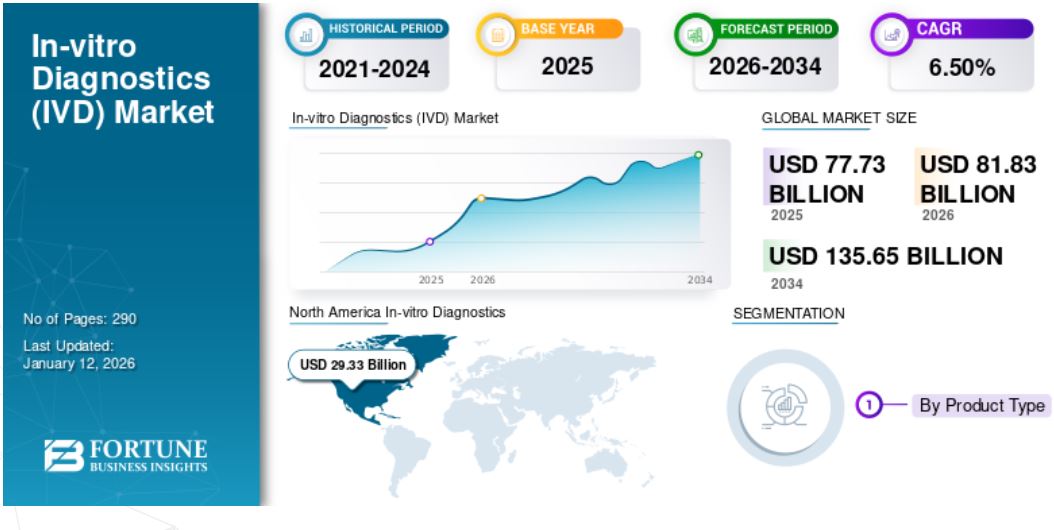
The in-vitro diagnostics market was valued at USD 77.73 billion in 2025 and is projected to grow from USD 81.83 billion in 2026 to USD 135.65 billion by 2034
PUNE, INDIA, February 7, 2026 /EINPresswire.com/ -- The global in-vitro diagnostics (IVD) market was valued at USD 77.73 billion in 2025 and is projected to grow from USD 81.83 billion in 2026 to USD 135.65 billion by 2034, exhibiting a CAGR of 6.50% during the forecast period. North America dominated the in-vitro diagnostics market with a market share of 37.70% in 2025.In-vitro diagnostics include medical tests performed on biological samples such as blood, urine, saliva, and tissue to detect diseases, monitor therapy, and guide clinical decision-making. IVD tests influence nearly 70% of medical decisions, highlighting their critical role in modern healthcare. As healthcare systems increasingly shift toward value-based care and personalized medicine, the importance of reliable and rapid diagnostic testing continues to rise, strengthening long-term demand for IVD solutions.
Get Free Sample Research Report:
https://www.fortunebusinessinsights.com/enquiry/request-sample-pdf/in-vitro-diagnostics-ivd-market-101443
Top Companies in In-vitro Diagnostics (IVD) Market
F. Hoffmann-La Roche Ltd.
Abbott
Thermo Fisher Scientific Inc.
Siemens Healthineers AG
Sysmex Corporation
BD (Becton, Dickinson and Company)
Seegene Inc.
DiaSorin S.p.A.
Quest Diagnostics Incorporated
Bio-Rad Laboratories, Inc.
In-vitro Diagnostics Market Trends
One of the key trends shaping the IVD market is the rising penetration of point-of-care (POC) testing devices. POC diagnostics provide rapid results, require minimal laboratory infrastructure, and enable testing in decentralized settings such as clinics, pharmacies, and even homes. These benefits are accelerating adoption for infectious disease screening, chronic disease monitoring, and emergency care.
Another major trend is the growing shift toward molecular diagnostics. Techniques such as polymerase chain reaction (PCR), next-generation sequencing (NGS), and nucleic acid amplification tests are increasingly preferred due to their high sensitivity and specificity. Molecular diagnostics are becoming standard tools for oncology, transplant diagnostics, and infectious disease testing.
In-vitro Diagnostics Market Growth Factors
The increasing prevalence of chronic and infectious diseases is a major driver of market growth. Conditions such as cardiovascular diseases, diabetes, cancer, tuberculosis, hepatitis, and neurological disorders require frequent diagnostic testing for screening, diagnosis, and monitoring. Early detection enabled by IVD tests allows clinicians to initiate timely treatment, improving patient outcomes and reducing healthcare costs.
The expanding geriatric population further contributes to market growth, as older adults are more susceptible to chronic conditions and require routine diagnostic monitoring. Countries such as China, Japan, and several European nations are experiencing rapid aging of their populations, driving sustained demand for diagnostic services.
Government support and funding initiatives are also strengthening market expansion. International organizations and national health authorities are promoting the use of essential diagnostics through policy frameworks and reimbursement programs. The World Health Organization’s Essential Diagnostics List encourages countries to prioritize access to critical IVD tests in primary healthcare and hospital settings.
Furthermore, continuous product launches and technological innovations by leading manufacturers are expanding the scope of IVD applications, supporting long-term market growth.
In-vitro Diagnostics Market Segmentation Analysis
By product type, the market is segmented into instruments and reagents & consumables. Reagents & consumables hold the largest share, driven by their recurring usage in routine testing, increasing adoption of POC kits, and growing volume of diagnostic procedures worldwide. Instruments are expected to witness steady growth owing to the launch of advanced analyzers, PCR systems, and automated platforms.
By technique, the market is categorized into immunodiagnostics, clinical chemistry, molecular diagnostics, and hematology. Molecular diagnostics dominate due to increasing adoption in infectious disease detection and oncology. Immunodiagnostics continue to hold a strong position, supported by widespread use of ELISA, fluorescence immunoassays, and rapid tests. Clinical chemistry remains a core segment, driven by routine metabolic and organ function tests.
By sample type, blood-based tests account for the largest share, as blood samples are widely used for disease diagnosis and monitoring. Urine and saliva samples are also gaining traction due to non-invasive collection and growing use in rapid testing.
By setting, laboratories dominate the market, as complex and high-throughput testing is primarily conducted in centralized labs. However, the point-of-care segment is projected to grow faster due to increasing demand for rapid and decentralized diagnostics.
By application, infectious diseases represent the largest segment, followed by oncology and cardiology. Rising cancer incidence and expanding use of molecular biomarkers are driving strong growth in oncology diagnostics.
Speak to Analyst:
https://www.fortunebusinessinsights.com/enquiry/speak-to-analyst/in-vitro-diagnostics-ivd-market-101443
Regional Insights
North America dominated the IVD market in 2025, with a market size of USD 29.33 billion and a share of 37.70%. The region benefits from a well-established healthcare infrastructure, high adoption of advanced diagnostics, strong presence of leading manufacturers, and favorable reimbursement policies. The U.S. remains the largest national market, driven by high disease prevalence and continuous product innovation.
Europe represents the second-largest market, supported by strong regulatory frameworks, high healthcare spending, and growing adoption of molecular and POC diagnostics. Germany leads the regional market, followed by the U.K. and France.
Asia Pacific is expected to record the fastest growth during the forecast period, driven by rising healthcare expenditure, expanding laboratory infrastructure, and increasing disease burden in countries such as China, India, and Japan. Government initiatives to improve diagnostic accessibility are further supporting regional growth.
Latin America and the Middle East & Africa are witnessing gradual expansion, supported by improving healthcare systems, growing awareness of early diagnosis, and increasing adoption of POC testing devices.
Key Industry Developments
• February 2024: Thermo Fisher Scientific Inc. launched a new ion chromatography instrument to enhance laboratory reliability and efficiency.
• December 2023: Sysmex Corporation received insurance coverage for its HISCL M2BPGi-Qt Assay Kit for chronic hepatitis diagnosis.
• November 2023: Abbott received U.S. FDA approval for its molecular HPV screening solution for the Alinity m platform.
• May 2023: Siemens Healthineers AG launched next-generation Atellica HEMA 570 and 580 hematology analyzers.
• March 2023: DiaSorin S.p.A. received U.S. FDA approval for its Simplexa COVID-19 & Flu A/B Direct assay.
Related Reports
Molecular Diagnostics Market, 2034
Point-of-Care Diagnostics Market, 2034
Ashwin Arora
Fortune Business Insights™ Pvt. Ltd.
+1 833-909-2966
sales@fortunebusinessinsights.com
Visit us on social media:
LinkedIn
Facebook
X
Legal Disclaimer:
EIN Presswire provides this news content "as is" without warranty of any kind. We do not accept any responsibility or liability for the accuracy, content, images, videos, licenses, completeness, legality, or reliability of the information contained in this article. If you have any complaints or copyright issues related to this article, kindly contact the author above.
