

Your top news on business and economy
Provided by AGP
Radar Security Market Size at USD 22.91 Billion in 2025, Expected to Reach USD 51.70 Billion by 2034 at 9.73% CAGR
The Radar Security Market is expanding due to rising defense spending, border surveillance needs, and AI-enabled radar systems adoption globally.
NY, UNITED STATES, February 9, 2026 /EINPresswire.com/ -- The global Radar Security Market was valued at USD 22.91 billion in 2025 and is projected to grow from USD 24.60 billion in 2026 to USD 51.70 billion by 2034, registering a CAGR of 9.73% during the forecast period. Growth is supported by increasing government investments in national defense, border control, and critical infrastructure protection. Radar security solutions are being deployed extensively across airports, seaports, oil & gas facilities, military bases, and national border regions to enhance situational awareness and threat detection capabilities.The Radar Security Market is witnessing strong growth driven by escalating geopolitical tensions, rising cross-border security concerns, and increasing deployment of advanced surveillance technologies. Radar security systems are widely used for real-time detection, tracking, and classification of intruding targets, including humans, vehicles, drones, and aircraft. Unlike optical surveillance systems, radar solutions operate effectively in adverse weather conditions such as fog, rain, and darkness, making them essential for critical security environments.
Get a Free Sample PDF: https://www.fortunebusinessinsights.com/enquiry/request-sample-pdf/radar-security-market-115052
Market Segmentation
The Radar Security Market is segmented by offering, radar type, frequency, range capability, security application, platform, end user, and region.
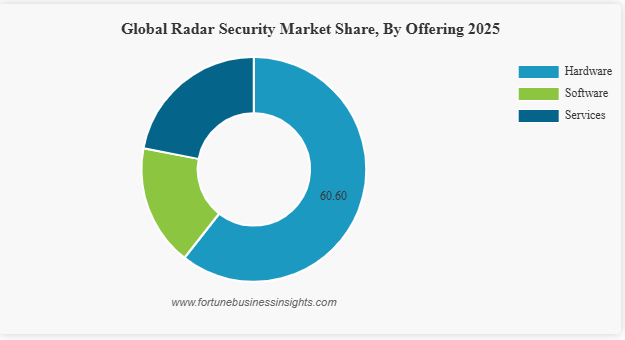
By offering, the market is categorized into hardware, software, and services. The hardware segment dominates the market, accounting for over 60% of total market share, driven by large-scale procurement of radar antennas, transmitters, receivers, and signal processing units. Software is the fastest-growing segment due to rising adoption of AI-driven analytics, cognitive radar platforms, and cloud-enabled signal processing.
By radar type, the market includes mechanical scanning radar, electronic scanning radar, pulse-doppler radar, continuous-wave radar, synthetic aperture radar (SAR), and others. Electronic scanning radar, including AESA and PESA systems, holds the largest share, supported by superior beam steering, faster target acquisition, and enhanced situational awareness.
By frequency, the market is segmented into HF/VHF/UHF, L-band, S-band, C-band, X-band, and Ku/K/Ka band. The S-band segment dominates due to its wide use in air surveillance and weather-resistant operations. The Ku/K/Ka band segment is expected to grow at the fastest pace, driven by miniaturization and applications in autonomous systems and drone detection.
By range capability, the market includes short, medium, long, and ultra-long range systems. Medium-range radar holds the largest share, while ultra-long range radar is the fastest-growing segment due to rising demand for ballistic missile detection and strategic early warning systems.
By security application, the market is segmented into perimeter & border security, critical infrastructure protection, maritime & coastal security, airspace security, military & defense security, homeland security, and civil security. Military & defense security dominates market share, while perimeter & border security is the fastest-growing segment.
By platform, the market includes ground-based, airborne, naval/maritime, and space-based radar. Ground-based radar dominates, accounting for over 53% of total market value, while space-based radar is witnessing the fastest growth.
Key Players
The Radar Security Market is highly competitive, with major defense contractors and technology providers leading global deployments. Key players operating in the market include:
Thales Group
RTX Corporation
Lockheed Martin Corporation
Northrop Grumman Corporation
Saab AB
Leonardo S.p.A.
HENSOLDT AG
Bharat Electronics Limited (BEL)
Elbit Systems Ltd.
Indra Sistemas, S.A.
BAE Systems plc
Mitsubishi Electric Corporation
Speack To Analyst:-
https://www.fortunebusinessinsights.com/enquiry/speak-to-analyst/radar-security-market-115052
Report Coverage
The report provides comprehensive analysis of the global Radar Security Market across all major segments. It covers historical data from 2021 to 2024, with 2025 as the base year and forecasts from 2026 to 2034. The study includes detailed insights into market size, growth trends, competitive landscape, and regional performance.
The report also evaluates technological advancements, regulatory frameworks, and procurement trends across government and commercial sectors. It provides strategic insights into mergers, partnerships, product launches, and contract awards impacting the competitive dynamics of the radar security industry.
Drivers and Restraints
A major driver of the Radar Security Market is escalating global security threats and geopolitical instability. Rising territorial disputes, cross-border infiltration, and terrorism threats are prompting governments to invest heavily in advanced radar surveillance systems. The increasing use of drones and unmanned aerial vehicles has further accelerated demand for counter-drone radar and airspace monitoring solutions.
Another key growth driver is the integration of artificial intelligence and machine learning into radar systems. AI-enabled radar platforms enhance target classification, reduce false alarms, and improve situational awareness, making them highly attractive for defense and homeland security applications.
However, high system costs remain a key restraint. Advanced radar systems require significant capital investment for procurement, installation, and maintenance. Additionally, technical complexity, high power consumption, and the need for skilled personnel to operate and interpret radar data can limit adoption, particularly in developing regions. Cybersecurity risks and regulatory constraints related to defense technology transfer also pose challenges.
Regional Insights
North America dominates the Radar Security Market, driven by high defense spending, advanced military infrastructure, and strong presence of leading radar manufacturers. The United States accounts for the largest regional share due to sustained investments in missile defense, border security, and airspace surveillance programs.
Europe represents the second-largest market, supported by NATO modernization programs and increasing procurement of advanced air and missile defense systems. Countries such as Germany, France, and the U.K. are investing in next-generation radar platforms to counter emerging aerial threats.
Asia Pacific is a high-growth region, driven by defense modernization initiatives in China, India, Japan, and South Korea. Rising geopolitical tensions and increasing military budgets are supporting large-scale radar system deployments across the region.
The Middle East & Africa and Latin America are emerging markets, supported by investments in border security, critical infrastructure protection, and maritime surveillance.
Key Industry Developments
The Radar Security Market has witnessed significant strategic developments. In October 2025, Blighter secured a follow-on contract in Southeast Asia to supply B400 series radars for border surveillance. In July 2025, Bharat Electronics Limited finalized a contract with India’s Ministry of Defence to deliver air defense fire control radars. In September 2025, Parsons Corporation received a major task order from the U.S. Army to support radar and C5ISR system upgrades.
Related Reports:-
Radar Market
Air Traffic Control Market
Ashwin Arora
Fortune Business Insights™ Pvt. Ltd.
+1 833-909-2966
sales@fortunebusinessinsights.com
Legal Disclaimer:
EIN Presswire provides this news content "as is" without warranty of any kind. We do not accept any responsibility or liability for the accuracy, content, images, videos, licenses, completeness, legality, or reliability of the information contained in this article. If you have any complaints or copyright issues related to this article, kindly contact the author above.
