

Global Structural Heart Devices Market to Surpass USD 27.16 Billion by 2034, Advancing at a 7.2% CAGR
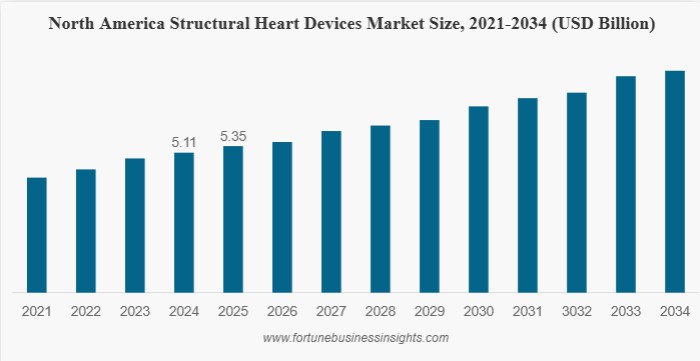
Structural Heart Devices Market Size
The structural heart devices market is led by key companies such as Medtronic, Boston Scientific, Abbott, Edwards Lifesciences, and LivaNova and more.
NY, UNITED STATES, February 11, 2026 /EINPresswire.com/ -- Structural heart devices are medical technologies designed to treat abnormalities in the heart’s internal structure. These devices are used primarily in minimally invasive procedures to correct defects in heart chambers, walls, and valves. They play a crucial role in treating conditions such as heart valve disease, congenital cardiac abnormalities, and other structural defects. The increasing incidence of structural heart disorders has resulted in a considerable rise in patient admissions to clinical settings. The ability of these devices to facilitate high‑risk procedures with reduced recovery times has fueled their adoption across developed and developing markets alike.The global Structural Heart Devices Market has emerged as one of the most promising segments within the medical technology landscape. Driven by rising cardiovascular disease prevalence, growing geriatric demographics, and advancements in minimally invasive procedures, the market is experiencing sustained growth. According to the latest data, the global structural heart devices market size was valued at USD 14.65 billion in 2025 and is anticipated to grow from USD 15.59 billion in 2026 to USD 27.16 billion by 2034, exhibiting a robust CAGR of 7.2% during the forecast period.
Get a Free Sample PDF: https://www.fortunebusinessinsights.com/enquiry/request-sample-pdf/structural-heart-devices-market-111600
Key Market Drivers
Several factors are fueling the demand and adoption of structural heart devices globally:
Growing Prevalence of Heart Disorders: Heart diseases including congenital heart defects, aortic stenosis, and other abnormalities continue to rise worldwide, leading to higher demand for structural heart procedures.
Aging Population: With more adults entering older age groups, age‑related heart issues such as valve degeneration are becoming more common, supporting increased procedure volumes.
Technological Improvements: Continuous innovations in transcatheter and minimally invasive device design have expanded treatment options for high‑risk patients, making procedures safer and more effective.
Product Approvals and R&D Initiatives: Major players are investing heavily in research and new product launches to expand their portfolios and introduce next‑generation solutions.
Market Restraints
Despite promising growth, the market faces several challenges:
High Cost of Devices and Procedures: Structural heart systems, especially minimally invasive ones like transcatheter aortic valve replacement (TAVR), are expensive to manufacture and deploy. This limits access in emerging markets.
Reimbursement Barriers: Limited reimbursement policies in many countries restrict adoption among patients who lack adequate health insurance coverage.
Infrastructure and Training Gaps: Adoption of advanced imaging technologies and trained interventional specialists is still limited in certain regions, hindering procedural uptake.
Emerging Opportunities
The structural heart devices market also presents several lucrative opportunities:
Acquisitions and Collaborations: Key players are increasingly entering strategic partnerships and merger activities to broaden product offerings and enter emerging markets.
Advanced Clinical Evidence Generation: Collaborative research between industry and academic institutions is enhancing evidence generation, thereby accelerating new device approvals.
Investor Interest in Innovation: Venture investments in early‑stage companies with novel technologies are expected to fuel sustained growth.
Structural Heart Devices Market Trends
Technological advancements continue to shape the future of the market. The next generation of structural heart systems features:
Retrievable and repositionable transcatheter valves.
Customized biomaterials and design improvements for enhanced biocompatibility.
3D modeling and patient‑specific valve sizing to improve procedural outcomes.
These technological trends are expanding patient eligibility to include younger demographics and those at lower procedural risk, boosting adoption further.
Market Segmentation
The structural heart devices market is broadly segmented based on product, procedure type, indication, and end user. Each segment plays a key role in understanding market dynamics:
By Product
The market is divided into instruments and accessories. Instruments — including heart valve devices, occlusion & closure devices, and others — dominated the market in 2025. This dominance is due to the increasing number of patient admissions for heart structural defect treatments worldwide.
The accessories segment is expected to exhibit strong CAGR growth through the forecast period, driven by rising procedural volumes and demand for supportive components.
By Procedure Type
Procedure types include valve replacement procedures, repair procedures, and closure procedures. Valve replacement procedures accounted for the largest market share in 2025 and are expected to maintain dominance through 2026 and beyond.
By Indication
Structural heart devices are largely used for heart valve diseases, congenital heart defects, and other indications. Heart valve diseases remain the largest indication category, accounting for over 75% of market share in 2025.
By End User
The end user landscape includes hospitals & ambulatory surgical centers (ASCs), specialty clinics, and others. Hospitals and ASCs represented the leading end user segment due to greater procedural volumes and hospital infrastructure availability.
Speack To Analyst:- https://www.fortunebusinessinsights.com/enquiry/speak-to-analyst/structural-heart-devices-market-111600
Regional Insights
Geographically, the market is segmented across:
North America: Dominated the global market with a valuation of USD 5.35 billion in 2025, driven by high procedural volumes and advanced healthcare infrastructure.
Europe: Holds significant share with increasing adoption of transcatheter procedures and improving healthcare facilities.
Asia Pacific: Rapidly growing due to increasing patient awareness and improving access to care.
Latin America & Middle East Africa: Slowly expanding but expected to show positive growth over the forecast period.
Competitive Landscape
Several key companies lead the global structural heart devices market by investing in research, innovation, and strategic partnerships. Prominent players such as Abbott, Medtronic, Boston Scientific Corporation, and others are focusing on expanding their portfolios to strengthen market presence through advanced technologies and acquisitions.
Conclusion
The structural heart devices market is poised for substantial growth through 2034 as technological innovation, demographic shifts, and clinical demand converge. With expanding opportunities and continuous investment in R&D, the market is expected to remain highly competitive and dynamic.
Ashwin Arora
Fortune Business Insights™ Pvt. Ltd.
+1 83390 92966
sales@fortunebusinessinsights.com
Legal Disclaimer:
EIN Presswire provides this news content "as is" without warranty of any kind. We do not accept any responsibility or liability for the accuracy, content, images, videos, licenses, completeness, legality, or reliability of the information contained in this article. If you have any complaints or copyright issues related to this article, kindly contact the author above.
