

Global Animal Parasiticides Market Expected to Reach USD 23.73 Billion by 2034, Expanding at a 6.99% CAGR
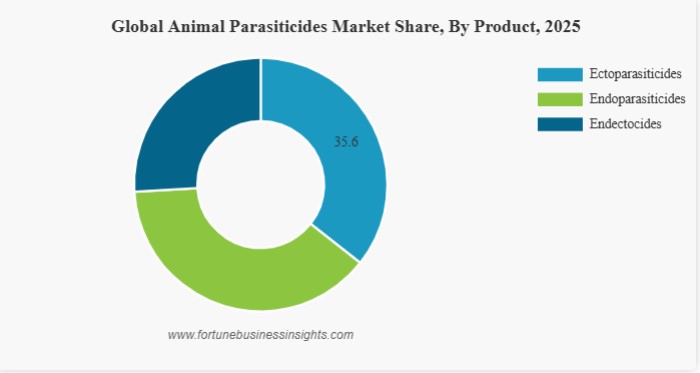
Animal Parasiticides Market Share
The animal parasiticides market is led by key companies such as Zoetis Services LLC, Merck & Co., Inc., Elanco, and Boehringer Ingelheim, Vetoquinol and more.
PUNE, MAHARASHTRA, INDIA, February 3, 2026 /EINPresswire.com/ -- Animal parasiticides are veterinary drugs used to prevent, control, and treat internal and external parasites in animals. These parasites include fleas, ticks, mites, lice, roundworms, tapeworms, and other harmful organisms that can significantly impact animal health and productivity. Parasitic infestations often lead to skin disorders, weight loss, reduced milk yield, and in severe cases, death, making effective parasite control essential across both companion animals and livestock. The growing emphasis on animal welfare, combined with increasing spending on veterinary care, has elevated the demand for reliable parasiticide solutions. As livestock producers aim to improve productivity and pet owners seek enhanced protection for companion animals, the market continues to expand across developed and emerging regions.The global Animal Parasiticides Market is experiencing steady expansion as animal health management becomes a top priority for pet owners, livestock producers, and veterinary professionals worldwide. The market was valued at USD 12.96 billion in 2025 and is projected to grow from USD 13.82 billion in 2026 to USD 23.73 billion by 2034, registering a robust CAGR of 6.99% during the forecast period. This growth reflects rising awareness of parasite control, increasing animal ownership, and advancements in veterinary pharmaceuticals.
Request a free sample PDF:- https://www.fortunebusinessinsights.com/enquiry/request-sample-pdf/animal-parasiticides-market-114910
Market Drivers and Growth Factors
A primary factor driving market growth is the rising global demand for animal-derived food products. Livestock farmers increasingly rely on parasiticides to protect animals from infections that can reduce productivity and cause economic losses. Healthy animals translate into higher-quality meat, milk, and other animal products, strengthening the adoption of parasiticides across commercial farming operations.
Additionally, the growing prevalence of parasitic infections among companion animals has increased the need for preventive treatments. Urbanization, climate change, and close interaction between pets and humans have heightened parasite exposure, further fueling demand for advanced parasiticide formulations.
Market Challenges and Restraints
Despite favorable growth prospects, the market faces challenges related to the increasing resistance of parasites to commonly used parasiticides. Overuse and improper administration of anti-parasitic drugs have enabled parasites to develop resistance, reducing treatment effectiveness and complicating parasite management.
Rising concerns about resistance have prompted regulatory bodies and industry stakeholders to emphasize responsible use and improved treatment protocols. These challenges encourage manufacturers to invest in innovation and the development of next-generation parasiticides.
Emerging Market Trends
One of the most prominent trends shaping the animal parasiticides market is increased investment in research and development. Pharmaceutical companies are focusing on creating advanced formulations that provide longer-lasting protection, broader parasite coverage, and improved safety profiles.
Another notable trend is the growing preference for combination products that target multiple parasites simultaneously. These solutions simplify treatment regimens and improve compliance among animal owners. Technological advancements and funding initiatives continue to support innovation in parasite prevention and treatment.
Market Segmentation Analysis
By Product Type
The market is segmented into ectoparasiticides, endoparasiticides, and endectocides. Among these, the endoparasiticides segment held the dominant market share in 2025. This dominance is attributed to the high prevalence of internal parasitic infections and the availability of new products designed to address both intestinal and systemic parasites.
By Animal Type
Based on animal type, the market is divided into companion animals and livestock. The companion animals segment accounted for the largest share in 2025, driven by increasing pet ownership, rising pet humanization, and greater awareness of parasite-related diseases. Livestock animals also represent a substantial portion of the market due to the need for disease prevention and productivity enhancement.
By Route of Administration
The oral route of administration dominated the market in 2025 due to ease of use and widespread availability. Oral parasiticides offer convenience and improved adherence to treatment schedules. The parenteral segment is expected to witness steady growth as injectable solutions gain acceptance in clinical and farm settings.
By Distribution Channel
Pharmacies and drug stores emerged as the leading distribution channel in 2025, supported by easy access and the availability of a wide range of parasiticides. Veterinary clinics and hospitals are anticipated to grow at a notable pace, as animal owners increasingly prefer professional diagnosis and treatment.
Speack To Analyst:- https://www.fortunebusinessinsights.com/enquiry/request-sample-pdf/animal-parasiticides-market-114910
Regional Market Insights
North America dominated the global animal parasiticides market in 2025, with a market value of USD 3.95 billion. The region benefits from high pet adoption rates, advanced veterinary infrastructure, and strong presence of leading pharmaceutical companies.
Europe followed closely, valued at USD 3.52 billion in 2025. Increased awareness among farmers and pet owners regarding parasite prevention has supported regional growth.
Asia Pacific emerged as the third-largest market with a valuation of USD 3.08 billion. Rapid expansion of livestock farming, rising pet ownership, and growing veterinary healthcare investments in countries such as China and India are driving regional demand.
Latin America and the Middle East & Africa are expected to witness moderate growth, supported by expanding livestock populations and improving animal healthcare awareness.
Competitive Landscape
The animal parasiticides market is highly competitive, with several global players actively investing in product innovation and strategic expansion. Key companies operating in the market include Zoetis Services LLC, Merck & Co., Inc., Elanco, Boehringer Ingelheim International GmbH, Ceva, Vetoquinol, Dechra Pharmaceuticals Limited, and Virbac Corporation.
These companies focus on strengthening their product portfolios, expanding geographical reach, and enhancing research capabilities to maintain a competitive edge.
Key Industry Developments
August 2025: Merck & Co., Inc. showcased its BRAVECTO fluralaner portfolio at a global veterinary parasitology congress, highlighting advancements in parasite prevention.
April 2025: Zoetis Services LLC received approval for a new label indication for Simparica Trio to prevent flea tapeworm infections in dogs.
Future Market Outlook
The global animal parasiticides market is expected to maintain strong momentum through 2034, supported by rising parasite incidence, increased focus on animal welfare, and continuous product innovation. Advancements in drug formulations and expanding awareness of parasite control will play a crucial role in shaping future market growth.
With sustained investments in research and a growing emphasis on preventive animal healthcare, the animal parasiticides market is well-positioned for long-term expansion across both developed and emerging regions.
Ashwin Arora
Fortune Business Insights™ Pvt. Ltd.
+91 83390 92966
email us here
Legal Disclaimer:
EIN Presswire provides this news content "as is" without warranty of any kind. We do not accept any responsibility or liability for the accuracy, content, images, videos, licenses, completeness, legality, or reliability of the information contained in this article. If you have any complaints or copyright issues related to this article, kindly contact the author above.
