

Biochar Market Size to Reach USD 2,731.94 Million by 2034 | CAGR 13.83% (2026–2034)
Biochar Market
Biochar Market Size, Sustainable Agriculture Demand, and Growth Outlook 2026–2034
Asia Pacific dominated the global market with a share of 82.97% in 2025”
PUNE, MAHARASHTRA, INDIA, February 11, 2026 /EINPresswire.com/ -- Biochar Market Overview Analysis— Fortune Business Insights
The global biochar market represents a rapidly expanding sector at the intersection of sustainable agriculture, climate change mitigation, and renewable energy systems. This charcoal-like material, produced through high-temperature decomposition of plant biomass, demonstrates remarkable potential for carbon sequestration, soil enhancement, and waste management applications. As environmental consciousness intensifies and carbon credit mechanisms gain prominence, biochar emerges as a compelling solution addressing multiple sustainability challenges simultaneously.
Market Valuation and Growth Trajectory
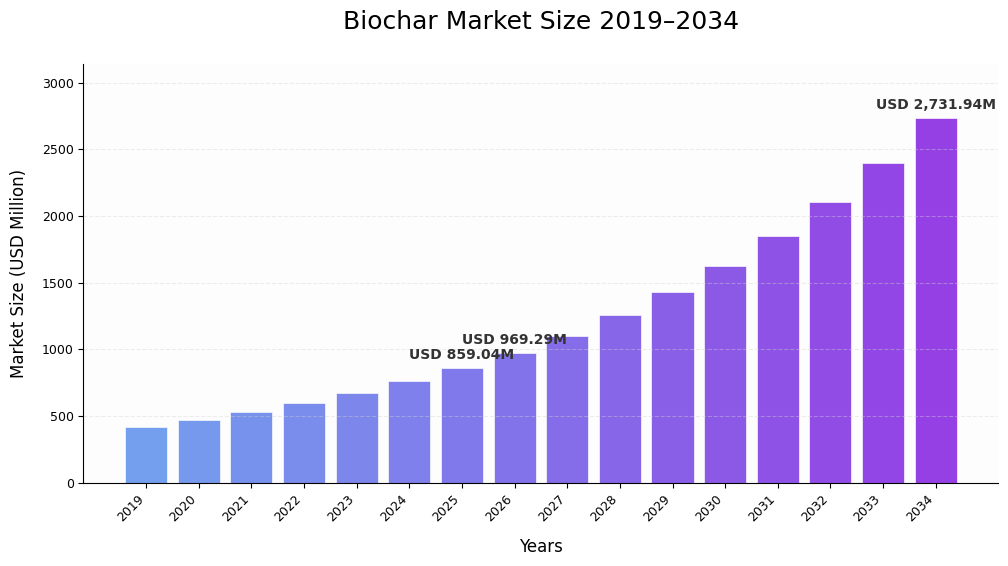
The global biochar market size was valued at USD 859.04 million in 2025. The market growth is projected to grow from USD 969.29 million in 2026 to USD 2,731.94 million by 2034, exhibiting a CAGR of 13.83% during the forecast period. Asia Pacific dominated the global market with a share of 82.97% in 2025. The biochar market in the U.S. is projected to grow significantly, reaching an estimated value of USD 43.61 million by 2032, driven by the federal and state renewable energy mandates and the push toward combating GHG emissions.
Request a Sample PDF: https://www.fortunebusinessinsights.com/enquiry/request-sample-pdf/biochar-market-100750
Regional analysis reveals Asia Pacific commanding overwhelming market dominance with an 82.47% share in 2024. This leadership position stems from the region's extensive agricultural activities, supportive government programs promoting sustainable farming practices, and large-scale soil remediation initiatives across countries including China and India. The region's abundant agricultural waste streams and growing environmental awareness create ideal conditions for biochar adoption and production capacity expansion.
Technology Segmentation and Production Methods
Pyrolysis technology maintains dominant market position as the preferred biochar production method, valued for cost-effectiveness, operational convenience, and versatility in handling diverse feedstock materials. This thermochemical conversion process transforms biomass into stable, carbon-rich biochar while avoiding direct greenhouse gas emissions associated with open burning or decomposition. The technology's ability to produce consistent, high-quality biochar suitable for agricultural and environmental applications underpins its market leadership.
Gasification represents an alternative production technology demonstrating significant growth potential. While producing smaller biochar quantities compared to pyrolysis, gasification generates lower air pollutant levels and offers efficiency advantages in specific applications. The technology operates through oxygen-introduced reaction vessels converting organic materials into carbon monoxide and carbon dioxide at elevated temperatures. Growing environmental regulations and air quality concerns support gradual gasification adoption, particularly in regions with stringent emission standards.
Application Landscape and Market Drivers
The farming segment dominates application categories, driven by biochar's proven benefits for soil enhancement, nutrient retention, and crop yield improvement. Agricultural applications leverage biochar's highly porous structure and carbon-rich composition to improve soil structure, water retention capacity, and nutrient availability. These properties create optimal conditions for plant growth while simultaneously sequestering atmospheric carbon in stable, long-lasting forms. The integration of biochar into sustainable agriculture practices addresses multiple challenges including soil degradation, water scarcity, and declining agricultural productivity.
Livestock applications represent growing market segments where biochar serves as feed additive and waste management solution. The material's adsorption properties reduce methane emissions from animal digestion while improving manure quality and reducing odor. Power generation applications utilize biochar as renewable fuel source, contributing to energy production while generating carbon credits through carbon sequestration. These diverse applications demonstrate biochar's versatility and multifunctional value proposition.
Carbon Credit Integration and Climate Solutions
Biochar's permanent carbon sequestration capability positions it strategically within emerging carbon credit markets. Unlike reduction credits that prevent emissions, biochar generates removal credits through physical carbon capture in stable form lasting centuries to millennia. Microsoft's purchase of 95,000 tons of carbon dioxide removal credits from Mexican biochar operations exemplifies major corporate commitments to biochar-based carbon strategies. Such high-profile transactions validate biochar's carbon sequestration potential and create lucrative revenue streams for producers.
The carbon dioxide removal credit mechanism provides secondary revenue opportunities beyond biochar's agricultural and industrial applications. As corporations and governments intensify climate commitments, demand for verified carbon removal solutions escalates. Biochar's measurable, permanent carbon sequestration characteristics make it particularly attractive for carbon accounting and climate goal achievement. This dual revenue model combining biochar sales with carbon credit generation enhances economic viability and accelerates market development.
Sustainable Agriculture and Soil Health Initiatives
Rising adoption of sustainable agriculture practices constitutes a fundamental market driver. Governments and organizations worldwide promote regenerative farming methods addressing soil health, water conservation, and ecosystem restoration. Major corporations including Mars, McCain Foods, McDonald's, Mondelez International, and PepsiCo collaborate on initiatives making regenerative farming financially viable and scalable across global markets. India's Agriculture Department distribution of 200 metric tons of biochar to farmers demonstrates government-level support for biochar adoption.
Biochar integration addresses critical agricultural challenges including soil erosion, compaction, nutrient depletion, and water retention deficiencies. The material's ability to improve soil aeration, enhance moisture retention, and increase nutrient capacity creates compelling value propositions for farmers seeking productivity improvements and environmental stewardship. These benefits prove particularly relevant in degraded agricultural lands and regions facing water scarcity or soil quality challenges.
Request for an Enquiry: https://www.fortunebusinessinsights.com/enquiry/book-a-call/biochar-market-100750
Competitive Landscape and Strategic Positioning
The market exhibits high fragmentation with numerous regional and international players. Leading companies including Chardust Ltd, Aries Clean Energy, Airex Energy, and Farm2Energy maintain strong positions through operational excellence, technology innovation, and geographic presence. Airex Energy's partnership with SUEZ Group demonstrates industry collaboration patterns addressing biomass residue recovery and carbon neutrality goals. Strategic alliances enable technology sharing, market access, and project risk mitigation supporting industry development.
Market participants differentiate through technology platforms, feedstock versatility, production efficiency, and carbon certification capabilities. Companies offering integrated solutions combining biochar production, carbon credit generation, and agricultural support services gain competitive advantages. The industry's relatively early development stage creates opportunities for innovative business models and market positioning strategies as standardization, quality certification, and carbon accounting frameworks continue evolving through 2032 and beyond.
Read More Research Reports:
Biogas Plant Market Size, Share & Industry Analysis
Liquid Biofuels Market Size, Share & Industry Analysis
Ashwin Arora
Fortune Business Insights™ Pvt. Ltd.
+1 833-909-2966
sales@fortunebusinessinsights.com
Legal Disclaimer:
EIN Presswire provides this news content "as is" without warranty of any kind. We do not accept any responsibility or liability for the accuracy, content, images, videos, licenses, completeness, legality, or reliability of the information contained in this article. If you have any complaints or copyright issues related to this article, kindly contact the author above.
