

Hearing-Safe Tool Market Forecast 2026-2036: Market Size, Share, Competitive Landscape & Future Growth Outlook
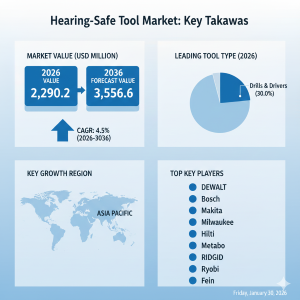
Hearing-Safe Tool Market grows steadily as industries prioritize worker safety, noise reduction, and compliance with occupational health standards.
ROCKVILLE, MD, UNITED STATES, January 30, 2026 /EINPresswire.com/ -- As industrial sectors intensify their focus on occupational health and safety, the global hearing-safe tool and protection market is undergoing a significant technological transformation. Valued at approximately USD 2,290.2 million in 2026, the market is forecasted to reach USD 3,556.6 million by 2036, growing at a steady Compound Annual Growth Rate (CAGR) of 4.5%.This expansion is driven by a critical intersection of regulatory necessity and engineering innovation. With over 40% of the global workforce currently exposed to hazardous noise levels in sectors like construction, manufacturing, and aviation, the demand for "hearing-safe" solutions—comprising both low-decibel power tools and advanced electronic hearing protection—has shifted from a secondary safety concern to a primary industrial priority.
Request for Sample Report | Customize Report |purchase Full Report - https://www.factmr.com/connectus/sample?flag=S&rep_id=13969
The Shift Toward "Hearing-Safe" Engineering: Who and How
The industry is moving beyond traditional "passive" protection. While foam earplugs still hold a significant unit share due to their affordability, the market’s value is increasingly concentrated in active and smart hearing technologies.
Key industry leaders, including 3M, Honeywell International, MSA Safety, and Starkey, are spearheading the "Who" of this transition. These companies are integrating IoT sensors and Active Noise Cancellation (ANC) into standard personal protective equipment (PPE). In January 2026, the market saw a surge in "situational awareness" tools—devices that suppress harmful impulse noises, such as hammer strikes or explosions, while simultaneously amplifying human speech to ensure site-wide communication remains intact.
Strategic Market Drivers:
Stricter Compliance: Regulatory bodies like OSHA (U.S.) and EU-OSHA (Europe) are enforcing lower Permissible Exposure Limits (PEL), compelling firms to adopt "Quiet by Design" equipment.
The "Quiet" Tool Revolution: Beyond PPE, there is a rising trend in the procurement of low-vibration and silenced power tools. Manufacturers are replacing pneumatic impact breakers with hydraulic or electric alternatives to mitigate noise at the source.
Technological Convergence: Smart headsets now feature real-time noise dosimetry, allowing safety managers to monitor a worker’s cumulative noise "dose" via mobile apps and cloud-based analytics.
Regional Outlook: North America Leads, Asia-Pacific Accelerates
Geographically, North America remains the largest market, accounting for roughly 31.5% of global revenue. This dominance is attributed to a mature safety culture and high adoption rates of premium electronic hearing protectors in the defense and oil and gas sectors.
However, the Asia-Pacific region is identified as the fastest-growing corridor. Rapid industrialization in India and China, coupled with new government mandates for worker safety in infrastructure projects, is driving a double-digit growth rate in the adoption of hearing-safe equipment across the region.
Economic and Health Implications
The "Why" behind this market's momentum is as much economic as it is medical. The World Health Organization (WHO) estimates that unaddressed hearing loss costs the global economy nearly $980 billion annually in lost productivity and healthcare expenses.
"We are seeing a fundamental shift in how industrial noise is managed," says a senior market analyst. "The industry is moving away from just 'blocking' sound and toward 'managing' it. By 2027, the standard expectation for a construction site will not just be the presence of earplugs, but the use of smart, connected devices that protect hearing without isolating the worker."
Future Trends and AI Optimization
Looking toward 2030, the market is set to be redefined by custom-molded 3D-printed protection and AI-driven sound filtering. These innovations address the leading cause of non-compliance: user discomfort. By providing a personalized fit and "natural" sound environments, manufacturers are successfully increasing the daily usage rates of hearing protection in high-risk zones.
About the Industry Analysis: This press release is based on 2026 market intelligence and industrial safety reports. It highlights the transition from passive to active hearing conservation strategies across the global industrial landscape.
To View Related Report:
Stationary Fuel Cell System Market https://www.factmr.com/report/2456/stationary-fuel-cell-systems-market
Light Towers Market https://www.factmr.com/report/2477/light-towers-market
Vacuum Degreaser Market https://www.factmr.com/report/2533/vacuum-degreaser-market
Cold Milling Machine Market https://www.factmr.com/report/2598/cold-milling-machine-market
About Fact.MR
Fact.MR is a global market research and consulting firm, trusted by Fortune 500 companies and emerging businesses for reliable insights and strategic intelligence. With a presence across the U.S., UK, India, and Dubai, we deliver data-driven research and tailored consulting solutions across 30+ industries and 1,000+ markets. Backed by deep expertise and advanced analytics, Fact.MR helps organizations uncover opportunities, reduce risks, and make informed decisions for sustainable growth.
S. N. Jha
Fact.MR
+ +1 628-251-1583
sales@factmr.com
Legal Disclaimer:
EIN Presswire provides this news content "as is" without warranty of any kind. We do not accept any responsibility or liability for the accuracy, content, images, videos, licenses, completeness, legality, or reliability of the information contained in this article. If you have any complaints or copyright issues related to this article, kindly contact the author above.
