

Automotive Battery Management System Market Witnesses 16.2% CAGR to Hit US$28.5 Bn by 2032 | Persistence Market Research
Automotive Battery Management System Market
Rising EV adoption and advanced battery technologies drive growth in the global automotive battery management system market.
BRENTFORD, LONDON, UNITED KINGDOM, January 29, 2026 /EINPresswire.com/ -- The global automotive battery management system market is witnessing significant growth due to the rapid adoption of electric vehicles (EVs) and the increasing demand for efficient battery performance. A battery management system (BMS) is a critical component that ensures the safety, longevity, and efficiency of automotive batteries. With automakers focusing on electric mobility and hybrid solutions, the integration of advanced BMS technology has become a priority to enhance energy storage systems, optimize battery life, and prevent overcharging or thermal failures. The growing awareness regarding environmental sustainability and stringent government regulations on emission control are further fueling the adoption of electric and hybrid vehicles, directly impacting the demand for automotive battery management systems.
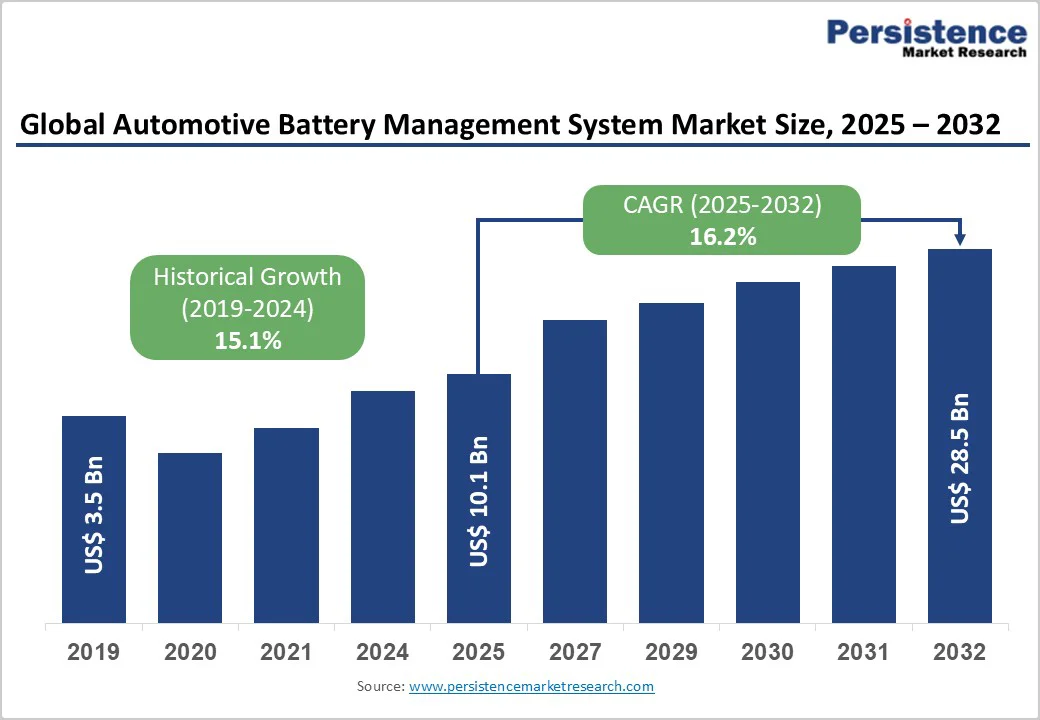
According to Persistence Market Research, the global automotive battery management system market size was valued at US$10.1 billion in 2025 and is projected to reach US$28.5 billion by 2032, registering a CAGR of 16.2% between 2025 and 2032. The market growth is driven by the increasing production of electric vehicles, rising consumer preference for fuel-efficient mobility solutions, and advancements in battery technology. Among the leading segments, the lithium-ion battery management systems are witnessing significant adoption due to their higher energy density and durability. Geographically, North America emerges as a dominant market, largely due to extensive EV adoption, robust automotive infrastructure, and supportive government incentives for electric mobility.
Get Your FREE Sample Report Instantly Click Now: https://www.persistencemarketresearch.com/samples/33548
The key players studied in the report include:
• Continental AG
• Denso Corporation
• LG Chem
• Robert Bosch GmbH
• Johnson Controls International plc (Clarios)
• NXP Semiconductors
• Texas Instruments Incorporated
• Eberspächer
• Calsonic Kansei Corporation
• Mitsubishi Electric Corporation
• Others Key Players
Key Highlights from the Report
➤ The global automotive battery management system market is projected to nearly triple in value from 2025 to 2032, reaching US$28.5 billion.
➤ Lithium-ion battery management systems are the leading product segment due to superior performance and safety features.
➤ North America remains the leading regional market owing to rapid EV adoption and government initiatives.
➤ Growing environmental regulations and emission reduction mandates are driving market demand.
➤ Technological advancements in battery monitoring and control are enabling better energy efficiency in EVs.
➤ Increasing consumer awareness regarding vehicle safety and battery longevity is contributing to market expansion.
Market Segmentation
By Topology
• Centralized
• Distributed
• Modular
By Battery Type
• Lithium-Ion Based
• Lead-Acid Based
• Nickel Based
• Misc
By Propulsion
• BEV
• HEV
• PHEV
By Vehicle Type
• Passenger Car
• LCV
• HCV
By Region
• North America
• Europe
• Asia Pacific
• Latin America
• Middle East & Africa
Customize This Report for Your Exact Requirements: https://www.persistencemarketresearch.com/request-customization/33548
Regional Insights
In terms of regional trends, North America dominates the automotive battery management system market, driven by robust EV adoption, technological innovation, and substantial government subsidies promoting electric mobility. The United States, in particular, is witnessing strong growth due to aggressive investments in EV infrastructure and the presence of leading BMS technology providers. Meanwhile, Europe is following closely, supported by stringent emission regulations and rising consumer adoption of hybrid and electric vehicles across Germany, France, and the UK.
Asia-Pacific is emerging as a high-growth market owing to rapid industrialization, increasing automotive production, and growing demand for electric vehicles in China, India, and Japan. Government policies encouraging EV adoption and local manufacturing of lithium-ion batteries are boosting market penetration. The region also benefits from competitive labor costs and a large consumer base for electric vehicles, making it a strategic market for global BMS manufacturers.
Market Drivers
The automotive battery management system market is primarily driven by the surge in electric vehicle production and adoption. EVs require sophisticated BMS solutions to monitor battery health, manage charging cycles, and prevent failures. Increasing environmental concerns and emission regulations worldwide are compelling automakers to integrate advanced battery management systems in their vehicles. Moreover, rising consumer awareness about battery safety, efficiency, and longevity is pushing manufacturers to adopt intelligent BMS solutions with real-time diagnostics and predictive analytics.
Technological advancements in battery monitoring, including the development of software-based and AI-integrated BMS systems, are further enhancing market growth. Smart battery management allows for optimized energy usage, reduced downtime, and better thermal management, which is critical for the performance of electric and hybrid vehicles. As automakers strive to improve EV performance and reduce maintenance costs, the adoption of advanced BMS technology is expected to accelerate, solidifying its role as a key growth driver for the market.
Market Opportunities
The automotive battery management system market offers significant growth opportunities, particularly in regions witnessing rapid EV adoption. The development of smart BMS solutions with AI and IoT integration is creating opportunities for companies to offer predictive maintenance, real-time monitoring, and battery optimization services. Partnerships between automakers and technology providers are expected to accelerate innovation, resulting in more efficient and cost-effective solutions.
Emerging markets in Asia-Pacific and Latin America provide new avenues for growth due to rising EV penetration and government incentives for clean mobility. Additionally, advancements in second-life battery applications, such as energy storage for renewable energy, create opportunities for BMS manufacturers to diversify offerings beyond automotive applications. As the electric mobility ecosystem continues to expand, companies that invest in advanced, adaptable, and scalable BMS solutions are poised to capture a significant market share.
Ready to Dive Deep? Buy Full Report Today: https://www.persistencemarketresearch.com/checkout/33548
Recent Developments:
• August 2025: LG Chem launched an AI-enabled battery management system to enhance EV performance.
• November 2025: Bosch announced a strategic partnership with a leading EV manufacturer to integrate advanced BMS solutions in next-generation electric vehicles.
Future Opportunities and Growth Prospects
The automotive battery management system market is set for continued growth as global electric vehicle adoption rises and technological innovations advance. Companies investing in smart BMS solutions, AI integration, and scalable battery monitoring systems are expected to capture a competitive edge. Expanding into emerging markets and developing solutions for next-generation battery technologies will create new revenue streams.
Persistence Market Research
Persistence Market Research Pvt Ltd
+1 646-878-6329
email us here
Visit us on social media:
LinkedIn
Instagram
Facebook
YouTube
X
Legal Disclaimer:
EIN Presswire provides this news content "as is" without warranty of any kind. We do not accept any responsibility or liability for the accuracy, content, images, videos, licenses, completeness, legality, or reliability of the information contained in this article. If you have any complaints or copyright issues related to this article, kindly contact the author above.
