

How Smart Helmets Are Redefining Protection Across Roads and Worksites
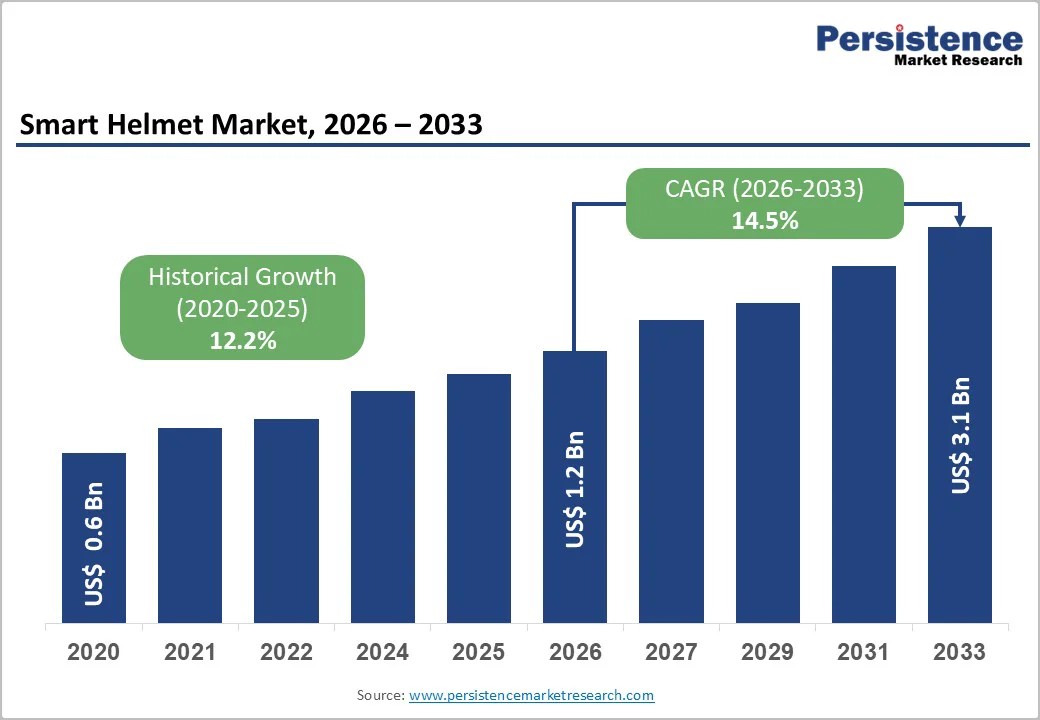
Smart Helmet Market to reach US$3.1 billion by 2033, growing at 14.5% CAGR, driven by IoT wearables, safety regulations, and rising adoption globally
BRENTFORD, ENGLAND, UNITED KINGDOM, January 29, 2026 /EINPresswire.com/ -- The global smart helmet market is transitioning from a niche innovation into a mainstream safety solution, driven by the convergence of digital connectivity, advanced sensors, and rising safety awareness. Smart helmets integrate features such as Bluetooth communication, GPS navigation, heads-up displays (HUDs), cameras, and impact detection to enhance user safety and situational awareness. Initially popular among premium motorcycle riders, these helmets are now gaining strong traction across construction, mining, manufacturing, and emergency response sectors.
From a market size perspective, the smart helmet market is likely to be valued at US$ 1.2 billion in 2026 and is projected to reach US$ 3.1 billion by 2033, expanding at a robust CAGR of 14.5% between 2026 and 2033. Growth is underpinned by increasing road accident fatality rates, stringent occupational safety regulations, and the rapid adoption of IoT-enabled wearable technologies. Full smart helmets currently dominate due to their advanced features and premium positioning, while North America leads geographically owing to strict safety mandates and early technology adoption, with Asia Pacific emerging as the fastest-growing region due to massive two-wheeler penetration in China and India.
𝐆𝐞𝐭 𝐚 𝐒𝐚𝐦𝐩𝐥𝐞 𝐏𝐃𝐅 𝐁𝐫𝐨𝐜𝐡𝐮𝐫𝐞 𝐨𝐟 𝐭𝐡𝐞 𝐑𝐞𝐩𝐨𝐫𝐭: https://www.persistencemarketresearch.com/samples/21517
Smart Helmet Market Segmentation Analysis
The smart helmet market is segmented by product type, including full smart helmets, smart hard hats, and half smart helmets. Full smart helmets currently hold the largest market share, primarily due to their higher average selling prices and comprehensive feature sets, such as HUDs, integrated cameras, and voice control. These helmets are widely adopted in premium motorcycling and professional sports, where enhanced visibility and communication are critical. Meanwhile, smart hard hats are witnessing accelerated adoption in industrial environments as companies prioritize worker safety and regulatory compliance.
Based on end-user segmentation, the market spans consumer, construction, industrial, mining, and emergency services. The consumer segment dominates the market with approximately 47% share in 2026, reflecting growing demand for connected motorcycle gear and rising disposable incomes. However, the construction segment is expected to grow at the fastest CAGR of nearly 18% through 2033. This growth is driven by increasing deployment of connected personal protective equipment (PPE) to monitor worker health, detect hazards in real time, and improve productivity on large infrastructure projects.
Regional Insights: Smart Helmet Market by Geography
North America remains the leading regional market for smart helmets, supported by stringent workplace safety laws, high consumer awareness, and strong penetration of advanced wearable technologies. The United States, in particular, benefits from robust R&D investments and the presence of key technology-driven helmet manufacturers focusing on AR, AI, and cloud connectivity.
Asia Pacific is poised to register the fastest growth during the forecast period, driven by rapid urbanization, expanding construction activity, and massive two-wheeler ownership in countries such as China and India. Government-led road safety campaigns, coupled with increasing affordability of smart helmets, are accelerating adoption across both consumer and industrial segments in the region.
𝐃𝐨 𝐘𝐨𝐮 𝐇𝐚𝐯𝐞 𝐀𝐧𝐲 𝐐𝐮𝐞𝐫𝐲 𝐎𝐫 𝐒𝐩𝐞𝐜𝐢𝐟𝐢𝐜 𝐑𝐞𝐪𝐮𝐢𝐫𝐞𝐦𝐞𝐧𝐭? 𝐑𝐞𝐪𝐮𝐞𝐬𝐭 𝐂𝐮𝐬𝐭𝐨𝐦𝐢𝐳𝐚𝐭𝐢𝐨𝐧 𝐨𝐟 𝐑𝐞𝐩𝐨𝐫𝐭: https://www.persistencemarketresearch.com/request-customization/21517
Market Drivers Fueling Smart Helmet Adoption
One of the primary drivers of the smart helmet market is the rising incidence of road accidents and workplace injuries, which has intensified the focus on proactive safety solutions. Smart helmets provide real-time alerts, collision detection, and emergency communication, significantly improving response times during accidents. Additionally, advancements in IoT, AI, and sensor miniaturization have enhanced helmet functionality while improving comfort and battery efficiency.
Another strong growth driver is the implementation of strict safety regulations across construction, mining, and manufacturing sectors. Governments and regulatory bodies worldwide are mandating the use of advanced protective gear to reduce fatalities and insurance costs. Smart helmets, with their ability to monitor worker behavior and environmental conditions, align well with these regulatory objectives.
Market Restraints Limiting Wider Penetration
Despite strong growth prospects, the smart helmet market faces challenges related to high initial costs and affordability concerns, particularly in price-sensitive emerging economies. Advanced features such as HUDs, cameras, and AI-driven analytics significantly increase product prices, limiting adoption among mass-market consumers and small enterprises.
Technical limitations, including battery life constraints, device weight, and data privacy concerns, also pose barriers to adoption. Continuous connectivity and real-time data transmission can drain battery performance, while the collection of user data raises concerns regarding cybersecurity and compliance with data protection regulations.
Market Opportunities and Future Potential
The integration of artificial intelligence, augmented reality, and 5G connectivity presents lucrative growth opportunities for smart helmet manufacturers. AI-powered analytics can enable predictive safety alerts, while AR-based HUDs can provide navigation, hazard warnings, and workflow instructions, particularly in industrial environments.
Expanding smart city initiatives and infrastructure development projects further open new avenues for smart helmet deployment. As cities invest in connected ecosystems, smart helmets can seamlessly integrate with traffic management systems, emergency services, and enterprise safety platforms, driving long-term demand across both consumer and industrial verticals.
𝐁𝐮𝐲 𝐍𝐨𝐰 𝐭𝐡𝐞 𝐃𝐞𝐭𝐚𝐢𝐥𝐞𝐝 𝐑𝐞𝐩𝐨𝐫𝐭: https://www.persistencemarketresearch.com/checkout/21517
Shoei Co., Ltd.
Forcite Helmet Systems
Sena Technologies, Inc.
LIVALL Technology Co., Ltd.
Schuberth GmbH
Daqri LLC
CrossHelmet Ltd.
Nand Logic (Jarvish)
Recent Developments:
In November 2025, Shoei launched the GT-Air 3 Smart Helmet, featuring the world’s first fully integrated AR HUD with nano-OLED display, mesh and cellular communication, noise-cancelling microphones, and a 10-hour battery life. Additionally, several manufacturers are actively investing in AI-driven safety analytics and enterprise partnerships to expand smart helmet adoption across construction and industrial sectors.
Conclusion: The Future of Smart Helmets
The smart helmet market is entering a high-growth phase, driven by technological innovation, rising safety awareness, and expanding use cases beyond motorcycling. As IoT, AI, and AR technologies mature, smart helmets are set to evolve into intelligent safety platforms rather than standalone protective gear. With North America leading adoption and Asia Pacific emerging as a growth powerhouse, the global smart helmet market presents compelling opportunities for manufacturers, investors, and technology providers seeking to shape the future of connected safety solutions.
Related Reports:
Pooja Gawai
Persistence Market Research
+1 646-878-6329
email us here
Visit us on social media:
LinkedIn
Instagram
Facebook
YouTube
Legal Disclaimer:
EIN Presswire provides this news content "as is" without warranty of any kind. We do not accept any responsibility or liability for the accuracy, content, images, videos, licenses, completeness, legality, or reliability of the information contained in this article. If you have any complaints or copyright issues related to this article, kindly contact the author above.
