

In-store Refill Stations Market Set to Reach USD 6.2 Billion by 2036 as Retail Efficiency, and Reuse Economics Converge
In-store refill stations Market
UK refill infrastructure demand to grow 11.8% CAGR to 2036, driven by packaging costs, compliance rules, and incentives for reuse and refill models.
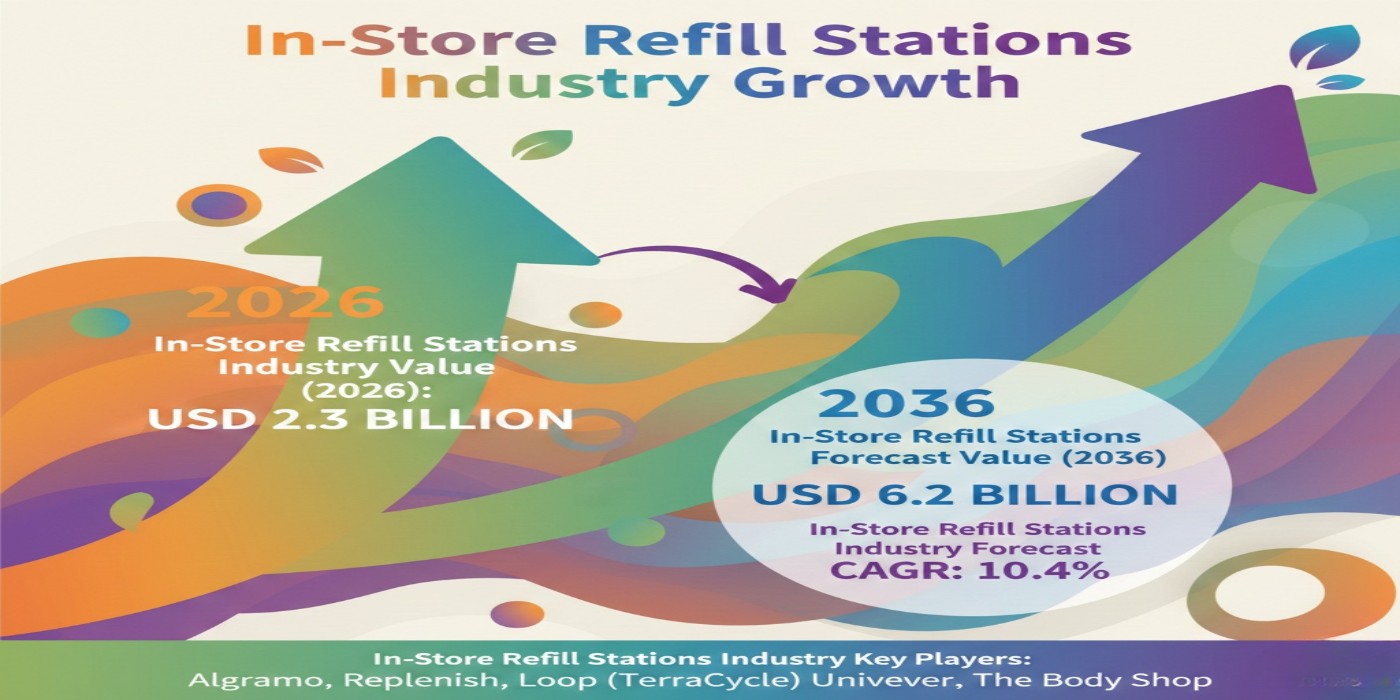
NEWARK, DE, UNITED STATES, January 29, 2026 /EINPresswire.com/ -- The global in-store refill stations market is entering a decisive scale-up phase as retailers, brands, and regulators align around measurable reductions in single-use packaging without compromising store operations, hygiene, or customer convenience. According to industry analysis, in-store refill stations are valued at USD 2.3 billion in 2026 and are projected to reach USD 6.2 billion by 2036, expanding at a compound annual growth rate (CAGR) of 10.4% over the forecast period.
This growth reflects a transition from small pilot programs to standardized, retail-ready refill formats across water, household liquids, and personal care products, where repeat purchase behavior is easiest to establish and operational predictability is critical.
Discover Growth Opportunities in the Market – Get Your Sample Report Now
https://www.futuremarketinsights.com/reports/sample/rep-gb-31763
Market Snapshot: In-store Refill Stations Industry
Quick Stats (2026–2036)
• Industry Size (2026): USD 2.3 Billion
• Forecast Value (2036): USD 6.2 Billion
• CAGR (2026–2036): 10.4%
• Leading Product Type: Water Refill Stations (34.8% share)
• Top Growth Regions: North America, Europe, Asia-Pacific
• Key Players: Algramo, Replenish, Loop (TerraCycle), Unilever, The Body Shop
Why In-store Refill Stations Are Scaling Now
Retailers are under growing pressure to reduce packaging waste in ways that are auditable, compliant, and operationally viable. In-store refill stations address this need by eliminating packaged volume at the point of sale while maintaining throughput, sanitation, and pricing control.
Investment is increasingly flowing into modular dispensing hardware that integrates with point-of-sale systems, supports precise metering by weight or volume, and incorporates spill control, container compatibility, and sanitation-focused design. These features allow retailers to manage labor, shrink, and compliance outcomes with greater certainty, turning refill from a sustainability initiative into a core retail capability.
Regulation as a Direct Market Accelerator
Government policy is no longer a background influence it is a primary growth driver reshaping the economics of packaging.
Key regulatory developments accelerating adoption include:
• European Union: The Packaging and Packaging Waste Regulation (EU) 2025/40 strengthens packaging prevention and reuse obligations, increasing pressure on retailers to deploy compliant refill and reuse systems at scale.
• United Kingdom: The Plastic Packaging Tax and expanding extended producer responsibility (EPR) requirements raise the cost of non-compliant packaging, reinforcing interest in packaging avoidance through refill.
• United States (California): SB 54 establishes one of the strongest EPR frameworks globally, explicitly supporting reuse and refill pathways as part of source reduction targets.
As compliance requirements tighten, competitive advantage shifts to operators that can demonstrate documented cleaning protocols, dispensing accuracy, and traceability, positioning refill stations as infrastructure for regulatory readiness rather than optional sustainability add-ons.
Water Refill Stations Lead Product Adoption
Water refill stations account for 34.8% of total market share in 2026, maintaining leadership due to high consumer acceptance and operational simplicity.
Key factors supporting water refill dominance include:
• Proven filtration stacks, including sediment pre-filtration, activated carbon, UV sterilization, and membrane purification
• Filter-life tracking and basic quality monitoring that simplify maintenance planning
• Suitability for high-footfall locations such as supermarkets, campuses, and transit-linked retail
Brand-led partnerships and co-branded refill points are further accelerating deployment by protecting premium positioning while reducing bottled SKU volume.
Commercial Applications Drive End-User Demand
Commercial applications represent 38.5% of end-user share in 2026, reflecting institutional commitments to measurable waste reduction and cost control.
Retail chains rely on refill stations to:
• Meet corporate sustainability mandates
• Deliver bulk household and personal care products efficiently
• Maintain customer satisfaction in high-volume environments
Automation and smart dispensing capabilities remain critical purchase criteria, reinforcing demand for systems designed for continuous, high-throughput operation.
Supermarkets Dominate Distribution Channels
Supermarkets and hypermarkets account for 42.1% of distribution channel share in 2026, benefiting from high traffic, flexible store layouts, and existing bulk merchandising infrastructure.
Their leadership is supported by:
• Seamless POS integration
• Compatibility with multiple payment and loyalty systems
• Consumer preference for one-stop access to refillable household essentials
Digital Integration Reshapes the Refill Experience
Digital layers are transforming refill stations into managed retail services. Subscription-style refills, app-linked credits, and loyalty integration are improving usage tracking, retention, and margin management. Smart dispensers provide real-time product information, usage data, and automated stock signals, reducing friction for both consumers and store staff.
Regional Outlook: Europe Sets the Pace
Europe leads the market due to stringent circular economy policies, while North America emphasizes technology-driven and franchise-based deployment models.
Country-level growth outlook (2026–2036):
• Germany: 12.2% CAGR
• United Kingdom: 11.8% CAGR
• United States: 10.9% CAGR
• Canada: 10.5% CAGR
• France: 9.7% CAGR
Germany’s growth is anchored in enforceable reuse obligations under the Packaging Act, while the UK and France benefit from EPR frameworks that actively support reuse financing and bulk retail models.
Competitive Landscape: Operational Excellence Over Messaging
Competition in the in-store refill stations market is increasingly defined by retail-proof execution, not sustainability claims. Accuracy, cleanliness, workflow simplicity, and traceability are decisive factors.
• Algramo is advancing smart, IoT-linked dispensing through retailer pilots in Europe and Asia.
• MIWA is scaling modular dry-goods refill systems across major German retailers.
• Loop (TerraCycle) continues to expand where return logistics and reuse infrastructure are firmly in place.
Outlook Through 2036
The in-store refill stations market is moving from experimentation to infrastructure. As regulation tightens and supply chains adapt toward concentrated formats and reverse logistics, refill systems are becoming a structural component of modern retail. Over the next decade, growth will favor solutions that integrate compliance, operational reliability, and digital intelligence—making refill a scalable, competitive retail model rather than a niche alternative.
Why FMI: https://www.futuremarketinsights.com/why-fmi
Have a Look at Related Research Reports on the Packaging Domain:
Food-Grade PCR Resin Market https://www.futuremarketinsights.com/reports/food-grade-pcr-resin-market
High-Clarity PCR Market https://www.futuremarketinsights.com/reports/high-clarity-pcr-market
Compostable PHA Film Packaging Materials Market https://www.futuremarketinsights.com/reports/compostable-pha-film-packaging-materials-market
Mesh Bag Market https://www.futuremarketinsights.com/reports/mesh-bags-market
About Future Market Insights (FMI)
Future Market Insights, Inc. (FMI) is an ESOMAR-certified, ISO 9001:2015 market research and consulting organization, trusted by Fortune 500 clients and global enterprises. With operations in the U.S., UK, India, and Dubai, FMI provides data-backed insights and strategic intelligence across 30+ industries and 1200 markets worldwide.
Sudip Saha
Future Market Insights Inc.
+1 347-918-3531
email us here
Legal Disclaimer:
EIN Presswire provides this news content "as is" without warranty of any kind. We do not accept any responsibility or liability for the accuracy, content, images, videos, licenses, completeness, legality, or reliability of the information contained in this article. If you have any complaints or copyright issues related to this article, kindly contact the author above.
