

Global Bolt Insertion Machine Market Deep-Dive 2036: Strategic Forecasts, Market Entry Insights & Emerging Opportunities
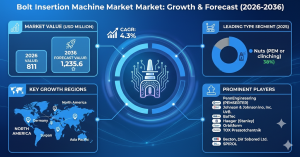
Bolt Insertion Machine Market expands as manufacturers adopt automated fastening solutions to improve assembly speed, precision, and production efficiency
ROCKVILLE, MD, UNITED STATES, January 28, 2026 /EINPresswire.com/ -- As global manufacturing sectors undergo a radical shift toward full-scale automation, the Bolt Insertion Machine Market has reached a critical inflection point. Driven by the necessity for precision in high-output environments like electric vehicle (EV) production and aerospace assembly, these automated systems are transitioning from elective upgrades to mandatory infrastructure for Tier-1 suppliers and OEMs.In early 2026, the market is characterized by a move away from manual fastening—often cited as a primary bottleneck in production lines—toward intelligent, programmable insertion platforms. By answering the industry’s demand for speed, repeatability, and data-backed quality control, bolt insertion technology is now a primary driver of operational resilience in a volatile global economy.
The Automation Mandate: Who, What, and Why
The rapid adoption of bolt insertion machines is being led by industrial heavyweights such as JUKI Corporation, National Machinery, Sacma Group, and ASADA, alongside specialized innovators in the Asia-Pacific and North American corridors. These machines integrate complex processes—including feeding, alignment, and high-speed torque application—into a single, seamless operation.
The "why" behind this market acceleration is rooted in three distinct industrial pressures:
Labor Scarcity and Safety: High-speed insertion machines eliminate the ergonomic strain and injury risks associated with manual bolting while mitigating the impact of global skilled labor shortages.
The EV Revolution: The production of battery packs and chassis for electric vehicles requires precision-engineered fasteners that must be installed with absolute consistency to ensure thermal and structural integrity.
Digital Traceability: Modern insertion machines act as data nodes, recording the exact torque and angle for every bolt, providing an "electronic birth certificate" for critical components in the aerospace and automotive sectors.
Request for Sample Report | Customize Report |purchase Full Report - https://www.factmr.com/connectus/sample?flag=S&rep_id=13882
Market Context and Data-Driven Insights
The broader industrial fastening and assembly equipment market has reached a significant valuation of approximately USD 811 million in 2026, underpinned by a steady compound annual growth rate (CAGR) of 4.2% to 4.7% projected through the end of the decade. Within this expansive ecosystem, automated insertion and tensioning solutions have emerged as the fastest-growing sub-sector, reflecting a global shift toward high-precision manufacturing. This growth is supported by a robust global fastener market, which is projected to reach USD 1,279 million by 2036, providing the essential components for these automated systems.
The drive toward modernization is further evidenced by a high automation adoption rate among Original Equipment Manufacturers (OEMs), who now allocate approximately 66.2% of their total assembly spend toward automated solutions. Regionally, the Asia-Pacific area stands out as the primary engine of growth, targeting an aggressive 7.3% CAGR as it expands its industrial footprint. From a sectoral perspective, the Automotive industry remains the dominant end-user, commanding a 35% market share as it integrates advanced bolt insertion and fastening technologies to meet the rigorous demands of next-generation vehicle production.
Technological Innovations: From MEMS to Modular AI
The 2026 landscape is defined by the emergence of "Smart Insertion Platforms." These systems utilize advanced sensors and AI-driven vision systems to identify misaligned components in real-time, effectively reducing "scrap and rework" rates by an estimated 25%.
Key technological shifts include:
Wireless and Compact Tooling: A surge in demand for lightweight, pneumatic, and electric bolt insertion units that can be easily integrated into robotic arms (cobots).
Multi-Tasking Platforms: Modern machines, such as the JUKI JM-series, now support "odd-shaped" part insertion, allowing a single station to handle bolts, connectors, and specialized fasteners.
High-Strength Fastening: The rise of renewable energy projects, particularly wind turbine assembly, has spurred the development of heavy-duty hydraulic bolt tensioning machines capable of managing $M42$ to $M72$ grade bolts.
Regional Outlook: Asia-Pacific and North America at the Forefront
Asia-Pacific remains the dominant force in the bolt insertion machine market, accounting for over 36% of global demand. This is fueled by the "Make in India" initiative and China’s massive aerospace expansion. Simultaneously, North America is seeing a resurgence in demand driven by "reshoring" efforts, where manufacturers are investing heavily in automation to offset domestic labor costs.
"Precision is the new currency of the assembly line," says a lead industrial consultant. "In 2026, a single improperly seated bolt in an EV battery tray isn't just a quality issue—it's a massive liability. Automated insertion machines are the only viable safeguard against that risk."
Strategic Outlook for 2026 and Beyond
For investors and industrial planners, the focus is shifting toward Software-as-a-Service (SaaS) integration within assembly hardware. Companies that offer "Plug-and-Play" insertion modules that sync directly with Enterprise Resource Planning (ERP) systems are expected to capture the highest market share through 2030.
About the Bolt Insertion Machine Market Intelligence:
This press release summarizes the latest 2026 market trends and data points concerning the global transition toward automated fastening solutions. It serves as a strategic overview for stakeholders in the industrial machinery, automotive, and aerospace sectors.
To View Related Report:
Stationary Fuel Cell System Market https://www.factmr.com/report/2456/stationary-fuel-cell-systems-market
Light Towers Market https://www.factmr.com/report/2477/light-towers-market
Vacuum Degreaser Market https://www.factmr.com/report/2533/vacuum-degreaser-market
Cold Milling Machine Market https://www.factmr.com/report/2598/cold-milling-machine-market
About Fact.MR
Fact.MR is a global market research and consulting firm, trusted by Fortune 500 companies and emerging businesses for reliable insights and strategic intelligence. With a presence across the U.S., UK, India, and Dubai, we deliver data-driven research and tailored consulting solutions across 30+ industries and 1,000+ markets. Backed by deep expertise and advanced analytics, Fact.MR helps organizations uncover opportunities, reduce risks, and make informed decisions for sustainable growth.
S. N. Jha
Fact.MR
+ +1 628-251-1583
sales@factmr.com
Legal Disclaimer:
EIN Presswire provides this news content "as is" without warranty of any kind. We do not accept any responsibility or liability for the accuracy, content, images, videos, licenses, completeness, legality, or reliability of the information contained in this article. If you have any complaints or copyright issues related to this article, kindly contact the author above.
