

Smart Water Management Market Powering the Future of Digital Water Infrastructure
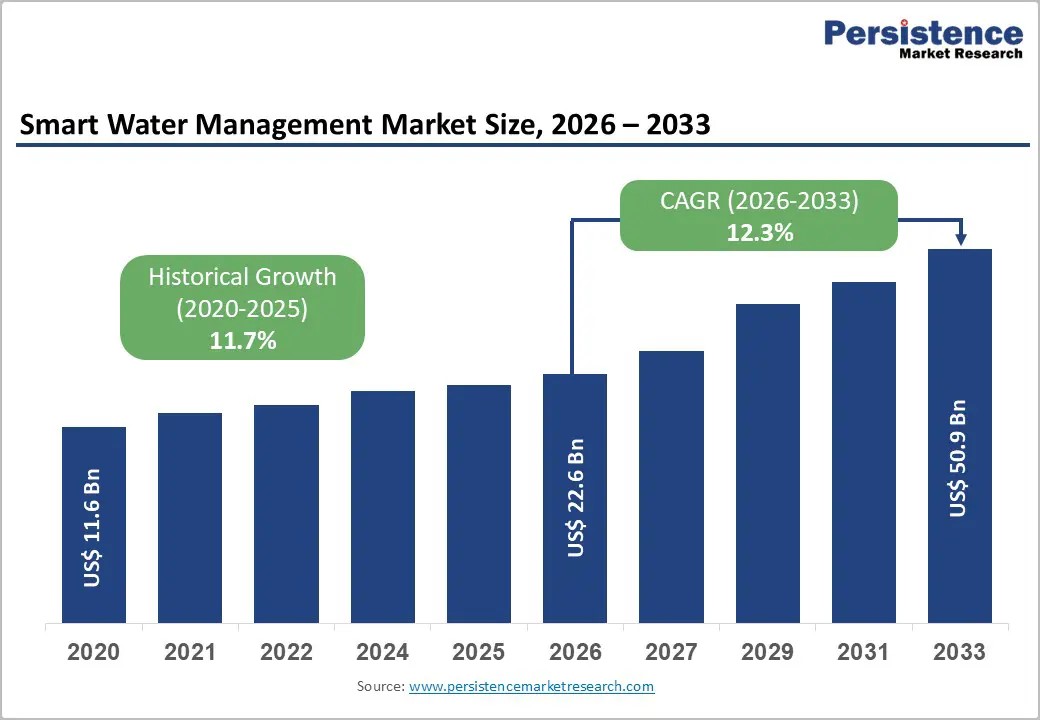
Global smart water management market to grow from US$22.6 Bn in 2026 to US$50.9 Bn by 2033, registering a CAGR of 12.3% during the forecast period.
BRENTFORD, ENGLAND, UNITED KINGDOM, January 28, 2026 /EINPresswire.com/ -- The smart water management market is rapidly emerging as a cornerstone of global sustainability and infrastructure modernization efforts. It integrates digital technologies such as IoT-enabled sensors, advanced metering infrastructure (AMI), cloud analytics, and AI-driven control systems to monitor, manage, and optimize water resources across the entire value chain. From source and treatment to distribution and consumption, smart water solutions are redefining how utilities, industries, and cities address water efficiency, resilience, and accountability.
In value terms, the global smart water management market is expected to reach US$ 22.6 billion in 2026 and expand to US$ 50.9 billion by 2033, registering a robust CAGR of 12.3% between 2026 and 2033. This strong growth trajectory reflects the rising urgency to combat water scarcity, reduce non-revenue water (NRW), and modernize aging infrastructure using digital-first solutions. The market’s scale and momentum position it as a critical enabler of smart cities, climate adaptation, and long-term water security strategies.
𝐆𝐞𝐭 𝐚 𝐒𝐚𝐦𝐩𝐥𝐞 𝐏𝐃𝐅 𝐁𝐫𝐨𝐜𝐡𝐮𝐫𝐞 𝐨𝐟 𝐭𝐡𝐞 𝐑𝐞𝐩𝐨𝐫𝐭: https://www.persistencemarketresearch.com/samples/33892
Market Statistics, Key Drivers, and Leadership Landscape
The smart water management market is driven by rising water scarcity, aging infrastructure with high NRW losses, and the growing maturity of IoT, AI, and cloud technologies that enable real-time monitoring and predictive control. These factors are pushing governments and utilities to adopt digital, conservation-focused water solutions.
Industries and utilities dominate the market with a 61% share due to large-scale infrastructure investments. North America leads with 37% market share, while Asia Pacific is the fastest-growing region, supported by rapid urbanization and government programs such as AMRUT 2.0 and Jal Shakti Abhiyan.
Smart Water Management Market Segmentation Analysis
Market segmentation by product and solution type highlights the growing importance of advanced metering infrastructure, smart sensors, leak detection systems, analytics platforms, and control and automation technologies. Smart meters and AMI systems continue to form the foundation of most deployments, enabling real-time consumption tracking, billing accuracy, and demand-side management. However, analytics and AI-driven software platforms are gaining traction as utilities seek actionable insights rather than raw data.
From an end-user perspective, utilities and municipalities dominate adoption due to their responsibility for large-scale water distribution and treatment infrastructure. Industrial users are increasingly deploying smart water systems to optimize process water usage, ensure regulatory compliance, and reduce operational risks. Residential and commercial segments, while smaller in value, are witnessing steady growth as smart city initiatives and sustainability-driven building standards encourage water-efficient technologies.
Technology Evolution in Smart Water Management
Technological innovation drives the smart water management market, with IoT sensors providing real-time data for leak detection and quality monitoring, while cloud platforms enable scalable data analysis.
AI and machine learning enhance predictive maintenance, demand forecasting, and autonomous control, allowing SCADA systems to optimize operations, reduce energy use, and improve service reliability.
𝐃𝐨 𝐘𝐨𝐮 𝐇𝐚𝐯𝐞 𝐀𝐧𝐲 𝐐𝐮𝐞𝐫𝐲 𝐎𝐫 𝐒𝐩𝐞𝐜𝐢𝐟𝐢𝐜 𝐑𝐞𝐪𝐮𝐢𝐫𝐞𝐦𝐞𝐧𝐭? 𝐑𝐞𝐪𝐮𝐞𝐬𝐭 𝐂𝐮𝐬𝐭𝐨𝐦𝐢𝐳𝐚𝐭𝐢𝐨𝐧 𝐨𝐟 𝐑𝐞𝐩𝐨𝐫𝐭: https://www.persistencemarketresearch.com/request-customization/33892
Regional Insights: Global Smart Water Management Trends
In North America, smart water adoption is largely driven by infrastructure modernization and regulatory compliance. Utilities across the United States and Canada are investing heavily in AMI rollouts, leak detection technologies, and digital twins to address aging pipelines and rising operational costs. Federal and state-level funding programs further accelerate adoption across municipalities.
The Asia Pacific region represents the fastest-growing market, supported by rapid urbanization, industrial expansion, and acute water stress. China and India are leading adopters, integrating smart water systems into large-scale smart city and urban renewal projects. Government-backed initiatives and public-private partnerships are playing a crucial role in scaling deployments across emerging economies.
Market Drivers Shaping Industry Growth
The primary driver of the smart water management market is the global water scarcity crisis, intensified by climate change, population growth, and urban expansion. Governments and utilities are under mounting pressure to improve water efficiency, reduce losses, and ensure long-term resource sustainability. Smart water technologies provide the data-driven tools required to meet these objectives.
Another significant driver is the need to reduce non-revenue water losses, which represent billions of dollars in lost revenue annually. Digital monitoring, leak detection, and pressure management systems enable utilities to identify inefficiencies and recover lost value. Additionally, rising awareness of ESG and sustainability goals is encouraging industrial and commercial users to invest in smart water solutions.
Market Restraints and Adoption Challenges
Despite strong growth prospects, the smart water management market faces several restraints. High initial capital investment remains a barrier, particularly for smaller utilities and municipalities with limited budgets. The cost of deploying smart meters, sensors, and communication infrastructure can delay adoption in price-sensitive regions.
Data security and interoperability challenges also pose concerns. Integrating legacy infrastructure with modern digital platforms requires technical expertise and robust cybersecurity frameworks. Resistance to change within traditional utility operations further slows adoption, highlighting the need for capacity building and stakeholder engagement.
Emerging Market Opportunities and Future Potential
The market offers significant opportunities in behind-the-meter smart water management, particularly for industrial and commercial users. Real-time monitoring and anomaly detection systems help organizations reduce consumption, lower operating costs, and meet sustainability certifications. Sectors such as manufacturing, data centers, and hospitality are increasingly adopting these solutions.
Another promising opportunity lies in the integration of smart water systems with smart city platforms. As cities invest in connected infrastructure, water management solutions that integrate with energy, waste, and transportation systems will gain strategic importance. Advances in AI and digital twins are expected to unlock new value streams across planning, operations, and asset management.
𝐁𝐮𝐲 𝐍𝐨𝐰 𝐭𝐡𝐞 𝐃𝐞𝐭𝐚𝐢𝐥𝐞𝐝 𝐑𝐞𝐩𝐨𝐫𝐭: https://www.persistencemarketresearch.com/checkout/33892
Company Insights
Key Players Operating in the Smart Water Management Market
SUEZ
Veolia
Xylem Inc.
Siemens AG
Schneider Electric
IBM Corporation
Honeywell International
Badger Meter Inc.
Recent Developments in the Market
Leading utilities in North America have expanded AI-enabled leak detection deployments to reduce NRW and energy consumption across large urban networks.
Major technology providers have launched cloud-based smart water platforms integrating digital twins and predictive analytics for utility-scale operations.
Related Reports:
Digital Marketing Services Market
Pooja Gawai
Persistence Market Research
+1 646-878-6329
email us here
Visit us on social media:
LinkedIn
Instagram
Facebook
YouTube
Legal Disclaimer:
EIN Presswire provides this news content "as is" without warranty of any kind. We do not accept any responsibility or liability for the accuracy, content, images, videos, licenses, completeness, legality, or reliability of the information contained in this article. If you have any complaints or copyright issues related to this article, kindly contact the author above.
