

Silk Market to Reach USD 37.71 Billion at a CAGR of 7.6% by 2032: Market Size, Share, Forecast & Competitive Analysis
Silk Market
Global Silk Market to Reach USD 37.71 Bn by 2032, Driven by Rising Textile Demand, Luxury Apparel Growth, and Sustainable Fabric Trends
Maximize Market Research highlights that changing trade dynamics, traceable supply chains, and bioengineered silk are reshaping the global silk market outlook and competitive landscape.”
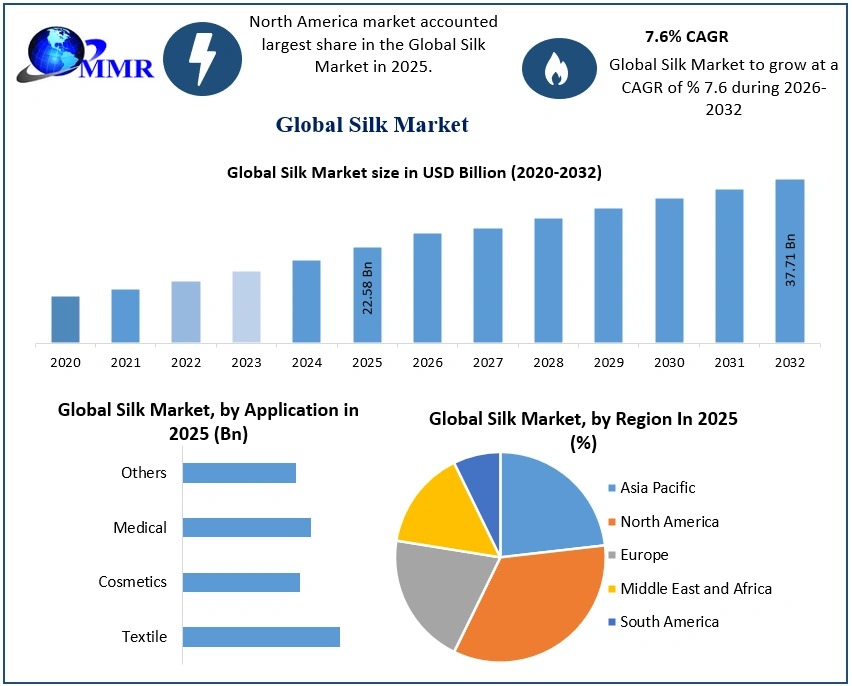
NEW YORK, NY, UNITED STATES, January 27, 2026 /EINPresswire.com/ -- Silk Market size was valued at USD 22.58 Billion in 2025 and the total Silk revenue is expected to grow at a CAGR of 7.6% from 2025 to 2032, reaching nearly USD 37.71 Billion by 2032.— Maximize Market Research
Global Silk Market Overview: Market Size, Growth Trends, Competitive Landscape, and Forecast Opportunities
Global silk market provides in-depth analysis of structural supply chain dynamics, global trade dependencies, regulatory transformations, and technological evolution across the silk value chain. The market is shaped by vertically integrated sericulture ecosystems, export-oriented textile manufacturing, and premium luxury apparel demand, positioning silk as a strategic natural fibre in global textile trade. Asia-Pacific dominates upstream production, while Europe and North America drive high-value consumption, influencing silk market trends and global value chain dynamics. Regulatory pressures on traceability, sustainability, and animal welfare are reshaping sourcing strategies, while technological advancements and sustainable silk certification frameworks are expected to strengthen silk market growth and the long-term silk industry outlook.
Get a Free PDF Sample>https://www.maximizemarketresearch.com/request-sample/26259/
“Why the Global Silk Market Is Expanding: Key Drivers Behind the Shift Toward Luxury and Sustainable Textiles”
Global silk market is propelled by a highly structured international value chain in which Asia-Pacific controls upstream sericulture and raw silk production, while Europe and North America dominate downstream luxury textile consumption. Growing integration of cocoon production, reeling, and textile manufacturing in China and India is strengthening cost efficiencies and export competitiveness. Additionally, premium fashion brands’ reliance on certified and traceable silk sourcing is reinforcing silk market growth.
Why the Global Silk Market Faces Headwinds: Key Restraints Impacting Industry Growth
Global silk market size faces structural constraints from price volatility in raw cocoons, limited mechanization in sericulture, and fragmented upstream supply networks in emerging economies. Increasing animal welfare regulations and stringent compliance frameworks are elevating production costs, while accelerating substitution by synthetic and bioengineered fibers is eroding silk market share. These factors collectively dampen silk market trends.
“Where the Global Silk Market Is Headed: Key Opportunities in Sustainable and Premium Textile Production”
Global silk market forecast indicates emerging opportunities from the commercialization of certified sustainable silk, digital traceability platforms, and the relocation of premium textile manufacturing to cost-efficient hubs in Southeast Asia and Africa. Expansion of luxury apparel e-commerce channels and rising capital investments in automated reeling and processing infrastructure are improving operational scalability. Additionally, targeted government incentives for sericulture modernization are expected to strengthen the long-term silk industry outlook.
Global Silk Market Segmentation: Product, Application, and Production Process Insights
Global Silk market segmentation highlights mulberry silk as the dominant product segment due to its superior fibre quality and large-scale commercial sericulture, while tussar and eri silk are witnessing high growth driven by sustainable and artisanal textile demand. Textile applications account for the largest silk market size, supported by luxury fashion and premium home décor, while cosmetics and medical applications are emerging high-growth segments. Cocoon production and reeling processes dominate the silk industry analysis, with advancements in weaving and dyeing technologies enhancing silk market growth.
By Product
Mulberry silk
Tussar silk
Eri silk
Others
By Application
Textile
Cosmetics
Medical
Others
By Production Process
Cocoon Production
Reeling, Throwing
Weaving and Dyeing
By Region
North America (United States, Canada and Mexico)
Europe (UK, France, Germany, Italy, Spain, Sweden, Austria, Turkey, Russia and Rest of Europe)
Asia Pacific (China, India, Japan, South Korea, Australia, ASEAN (Indonesia, Malaysia, Myanmar, Philippines, Singapore, Thailand, Viet Nam etc.) and Rest of APAC)
Middle East and Africa (South Africa, GCC, Egypt, Nigeria and Rest of ME&A)
South America (Brazil, Argentina, Colombia and Rest of South America)
Details insights on this market, request for methodology here>https://www.maximizemarketresearch.com/request-sample/26259/
Key Regional Dynamics: Asia Pacific Production and Europe Consumption in the Global Silk Market
Asia-Pacific dominates the Global silk market size due to its vertically integrated sericulture industry, large-scale cocoon production, and strong export-oriented textile manufacturing infrastructure. China and India control upstream raw silk supply chains, benefiting from government subsidies, rural sericulture programs, and low labor costs. These structural advantages strengthen silk market growth and reinforce Asia-Pacific’s central role in the global silk value chain.
Europe represents a high-value and fast-growing consumption hub in the Global silk market, driven by luxury fashion brands, premium textile imports, and strict regulatory frameworks on textile traceability and sustainability. Increasing adoption of certified and ethically sourced silk is influencing silk market trends, while stringent quality and environmental regulations are shaping supplier compliance requirements, supporting a strong silk market forecast.
Global Silk Market Trends: Supply Chain Concentration, Trade Route Shifts, and Regulatory-Driven Industry Transformation
Global silk market is increasingly concentrated in China and India, creating supply-side dominance that influences silk market size, global pricing mechanisms, and trade dependency patterns across downstream textile manufacturing hubs.
Shifting luxury textile demand toward Europe and North America is restructuring silk market trends, with rising imports of semi-finished silk yarn and fabrics, altering global trade balances and reinforcing Asia-to-West silk export corridors.
Stricter animal welfare policies and textile sustainability regulations are reshaping silk industry analysis, increasing compliance costs and accelerating investments in ethical sericulture certification systems, influencing silk market growth and procurement frameworks.
Automation in cocoon sorting, digital farm monitoring, and mechanized reeling is improving productivity and traceability, strengthening silk market forecast reliability and enhancing operational efficiency across the silk value chain, supporting long-term silk industry outlook.
Global Silk Market Competitive Landscape:
Global silk market is led by vertically integrated Chinese manufacturers such as Wujiang First Textile Co., Anhui Silk, and Zhejiang Jiaxin Silk Co., which control upstream cocoon sourcing and downstream textile manufacturing. Their strong export-oriented production clusters, economies of scale, and government-supported sericulture ecosystems enhance silk market share, strengthen silk industry analysis, and support sustained silk market growth across global luxury textile supply chains.
Bolt Threads Inc. represents a technology-driven competitor in the Global silk market, focusing on bioengineered and sustainable silk alternatives to address regulatory and ethical concerns. Its innovation-led strategy, global brand partnerships, and strong R&D positioning create competitive differentiation in premium fashion applications, influencing silk market trends, shaping the silk market forecast.
Key Recent Developments in the Global Silk Market: Capacity Expansion, Technology Adoption, and Strategic Partnerships
On March 12, 2024, Wujiang First Textile Co., Ltd. expanded its high-end silk fabric production facility in Jiangsu Province to strengthen export-oriented textile manufacturing, improve vertical integration, and capture rising premium apparel demand in the Global silk market.
On July 18, 2023, Anhui Silk invested in automated silk reeling and textile processing systems to improve operational efficiency, enhance silk market growth, and strengthen supply chain control across its upstream sericulture and downstream textile manufacturing operations.
On May 22, 2024, Wensli Group Co., Ltd. launched AI-driven textile design and digital manufacturing solutions to reduce product development cycles, enhance customization capabilities, and expand global premium textile distribution in the Global silk market.
On November 15, 2023, Bolt Threads Inc. secured strategic partnerships for commercial production of bioengineered silk materials to expand sustainable textile offerings, address ethical sourcing regulations, and strengthen silk industry analysis in next-generation textile applications.
Global Silk Market Key Players:
Wujiang First Textile Co., Ltd.
Anhui Silk
Shengkun Silk Manufacturing Co., Ltd.
Zhejiang Jiaxin Silk Co., Ltd.
AM Silk GmbH
China Silk Corporation
Jinchengjiang Xinxing Cocoon Silk Co., Ltd.
Bolt Threads Inc.
Kraig Biocraft Laboratories, Inc.
Entogenetics Inc
Wensli Group Co. Ltd.
Sichuan Nanchong Liuhe
Wujiang Wanshiyi Silk Co. Ltd.
Silk India international Ltd.
Global Silk Mills Pvt. Ltd.
Shanghai Silk Group Co., Ltd.
Jiangsu Sutong Cocoon & Silk Co., Ltd.
Hangzhou Cocomo Silk Co., Ltd.
Guangzhou Yunyin Silk Factory
Zhejiang Zhuji Sanren Xinyuan Silks Co., Ltd.
Jiangsu Xinmin Textile Science & Technology Co., Ltd.
Jiangsu Tiansheng Group Co., Ltd.
Ratti S.p.A.
Mulberry Silks Ltd.
Himatsingka Seide Ltd.
Sinosilk Co., Ltd.
Bao Loc Silk
Thai Silk Company (Thai Silk Co., Ltd.)
Spiber Inc.
Reshamwala Group
Browse Complete Research Report>https://www.maximizemarketresearch.com/market-report/global-silk-market/26259/
FAQ’s
1.What are the key drivers of the Global Silk Market?
The Global silk market is driven by vertically integrated sericulture, expanding luxury fashion demand, rising exports from Asia-Pacific, and growing adoption of sustainable and traceable silk supply chains.
2.What are the major restraints affecting silk market growth?
Key restraints include volatile cocoon prices, labor-intensive production, fragmented supply chains, animal welfare regulations, and competition from synthetic and bioengineered fibers limiting silk market share and silk market growth.
3.Which regions dominate the Global Silk Market and why?
Asia-Pacific dominates silk market size due to upstream production, while Europe leads high-value consumption; this dual structure shapes global trade flows, pricing power, and long-term silk industry outlook.
4.What are the key opportunities in the Global Silk Market?
Opportunities include sustainable silk certification, automated reeling technologies, expanding luxury manufacturing hubs in Southeast Asia and Africa, and cross-border e-commerce channels strengthening global silk market forecast and competitive positioning.
5.How is the competitive landscape evolving in the Global Silk Market?
The competitive landscape features vertically integrated Chinese manufacturers and emerging bioengineered silk innovators; technology partnerships, capacity expansion, and sustainability compliance are key strategies shaping silk market trends and industry analysis.
Analyst Perspective
Global Silk Market is undergoing structural transformation driven by vertically integrated sericulture, premium luxury textile demand, and evolving sustainability regulations. Asia-Pacific’s dominance in upstream production combined with Europe’s high-value consumption is reshaping global trade flows and silk market trends. Technological innovation in automated reeling and bioengineered silk materials is strengthening silk industry analysis and competitive dynamics. Increasing traceability requirements and e-commerce expansion are expected to reinforce silk market growth and improve the long-term silk industry outlook across global textile value chains.
Related Reports:
Synthetic Spider Silk Market : https://www.maximizemarketresearch.com/market-report/global-synthetic-spider-silk-market/119298/
Top Reports :
Private Tutoring Market was valued at USD 83.80 Billion in 2023, and it is expected to reach USD 152.91 Billion by 2030, exhibiting a CAGR of 8.97 % during the forecast period (2024-2030) : https://www.maximizemarketresearch.com/market-report/global-private-tutoring-market/26273/
Heat Sink Market size was valued at USD 7.63 Billion in 2024 and the total Heat Sink revenue is expected to grow at a CAGR of 7.5% from 2025 to 2032, reaching nearly USD 13.61 Billion:https://www.maximizemarketresearch.com/market-report/heat-sinks-market/11450/
Ecotourism Market size was valued at USD 386.87 Billion in 2025 and the total Ecotourism revenue is expected to grow at a CAGR of 14.5% from 2025 to 2032, reaching nearly USD 998.17 Billion by 2032:https://www.maximizemarketresearch.com/market-report/global-ecotourism-market/147136/
Audio Plug-ins Software Application Market is anticipated to reach USD 3.25 Bn by 2030 from USD 1.20 Bn in 2023 at a CAGR of 15.2%during a forecast period:https://www.maximizemarketresearch.com/market-report/global-audio-plug-ins-software-application-market/100413/
Higher Education Market size was valued at USD 919.30 Billion in 2025 and the total Higher Education revenue is expected to grow at a CAGR of 12.66% from 2025 to 2032, reaching nearly USD 2117.61 Billion by 2032:https://www.maximizemarketresearch.com/market-report/global-higher-education-market/7167/
Lumawant Godage
MAXIMIZE MARKET RESEARCH PVT. LTD.
+ +91 96073 65656
email us here
Visit us on social media:
LinkedIn
Instagram
Facebook
X
Legal Disclaimer:
EIN Presswire provides this news content "as is" without warranty of any kind. We do not accept any responsibility or liability for the accuracy, content, images, videos, licenses, completeness, legality, or reliability of the information contained in this article. If you have any complaints or copyright issues related to this article, kindly contact the author above.
