

Global Bio-Based Effect Pigments for Color Cosmetics Market Size, Share & Forecast: High-Growth Segments
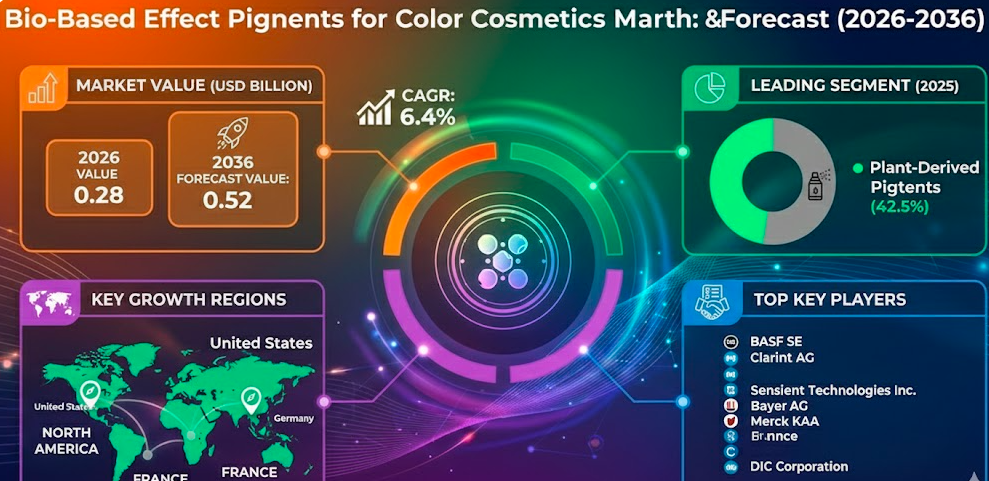
Bio-Based Effect Pigments for Color Cosmetics Market
Global Bio-Based Effect Pigments Market for Color Cosmetics Approaches Pivotal Growth Milestone Amidst Shifting Regulatory Landscapes
ROCKVILLE, MD, UNITED STATES, January 27, 2026 /EINPresswire.com/ -- The global color cosmetics industry is undergoing a structural transition as the Bio-Based Effect Pigments market matures from a niche sustainability initiative into a primary driver of high-performance formulation. Driven by tightening international regulations and a decisive shift in consumer clean beauty preferences, the market is projected to play a critical role in the broader cosmetic pigments sector, which is estimated to reach $1.55 billion by 2033, according to the latest industry analysis.Request for Sample Report | Customize Report |purchase Full Report - https://www.factmr.com/connectus/sample?flag=S&rep_id=12853
The 2026 Pivot: Addressing the Who, What, When, and Why
As of early 2026, the demand for bio-based effect pigments—substances derived from renewable biological sources such as microorganisms, plants, and fruits—has surged. This acceleration is led by industry leaders including BASF, Clariant, and Merck, who are responding to the European Union’s 2026 mandatory INCI glossary updates and the ongoing phase-out of intentionally added microplastics.
Who: Leading chemical manufacturers, indie beauty brands, and global conglomerates (L’Oréal, Estée Lauder) are the primary adopters.
What: A transition from synthetic, petrochemical-based pigments to bio-derived alternatives that offer pearlescent, metallic, and color-travel effects.
When: The 2026–2030 period is identified as the critical compliance window for brands to reformulate leave-on products.
Where: While Asia-Pacific remains the fastest-growing market by volume, Europe and North America are driving the innovation in bio-synthetic fermentation.
Why: Escalating microplastic bans and a 40% reduction in carbon footprints compared to traditional synthetic processes are making bio-based options economically and ethically non-negotiable.
Market Context and Data-Backed Insights
The integration of bio-based pigments is no longer limited to basic earth tones. Modern biotechnology has enabled the creation of High-Performance Pigments (HPPs) that maintain color strength and brilliance under harsh conditions. Market data indicates that while inorganic pigments currently hold a significant market share due to their opacity and UV protection, the organic and bio-based segment is projected to grow at a higher CAGR of over 6.0% through 2030.
One of the most significant catalysts for this growth is the EU’s Omnibus VIII Regulation, which mandates compliance for various hair dye intermediates and pigments by May 2026. This regulatory pressure is forcing a reformulation wave where brands are replacing traditional glitters and synthetic mica with bio-derived cellulose and fermentation-sourced colorants.
Shifting Consumer Preferences Drive Strategic Innovation
Consumer behavior in 2026 is defined by ingredient-savvy purchasing. There is a growing demand for makeup that doubles as skincare—a trend where bio-based pigments excel. By utilizing plant-origin emollients and bio-based elastomers, such as those used in recent product launches by Grant Industries and Sun Chemical, formulators can achieve the silky slip of silicones while maintaining a 100% bio-based carbon content.
The industry is moving toward a parallel supply chain, notes a leading market analyst. We see commodity synthetics remaining for cost efficiency in certain sectors, but bio-based grades have become the gold standard for premium eco-labels and prestige color cosmetics.
Regional Analysis: Asia-Pacific and North America Lead
The Asia-Pacific region, particularly China and India, continues to dominate production and consumption, valued at approximately $2.36 billion in the broader high-performance pigment category for 2026. This is fueled by rapid urbanization and the influence of K-Beauty and C-Beauty trends that prioritize luminous, natural finishes.
In contrast, the North American market, projected to reach $1.26 billion this year, is focusing heavily on the Clean at Sephora and Conscious Beauty at Ulta standards. This has created a lucrative environment for startups focusing on microorganism-based pigments (sourced from algae and fungi), which offer vibrant hues that were previously difficult to stabilize in natural formulations.
Regulatory Pressures and the Path to 2036
The how of this market evolution is rooted in technological dispersion. Brands are no longer just buying colors; they are investing in pigment dispersions compatible with AI-driven color-matching platforms. This ensures that bio-based lipsticks and foundations provide the same long-wear and soft-focus effects as their synthetic predecessors.
Looking forward, the market expects to see continued investment in circular beauty. With the EU's 2026 deadlines for CMR (Carcinogenic, Mutagenic, or Reprotoxic) substance withdrawals, the transition to bio-based effect pigments is not just a trend—it is a survival strategy for global cosmetic brands.
About the Industry Report: This press release is based on a synthesis of 2026 market projections, regulatory filings, and chemical industry data regarding the Bio-Based Effect Pigments for Color Cosmetics Market. It highlights the intersection of sustainability, compliance, and aesthetic performance in the modern beauty landscape.
To View Related Report
Bio-based Platform Chemicals Market https://www.factmr.com/report/5366/biobased-platform-chemicals-market
Bio-Based Coagulants for Municipal Water Market https://www.factmr.com/report/bio-based-coagulants-for-municipal-water-market
Bio-Based Surfactants for Detergents Market https://www.factmr.com/report/bio-based-surfactants-for-detergents-market
Bio-Based Cleaning Chemicals for Solar Panels Market https://www.factmr.com/report/bio-based-cleaning-chemicals-for-solar-panels-market
S. N. Jha
Fact.MR
+1 628-251-1583
email us here
Legal Disclaimer:
EIN Presswire provides this news content "as is" without warranty of any kind. We do not accept any responsibility or liability for the accuracy, content, images, videos, licenses, completeness, legality, or reliability of the information contained in this article. If you have any complaints or copyright issues related to this article, kindly contact the author above.
