

Fiber Optic Connectors Market Set to Surge with 5G and AI-Driven Data Center Expansion
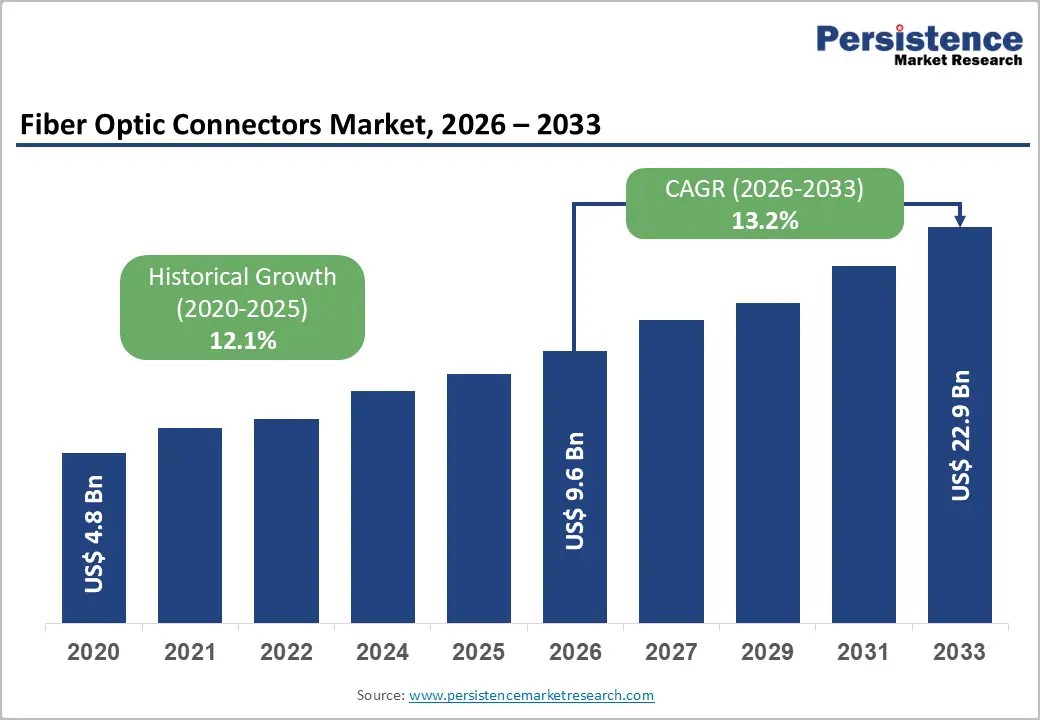
The global fiber optic connector market size is projected at US$9.6 Bn in 2026 and expected to reach US$22.9 Bn by 2033, growing at a 13.2% CAGR
BRENTFORD, ENGLAND, UNITED KINGDOM, January 27, 2026 /EINPresswire.com/ -- The fiber optic connectors market is entering a high-growth phase as global digital infrastructure scales at unprecedented speed. In 2026, the market is projected to be valued at approximately US$ 9.6 billion, and it is expected to surge to US$ 22.9 billion by 2033, expanding at a robust CAGR of 13.2% during the forecast period. This acceleration reflects the critical role fiber connectivity plays in enabling high-speed, low-latency communication across industries.
One of the primary growth drivers is the rapid deployment of 5G networks, coupled with the explosive expansion of AI-driven hyperscale data centers. According to ITU data, global active mobile broadband subscriptions reached nearly 7 billion connections in 2023, reinforcing the need for reliable, high-density fiber optic connectors that support rising data traffic, cloud workloads, and real-time applications.
𝐆𝐞𝐭 𝐚 𝐒𝐚𝐦𝐩𝐥𝐞 𝐏𝐃𝐅 𝐁𝐫𝐨𝐜𝐡𝐮𝐫𝐞 𝐨𝐟 𝐭𝐡𝐞 𝐑𝐞𝐩𝐨𝐫𝐭: https://www.persistencemarketresearch.com/samples/22987
Market Dynamics: Leading Segments and Regional Dominance
From a segmentation perspective, LC fiber optic connectors lead the market with nearly 37% share, driven by their compact form factor and suitability for high-density environments. These connectors are widely adopted across telecom networks, FTTH deployments, and modern data centers where space efficiency and performance reliability are paramount. On the application side, telecommunications accounts for around 22.3% share, while data centers remain the fastest-growing segment due to 400G–800G Ethernet upgrades and AI workload intensification.
Regionally, North America holds about 34.6% market share, supported by strong U.S. broadband funding initiatives, aggressive 5G rollouts, and the presence of hyperscale cloud providers. Meanwhile, Asia Pacific, accounting for approximately 38.4% share, stands out as the fastest-growing region, fueled by China’s massive FTTH expansion, India’s BharatNet program, and Japan’s advanced fiber ecosystem.
Key Highlights from the Fiber Optic Connectors Market Report
The global fiber optic connectors market is projected to grow at a strong CAGR of 13.2% from 2026 to 2033.
LC connectors dominate the product landscape due to their compact size and high-density networking benefits.
Data centers represent the fastest-growing application segment, driven by AI and hyperscale cloud expansion.
Asia Pacific is the fastest-growing regional market, supported by government-backed broadband initiatives.
North America maintains leadership through dense data center infrastructure and early 5G adoption.
Edge computing and industrial IoT create new demand opportunities for ruggedized fiber connectors.
Fiber Optic Connectors Market Segmentation Analysis
The market is segmented by connector type, including LC, SC, ST, FC, and MTP/MPO connectors. Among these, LC connectors dominate due to their small footprint and superior performance in high-density fiber environments. MTP/MPO connectors are also gaining traction, particularly in hyperscale data centers, as they support parallel optics and high-bandwidth transmission required for next-generation networks.
Based on end-user and application, the market spans telecommunications, data centers, enterprise networking, industrial automation, defense, and healthcare. Telecommunications remains a foundational segment, while data centers are emerging as the most dynamic growth area. The increasing adoption of cloud computing, AI workloads, and edge infrastructure continues to reshape demand patterns across these segments.
Regional Insights: Global Fiber Connectivity Trends
In North America, the fiber optic connectors market benefits from strong federal broadband funding, widespread fiber-to-the-premises (FTTP) deployments, and a dense concentration of hyperscale data centers. The U.S. continues to lead innovation in high-speed networking, driving consistent demand for advanced connector solutions.
The Asia Pacific region is experiencing rapid growth due to large-scale infrastructure projects and rising internet penetration. China’s aggressive FTTH rollout, India’s nationwide BharatNet initiative, and Japan’s mature fiber networks are collectively accelerating adoption, making the region a critical growth engine for global manufacturers.
𝐃𝐨 𝐘𝐨𝐮 𝐇𝐚𝐯𝐞 𝐀𝐧𝐲 𝐐𝐮𝐞𝐫𝐲 𝐎𝐫 𝐒𝐩𝐞𝐜𝐢𝐟𝐢𝐜 𝐑𝐞𝐪𝐮𝐢𝐫𝐞𝐦𝐞𝐧𝐭? 𝐑𝐞𝐪𝐮𝐞𝐬𝐭 𝐂𝐮𝐬𝐭𝐨𝐦𝐢𝐳𝐚𝐭𝐢𝐨𝐧 𝐨𝐟 𝐑𝐞𝐩𝐨𝐫𝐭: https://www.persistencemarketresearch.com/request-customization/22987
Market Drivers Shaping Industry Expansion
One of the strongest market drivers is the global transition toward 5G and future 6G-ready infrastructure, which requires dense fiber backhaul and fronthaul networks. Fiber optic connectors enable seamless connectivity between base stations, data centers, and core networks, ensuring minimal signal loss and high reliability.
Additionally, the rapid rise of AI, cloud computing, and IoT ecosystems is increasing demand for high-performance, low-latency fiber connectivity. Enterprises and service providers are investing heavily in scalable fiber networks to support real-time analytics, autonomous systems, and data-intensive applications.
Market Restraints Impacting Growth
Despite strong growth prospects, the market faces challenges related to high initial deployment costs. Fiber optic infrastructure requires significant upfront investment in installation, skilled labor, and precision components, which can be a barrier for small-scale operators and emerging markets.
Another restraint is the complexity of connector handling and maintenance. Fiber optic connectors are sensitive to contamination and misalignment, requiring strict quality control and specialized training, which can increase operational costs and slow adoption in cost-sensitive environments.
Market Opportunities and Future Growth Potential
The expansion of edge computing and industrial IoT represents a major growth opportunity for the fiber optic connectors market. With the edge computing market projected to grow at a 28.4% CAGR through 2032, demand for ruggedized, high-performance connectors in factories, smart cities, and energy infrastructure is rising rapidly.
Furthermore, advancements in high-density and multi-fiber connectors are opening new avenues in hyperscale data centers and next-generation Ethernet standards. As networks migrate toward 800G and beyond, connector innovation will remain central to enabling scalable, future-proof infrastructure.
𝐁𝐮𝐲 𝐍𝐨𝐰 𝐭𝐡𝐞 𝐃𝐞𝐭𝐚𝐢𝐥𝐞𝐝 𝐑𝐞𝐩𝐨𝐫𝐭: https://www.persistencemarketresearch.com/checkout/22987
Company Insights: Key Players in the Fiber Optic Connectors Market
Corning Incorporated
TE Connectivity
Amphenol Corporation
CommScope Holding Company
Molex LLC
Fujikura Ltd.
Sumitomo Electric Industries
Rosenberger Group
Conclusion
The fiber optic connectors market is positioned at the core of the global digital transformation journey. As 5G, AI, cloud computing, and edge infrastructure continue to reshape connectivity demands, fiber optic connectors will remain indispensable to enabling scalable, high-speed, and reliable networks. With strong growth across regions and applications, the market offers compelling opportunities for technology providers, investors, and infrastructure developers alike.
Related Reports:
Environmental Intelligent Platform Market
Pooja Gawai
Persistence Market Research
+1 646-878-6329
email us here
Visit us on social media:
LinkedIn
Instagram
Facebook
YouTube
Legal Disclaimer:
EIN Presswire provides this news content "as is" without warranty of any kind. We do not accept any responsibility or liability for the accuracy, content, images, videos, licenses, completeness, legality, or reliability of the information contained in this article. If you have any complaints or copyright issues related to this article, kindly contact the author above.
