

Mono-Material Recyclable Stretch Yarn Market Gains Momentum of USD 2,581.1Mn by 2036 as Circular Apparel Design Expands
Mono-Material Recyclable Stretch Yarn Market
Textile industry shifts toward Mono-Material Recyclable Stretch Yarn to improve recyclability, performance, and compliance with circular economy goals.
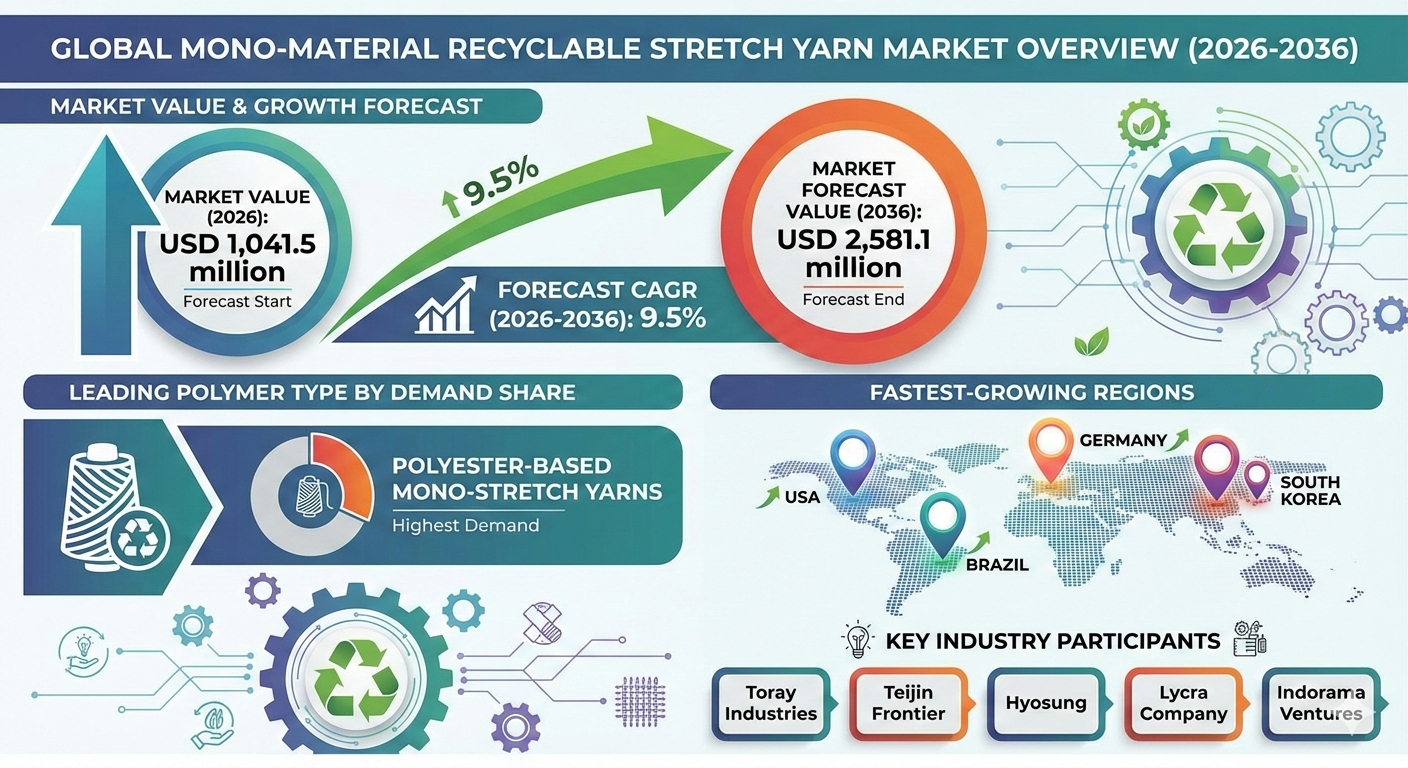
NEWARK, DE, UNITED STATES, January 23, 2026 /EINPresswire.com/ -- The mono-material recyclable stretch yarn market is gaining industry-wide attention as apparel manufacturers adopt materials that support recyclability without compromising fabric performance. The market is expected to be valued at USD 1,041.5 million in 2026 and is projected to reach USD 2,581.1 million by 2036, expanding at a CAGR of 9.5%. This growth reflects structural changes in textile engineering, sustainability regulations, and brand sourcing strategies.
Mono-material stretch yarns—primarily based on polyester and polyamide—are designed to deliver elasticity, recovery, and wearer comfort while remaining within a single polymer category. Unlike traditional stretch fabrics that blend incompatible fibers, these yarns enable garments to move more easily through mechanical and chemical recycling systems, supporting long-term circular textile objectives.
The shift toward mono-material yarns is closely tied to design-for-recycling frameworks now shaping product development across active and performance apparel. Brands are prioritizing materials that reduce textile waste while preserving fit, durability, and processing efficiency. Adoption is strongest in categories where stretch performance is critical, including activewear, athleisure, swimwear, and performance undergarments.
Fabric engineers and sourcing teams value mono-material stretch yarns for their compatibility with established textile manufacturing processes. Uniform polymer chemistry supports consistent dye uptake, predictable thermal bonding, and stable finishing outcomes, reducing production disruptions during sustainability transitions.
Key Market Forces Influencing Adoption
Several interconnected factors are accelerating demand:
• Regulatory pressure to reduce textile waste and improve recycling rates
• Brand commitments to circular fashion and measurable sustainability targets
• Consumer demand for transparent, eco-conscious material sourcing
• Expansion of performance apparel requiring durable, stretch-enabled fabrics
• Development of yarn technologies that embed stretch without elastane blends
Market growth remains substitution-driven rather than volume-led, as brands replace conventional stretch yarns in existing product lines. However, performance trade-offs and cost premiums continue to influence procurement decisions, particularly in value-focused apparel segments.
Polymer Innovation and Material Engineering
Polyester-based mono-stretch yarns lead demand due to established global recycling systems, thermal stability, and compatibility with current spinning and knitting infrastructure. These yarns often achieve stretch through engineered filament geometry or molecular orientation rather than external elastic fibers.
Polyamide-based mono-material yarns are preferred in applications requiring higher resilience, abrasion resistance, and recovery performance. Emerging specialty polyester and other single-polymer systems are being evaluated for niche technical uses. Transition materials remain in circulation as manufacturers phase out multi-material stretch constructions.
Application Trends Across Fabric Structures
Mono-material stretch yarns are used across multiple textile constructions, reflecting broad integration into apparel manufacturing:
• Knitted fabrics dominate usage due to inherent structural stretch, reducing dependence on high-elastic blends
• Woven fabrics incorporate mono-material yarns in warp or weft for controlled comfort elasticity
• Seamless and warp-knit constructions use these yarns for bodywear and precision-fit garments
• Additional uses include linings, technical textiles, and recyclable uniform programs
These applications highlight how material science decisions are aligning with end-use performance requirements and recyclability standards.
Regional Demand Evolution
Global demand is rising as textile producers align operations with sustainability directives. China shows the fastest expansion, supported by its large export-oriented manufacturing base and recycling policy initiatives. Brazil’s market is growing as apparel producers adopt recyclable materials to meet international standards. The United States is driven by performance apparel innovation and consumer sustainability expectations. Germany’s demand aligns with EU circular economy policies, while South Korea advances adoption through innovation in technical and high-quality textiles.
To Explore Detailed Market Data, Segment-Wise Forecasts, and Competitive Insights, Request Sample Report! https://www.futuremarketinsights.com/reports/sample/rep-gb-31723
Competitive Landscape Overview
The market features global fiber and yarn manufacturers focused on performance-driven recyclability. Competitive differentiation centers on elasticity performance, colorfastness, durability, and compatibility with existing production systems. Key industry participants include Toray Industries, Teijin Frontier, Hyosung, Lycra Company, Indorama Ventures, Unifi, Mitsubishi Chemical Group, Kolon Industries, Asahi Kasei, and Far Eastern New Century. These companies are investing in mono-material solutions that support circular textile systems while maintaining fabric comfort and longevity.
Key Players in the Mono-Material Recyclable Stretch Yarn Market
• Toray Industries
• Teijin Frontier
• Hyosung
• Lycra Company
• Indorama Ventures
• Unifi
• Mitsubishi Chemical Group
• Kolon Industries
• Asahi Kasei
• Far Eastern New Century
Browse Related Insights
Recyclable Perfume Dropper Resins Market: https://www.futuremarketinsights.com/reports/recyclable-perfume-dropper-resins-market
Glass Fibre Yarn Market: https://www.futuremarketinsights.com/reports/glass-fibre-yarn-market
Polypropylene Yarn Market: https://www.futuremarketinsights.com/reports/polypropylene-yarn-market
About Future Market Insights (FMI)
Future Market Insights, Inc. (FMI) is an ESOMAR-certified, ISO 9001:2015 market research and consulting organization, trusted by Fortune 500 clients and global enterprises. With operations in the U.S., UK, India, and Dubai, FMI provides data-backed insights and strategic intelligence across 30+ industries and 1200 markets worldwide.
Sudip Saha
Future Market Insights Inc.
+18455795705 ext.
email us here
Legal Disclaimer:
EIN Presswire provides this news content "as is" without warranty of any kind. We do not accept any responsibility or liability for the accuracy, content, images, videos, licenses, completeness, legality, or reliability of the information contained in this article. If you have any complaints or copyright issues related to this article, kindly contact the author above.
