

Global Regenerative Braking Optimization Software Market: The Intelligent Deceleration Frontier
Regenerative Braking Optimization Software Market
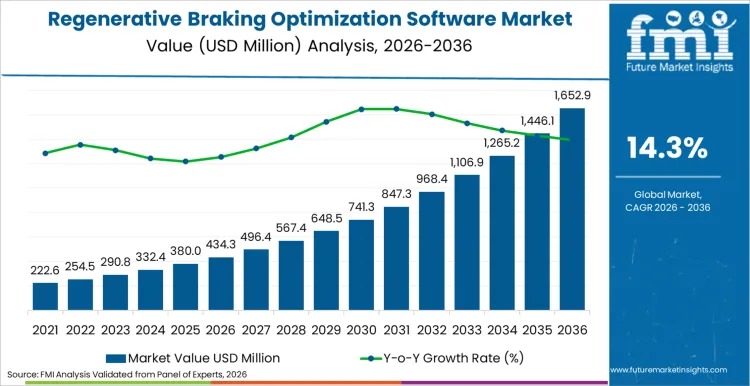
The regenerative braking optimization software market is projected to grow from USD 434.3 million in 2026 to USD 1,652.9 million by 2036, at a CAGR of 14.3%.
NEWARK, DE, UNITED STATES, January 22, 2026 /EINPresswire.com/ -- The transition to software-defined vehicles (SDVs) has fundamentally reclassified the braking system. No longer a purely mechanical safety assembly, braking is now a primary energy-management layer. The Regenerative Braking Optimization Software Market, valued at USD 434.3 million in 2026, is projected to reach USD 1,652.9 million by 2036, growing at a 14.3% CAGR.
As automakers strive for the "efficiency-range-safety" trifecta, the intelligence of the control logic has become the defining factor in electric vehicle (EV) performance.
Market Quick Stats: 2026–2036
• 2026 Market Value: USD 434.3 Million
• 2036 Forecast Value: USD 1,652.9 Million
• Forecast CAGR: 14.3%
• Primary Growth Driver: Software-defined vehicle architectures and AI-based torque blending.
• Key Regions: China, USA, Germany, South Korea, Japan.
Request For Sample Report | Customize Report | Purchase Full Report
https://www.futuremarketinsights.com/reports/sample/rep-gb-31701
The Shift from Hardware to Control Logic
Historically, regenerative braking was limited by motor capacity and battery acceptance. In 2026, the hardware is mature, but the software remains the bottleneck. Modern optimization software now manages a complex real-time "negotiation" between energy recovery, braking stability, and pedal consistency.
Optimization software functions as the central nervous system for deceleration, continuously calculating the ideal distribution between motor-generated counter-torque and traditional hydraulic force. By using advanced algorithms to manage this "blended" state, manufacturers can recapture up to 90% of kinetic energy during typical city driving. This software layer is also responsible for protecting the battery from over-voltage during peak regeneration events, effectively extending the lifecycle of the high-voltage pack by preventing rapid State of Charge (SOC) spikes that could lead to thermal stress.
Regional Dynamics & Growth Catalysts
• China (16.9% CAGR): Leads the world in volume and innovation. The market is driven by "Super-App" vehicle platforms that require regenerative strategies to adapt to hyper-dense urban traffic and varying high-altitude topographies.
• USA (13.5% CAGR): Driven by the electrification of heavy-duty pickups and SUVs. Software optimization is critical here to manage the massive kinetic energy of high-mass vehicles without overheating battery thermal management systems.
• Germany (13.3% CAGR): Focuses on "Brand Signature" tuning. German OEMs use optimization software to ensure that the braking feel of an EV remains identical to their legendary internal combustion counterparts.
• South Korea (13.2% CAGR): Home to aggressive platform scaling, where software must be robust enough to run across dozens of different vehicle variants without massive recalibration.
Optimization Focus: Energy vs. Drivability
While Energy Recovery Maximization holds the largest share (~34%), the market is bifurcating into specialized tuning layers:
Beyond simple energy capture, the next wave of demand is focused on predictive and adaptive deceleration. By integrating with vehicle-to-everything (V2X) data and ADAS sensors, optimization software can "look ahead" to upcoming traffic lights or terrain changes. This allows the system to engage regenerative braking more gradually, maximizing capture time while reducing the "jerk" sensation for passengers. For commercial fleets, this predictive capability is a financial game-changer, as it reduces mechanical brake wear by up to 80%, slashing maintenance costs and improving vehicle uptime in grueling urban delivery cycles.
Competitive Landscape & Strategic Leaders
The market is dominated by a mix of traditional Tier-1 suppliers and high-performance computing leaders:
• Bosch & Continental: Providing the "iBooster" and integrated power brake solutions that blend vacuum-independent hardware with predictive control software.
• NVIDIA & Aptiv: Leveraging "Edge AI" to process sensor data in milliseconds, allowing for anticipatory braking based on traffic patterns and route topography.
• MathWorks & dSPACE: Dominating the development phase with "Model-Based Design" and "Hardware-in-the-Loop" (HIL) simulation tools.
Similar Industry Reports
Regenerative Braking System Market
https://www.futuremarketinsights.com/reports/regenerative-braking-systems-market
EV Regenerative Braking Control Systems Market
https://www.futuremarketinsights.com/reports/ev-regenerative-braking-control-systems-market
App Store Optimization Software Market
https://www.futuremarketinsights.com/reports/app-store-optimization-software-market
Sudip Saha
Future Market Insights Inc.
+1 347-918-3531
email us here
Legal Disclaimer:
EIN Presswire provides this news content "as is" without warranty of any kind. We do not accept any responsibility or liability for the accuracy, content, images, videos, licenses, completeness, legality, or reliability of the information contained in this article. If you have any complaints or copyright issues related to this article, kindly contact the author above.
