
Global High-Clarity PCR Market Projected to Hit USD 14.8 Billion by 2036 as Brands Pivot to Premium Recycled Packaging
High-Clarity PCR Market
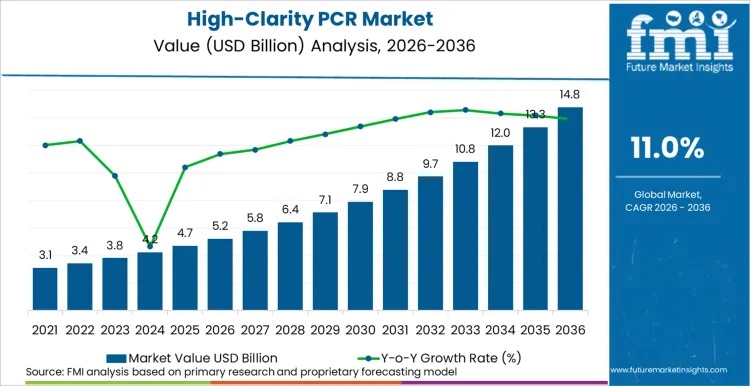
The high-clarity pcr market is projected to grow from USD 5.2 billion in 2026 to USD 14.8 billion by 2036, at a CAGR of 11.0%.
NEWARK, DE, UNITED STATES, January 22, 2026 /EINPresswire.com/ -- The global landscape for sustainable materials is witnessing a decisive shift from standard recycling to high-performance, appearance-grade polymers. According to new industry data, spending on high-clarity Post-Consumer Recycled (PCR) resin is set to reach USD 5.2 billion in 2026 and is projected to soar to USD 14.8 billion by 2036. This rapid expansion, moving at a 11.0% compound annual growth rate (CAGR), marks the end of the "sustainability vs. aesthetics" trade-off for global consumer brands.
In the modern retail environment, shelf presentation carries equal weight with sustainability claims. High-clarity PCR demand is now defined by stringent visual appearance requirements and brand standards applied to transparent packaging. As beverage, personal care, and cosmetics giants move to fulfill 2030 recycled content targets, the focus has shifted toward resins that maintain near-virgin haze limits and color tolerances.
The Optical Frontier: Why Clarity Controls the Market
Unlike standard recycled plastics, the high-clarity PCR market is governed by optical performance. In this segment, haze, color cast, and gel count determine commercial acceptance. For brand owners in the beverage and cosmetics packaging sectors—which currently represent a 41% share of the market—any visual defect in a transparent pack is immediately exposed to the consumer.
"Packaging producers treat the high-clarity PCR market as an essential part of product acceptance and claims governance rather than a simple material upgrade," the report states. To protect brand integrity, engineering groups are now implementing specialized decontamination and melt filtration systems. These protocols ensure that PCR resin remains within the narrow inspection limits required for premium "front-facing" formats.
Request For Sample Report | Customize Report | Purchase Full Report
https://www.futuremarketinsights.com/reports/sample/rep-gb-31721
High-Clarity PCR Quick Stats (2026–2036)
• Market Valuation: Currently valued at USD 5.2 Billion in 2026, with a projected climb to USD 14.8 Billion by 2036.
• Compound Annual Growth Rate (CAGR): The sector is expected to expand at a steady 11.0% over the ten-year forecast period.
• Leading End-Use Segment: Beverage & Cosmetics packaging dominates the market, accounting for a 41% share.
• Leading Product Type: Bottles & Rigid Containers represent the primary format, capturing 50% of the total market share.
Supply Chain Integration: The Move Toward Audited Ecosystems
Access to high-clarity PCR is no longer a matter of spot procurement. The market is increasingly structured around approved supply chains that control every stage of the lifecycle—from collection and segregation to advanced purification.
Because customer specifications and labeling claims reference defined material sources, once a packaging family is approved for a specific resin stream, those material choices remain fixed for multiple years. This "locked-in" system organization favors suppliers who can provide:
• Repeatable Optical Properties: Consistency in haze and yellowness index across production runs.
• Traceability: Documented input quality and process control depth.
• Audit Readiness: Verified mass-balance accounting for recycled content declarations.
Supplier changes in this environment occur during major packaging platform updates rather than routine sourcing, emphasizing the importance of early involvement in the initial pack design phase.
Regional Growth: India and China Lead the Global Transformation
While demand is rising globally, the pace of adoption is highest in regions where e-commerce growth and regulatory mandates converge.
• India (14.8% CAGR): India leads the world in growth, supported by rapid expansion in packaged goods and a robust regulatory framework favoring high-quality PCR integration.
• China (12.8% CAGR): Driven by massive urban logistics networks and e-commerce platforms requiring verified recycled content in transparent containers.
• Germany (10.6% CAGR): Reflects the most stringent industrial standards for purity, shaped by EU regulations on food-contact materials.
• USA (10.2% CAGR): Shaped by corporate sustainability initiatives and retail packaging programs prioritizing shelf-stable appearance.
• Japan (8.8% CAGR): A mature market focused on the highest tiers of safety, performance, and certified material history.
Segment Highlights: Bottles and Rigid Containers Dominate
Bottles and rigid containers account for approximately 50% of the market share, reflecting their central role in household liquids, soft drinks, and personal care. This format magnifies optical defects, which has forced the industry to innovate in mold design and polishing standards.
Beyond bottles, high-clarity trays are seeing increased adoption in food displays where gloss and flatness are paramount. Meanwhile, ultra-clear bottles are targeting the premium segment, where consumers expect near-virgin visual quality alongside a "100% Recycled" label.
Institutional Barriers and Strategy for Scale
The report highlights that the primary obstacle to rapid expansion is input variability. Small amounts of degraded or colored material in the collection stream can raise haze levels, leading to high rejection rates. To combat this, market leaders are shifting away from open-market feedstock toward closed-loop programs.
Strategic initiatives among top players emphasize this coordination:
• Indorama Ventures and Plastipak are optimizing polyester and injection-molded resins for high-speed beverage lines.
• ALPLA and Borealis are focusing on industrial-scale production that maintains mechanical and optical integrity.
• JEPLAN and Suntory are pioneering traceable, closed-loop recycling models that ensure material is returned to its original high-clarity application.
Key Market Participants
The competitive landscape is defined by companies capable of delivering reproducible resin quality and scalable supply:
• Indorama Ventures Public Company Limited
• Plastipak Holdings, Inc.
• ALPLA Group
• Borealis AG
• Far Eastern New Century Corporation
• JEPLAN, Inc.
• Suntory Holdings Limited
Outlook: A Risk Management Decision
Ultimately, the adoption of high-clarity PCR has evolved into a quality assurance and risk management decision. Brands can no longer afford the reputational risk of "yellowed" or hazy packaging on the shelf. As annual market values pass USD 9.7 billion in 2032 and head toward the USD 14.8 billion mark in 2036, the winners will be those who master the science of optical purity in a recycled loop.
Similar Industry Reports
PCR Compliance Market
https://www.futuremarketinsights.com/reports/pcr-compliance-market
PCR Market for Liquor, Water & Beverage Bottles Market
https://www.futuremarketinsights.com/reports/pcr-market-for-liquor-water-and-beverage-bottles-market
PCR Cosmetic Packaging Market
https://www.futuremarketinsights.com/reports/pcr-cosmetic-packaging-market
Sudip Saha
Future Market Insights Inc.
+1 347-918-3531
email us here
Legal Disclaimer:
EIN Presswire provides this news content "as is" without warranty of any kind. We do not accept any responsibility or liability for the accuracy, content, images, videos, licenses, completeness, legality, or reliability of the information contained in this article. If you have any complaints or copyright issues related to this article, kindly contact the author above.
