

Medical Oncology Software Market US$7.34Bn by 2032 – Persistence Market Research
Medical Oncology Software Market
The global medical oncology software market is expanding, driven by rising cancer cases, complex treatment protocols, and increasing demand for integrated care
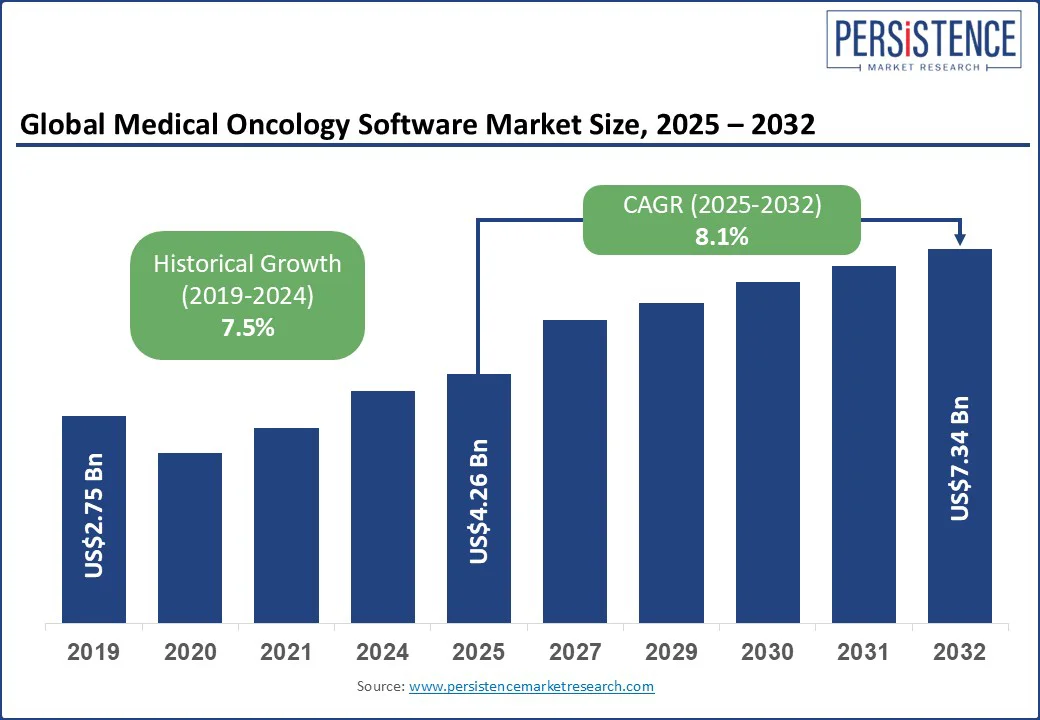
LONDON, UNITED KINGDOM, January 20, 2026 /EINPresswire.com/ -- The global medical oncology software market is expected to experience substantial growth, with its size projected to increase from USD 4.26 billion in 2025 to USD 7.34 billion by 2032. This marks a compound annual growth rate (CAGR) of 8.1% during the forecast period from 2025 to 2032. The escalating incidence of cancer, the increasing complexity of treatment protocols, and the growing demand for integrated, data-driven care coordination are some of the key factors driving the market’s expansion. The sector includes oncology information systems (OIS), chemotherapy management platforms, cancer registry solutions, and decision-support tools that aim to streamline and optimize cancer care delivery across hospitals, clinics, and research centers.
Download Your Free Sample & Explore Key Insights: https://www.persistencemarketresearch.com/samples/35574
Key Industry Highlights and Trends
The medical oncology software market is set to witness significant regional and sectoral shifts in the coming years. North America is expected to maintain its dominance, holding approximately 42% of the market share in 2025. This dominance is attributed to advanced healthcare IT infrastructure, high adoption rates of oncology electronic health records (EHR), and the presence of major industry players such as Elekta, Varian, and Flatiron Health. Meanwhile, Asia Pacific is projected to emerge as the fastest-growing region, fueled by large-scale cancer screening programs, national precision oncology initiatives in China and India, and rapid adoption of cloud-based oncology platforms.
Among the various types of software, oncology information systems (OIS) are set to dominate, accounting for about 50% of the market share in 2025. These systems integrate multiple aspects of oncology care, including patient records, treatment planning, and multidisciplinary care coordination. Medical oncology, as an application area, is also anticipated to capture the largest market share, driven by the high demand for chemotherapy order safety, infusion documentation, and survivorship management modules not typically offered by generic EHR systems.
Market Dynamics: Drivers, Restraints, and Opportunities
One of the key drivers of the medical oncology software market is the growing complexity of cancer care. As cancer incidence rates rise and patients live longer, there is an increasing need for long-term, coordinated care platforms. Oncology departments are adopting specialized chemotherapy order-entry systems to reduce medication errors, and infusion centers are leveraging workflow automation to optimize chair utilization, scheduling, and sterile compounding. Furthermore, the integration of precision medicine is driving demand for software solutions that incorporate genomic data, enabling clinicians to offer personalized treatment options based on genetic profiles.
Despite these challenges, the market presents numerous opportunities, particularly in the areas of artificial intelligence (AI) and remote care solutions. AI-driven oncology software is transforming patient care by enabling clinicians to predict and mitigate chemotherapy-related toxicity, thereby improving patient safety. AI-enhanced decision-support tools are being integrated with OIS platforms to provide personalized treatment recommendations, further driving the demand for AI-enabled medical oncology software. Moreover, the growing trend toward tele-oncology and home-infusion models is boosting demand for remote chemotherapy monitoring, smart infusion pumps, and integrated scheduling tools.
Get Custom Insights Designed for Your Business: https://www.persistencemarketresearch.com/request-customization/35574
Regional Insights and Competitive Landscape
North America is set to lead the medical oncology software market, accounting for a significant share in 2025. The U.S. healthcare system’s high level of technological integration and the strong presence of major vendors, such as Varian Medical Systems, Cerner, and Flatiron Health, are key contributors to this growth. The increasing adoption of AI in oncology workflows, particularly in clinical trials, is further accelerating the market's expansion in this region. Partnerships with academic institutions and research centers are facilitating the development of advanced oncology solutions, including AI-driven tools for chemotherapy toxicity prediction and next-generation sequencing interpretation.
Europe, on the other hand, is witnessing strong demand for integrated oncology solutions that combine both medical and radiation oncology workflows. The U.K.’s Cancer 360 program and Germany’s emphasis on high-quality compliance and integration are driving the adoption of oncology software in the region. In Germany, for instance, the preference for bundled solutions that integrate radiation therapy planning with OIS capabilities is a notable trend, with vendors like Elekta and Varian leading the market.
Asia Pacific, particularly China and India, is rapidly catching up, with China investing heavily in AI applications for oncology workflows. Tele-oncology is expanding across India, supported by digital health investments and initiatives to improve access to cancer care in rural areas. The adoption of cloud-based SaaS solutions in the region is expected to further fuel growth in the medical oncology software market.
Checkout Now & Download Complete Market Report: https://www.persistencemarketresearch.com/checkout/35574
Companies Covered in Medical Oncology Software Market
Varian Medical Systems, Inc. (Siemens Healthineers)
Elekta AB
Philips Healthcare
Cerner Corporation (Oracle)
McKesson Corporation
Flatiron Health, Inc. (Roche)
RaySearch Laboratories AB
IBM Watson Health (Merative)
F. Hoffmann-La Roche Ltd.
Epic Systems Corporation
OncoEMR (Altos Solutions)
CureMD Healthcare
Koninklijke Philips N.V.
Emerging players such as Flatiron Health, Tempus, and RaySearch Laboratories are gaining traction by focusing on precision oncology and AI-powered decision support systems. Strategic partnerships, mergers, and acquisitions are expected to drive innovation and market expansion, especially in the precision oncology sector.
Market Segmentation
By Solution Type
Oncology Information Systems (OIS)
Chemotherapy Management Software
Cancer Registry Software
Oncology Clinical Decision Support Systems
Trial Management & EHR-EDC Integration Tools
By Application Area
Medical Oncology
Radiation Oncology Integration
Surgical Oncology Support
Precision Oncology & Genomics
By End-user
Hospitals & Cancer Centers
Specialty Oncology Clinics & Infusion Centers
Research Institutes & Academic Medical Centers
Pharmaceutical & Life Sciences Companies
By Region
North America
Europe
Asia Pacific
Latin America
Middle East & Africa
Read Related Reports:
Defibrillator Pads Market: Defibrillator pads market to grow from US$1.4 Bn in 2026 to US$2.6 Bn by 2033, driven by CVD prevalence and rising AED deployment worldwide demand.
Musculoskeletal Medicine Market: The musculoskeletal medicine market to grow from US$ 65.5 Bn in 2026 to US$ 89.2 Bn by 2033, registering a 4.5% CAGR driven by rising orthopedic demand.
Persistence Market Research
Persistence Market Research Pvt Ltd
+1 646-878-6329
email us here
Visit us on social media:
LinkedIn
Instagram
Facebook
YouTube
X
Legal Disclaimer:
EIN Presswire provides this news content "as is" without warranty of any kind. We do not accept any responsibility or liability for the accuracy, content, images, videos, licenses, completeness, legality, or reliability of the information contained in this article. If you have any complaints or copyright issues related to this article, kindly contact the author above.
